3 out of 10 Job Seekers Say "New Hiring Environment Worse Than Last Year"
Companies Prefer Experienced Workers "Because They Can Be Immediately Deployed"
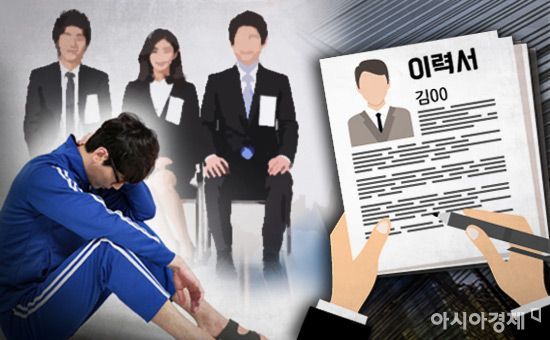
[Asia Economy Culture Young Intern Reporter] Companies' preference for experienced hires continues steadily. As a result, job seekers preparing for entry-level recruitment are expressing dissatisfaction, saying, "If everyone only hires experienced workers, where are the newcomers supposed to gain experience?"
According to the "2022 University Student Employment Perception Survey" conducted by the Federation of Korean Industries on 2,469 students and graduates (or expected graduates) from four-year universities nationwide on the 23rd, 29.6% responded that "the environment for new college graduate recruitment this year is more difficult than last year." Those who answered "similar to last year" accounted for 29%.
Regarding difficulties in the job preparation process, "decreased opportunities for entry-level recruitment due to preference for experienced hires" was the highest at 28.2%. This was followed by ▲lack of good jobs matching desired working conditions (26.0%) ▲difficulty securing practical experience opportunities such as experiential internships (19.9%) ▲increased burden of job preparation costs due to soaring prices (13.9%).
The gloomy employment outlook for job seekers is analyzed to be due to companies' trend toward "rolling recruitment." As of last year, among 437 companies that had experience hiring mid-career entry-level employees within a year, the proportion of mid-career entry-level employees among all new hires averaged 34.7%. This is an increase of 7.5 percentage points compared to the 26.1% average in 2020.
Such "mid-career entry-level" and "rolling recruitment" by companies are increasing more and more. Currently, among the top five domestic conglomerates, only Samsung maintains a regular recruitment system, while most large companies reduce regular recruitment and instead select necessary personnel by department or team as needed. The stance is that they can hire the required talent promptly through practical applicants with career experience and respond easily to rapidly changing corporate environments.
According to a survey by the job matching platform Saramin last year targeting 560 companies about mid-career entry-level applications, 85.9% of responding companies preferred mid-career entry-level candidates. The overwhelming top reason, at 80.5%, was "because they can be immediately deployed to practical work." Other reasons included ▲saving education costs and time (44.9%) ▲likely to adapt well to the organization (34.7%) ▲seem experienced in work and company life (32.4%) ▲high satisfaction with existing mid-career entry-level employees (7.1%).
The average years of experience for applicants applying as mid-career entry-level was 2.3 years. Regarding applicants with the maximum allowable years of experience, 70.2% of companies said they first conduct document screening. Regarding age, 73.6% of all companies said there is a maximum allowable age for mid-career entry-level applicants, with an average of 32.3 years old.
As mid-career entry-level recruitment increases, the number of people quitting their current jobs and rejoining as new employees is also rising. Mr. A, in his 20s, who has been working at a small or medium-sized enterprise for two years, recently applied for a large company’s new employee recruitment. Mr. A said, "I wanted to change jobs early, so I applied through the new employee recruitment." He added, "The fact that companies nowadays prefer mid-career entry-level candidates also played a part."
© The Asia Business Daily(www.asiae.co.kr). All rights reserved.
![Clutching a Stolen Dior Bag, Saying "I Hate Being Poor but Real"... The Grotesque Con of a "Human Knockoff" [Slate]](https://cwcontent.asiae.co.kr/asiaresize/183/2026021902243444107_1771435474.jpg)
















