2nd Anniversary of Late Chairman Lee Geonhee's Passing on the 25th
Samsung Family's Largest Ever Social Contribution
Three Legacies He Left: Cultural Heritage and Art Donations, Infectious Disease Specialty Hospital Establishment, Pediatric Cancer and Rare Disease Support
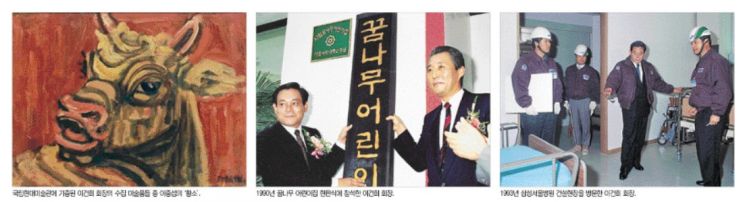
[Asia Economy Reporter Park Sun-mi] The second anniversary memorial service for the late Lee Kun-hee, Chairman of Samsung Electronics, was solemnly held on the morning of the 25th at the family burial site located in Imok-dong, Suwon-si, Gyeonggi-do. Attendees included Hong Ra-hee, former director of the Samsung Museum of Art Leeum; Lee Jae-yong, Vice Chairman of Samsung Electronics; Lee Boo-jin, President of Hotel Shilla; Lee Seo-hyun, Chairwoman of the Samsung Welfare Foundation and Advisor to Samsung Global Research; and Kim Jae-yeol, President of the International Skating Union. Over 300 executives, including current and former presidents and vice presidents, also visited the burial site sequentially to pay their respects.
◆ The Great Social Contribution of KH... Three Legacies He Left Behind= Following the late Chairman Lee’s wishes, his family, including Vice Chairman Lee Jae-yong, is carrying out the largest-ever social contributions amounting to about 60% of the inheritance.
Samsung donated approximately 23,000 cultural assets and artworks collected by the late Chairman Lee throughout his life to national institutions to promote the development of Korean art. This donation of cultural and artistic works aligns with the late Chairman Lee’s philosophy emphasizing 'corporate social responsibility and coexistence.' Special exhibitions held at the National Museum of Korea and the National Museum of Modern and Contemporary Art have sold out every time, sparking the 'Lee Kun-hee Collection Syndrome.' So far, 720,000 visitors have appreciated the national treasure-level cultural assets and world-class artworks donated by the family.
Overseas museums have also shown great interest in the Lee Kun-hee Collection. The National Museum of Korea is currently discussing plans to hold large-scale 'Lee Kun-hee Collection Special Exhibitions' at the Metropolitan Museum of Art in New York in 2025 and the Chicago Museum in 2026. There is also consideration of exchanging exhibits between the Lee Kun-hee Collection and the Metropolitan Museum of Art’s holdings for a certain period. If this exchange exhibition is realized, Korean citizens will have the opportunity to view exhibits from one of the world’s top three museums without traveling to the United States.
Samsung is also pursuing donation projects worth 1 trillion won for medical contributions, including ▲support for overcoming infectious diseases and ▲support for pediatric cancer and rare diseases. This is based on the late Chairman Lee’s philosophy of 'respect for humanity' and his special interest in medical contributions. Last May, the family, including Vice Chairman Lee, held a donation ceremony for the 'Korea Infectious Disease Overcoming Support Project' at the National Medical Center, pledging 700 billion won to combat infectious diseases. Five hundred billion won will be used to build Korea’s first specialized infectious disease hospital, the 'Central Infectious Disease Specialized Hospital,' and the remaining 200 billion won will be used to expand infrastructure for infectious disease response.
Inheriting the late Chairman Lee’s emphasis that 'children are the hope of the future,' the family is also carrying out support projects for pediatric cancer and rare disease patients. Seoul National University Hospital launched the 'Lee Kun-hee Pediatric Cancer and Rare Disease Project Team' in August last year and plans to begin full-scale support for patient examinations and treatments by the end of this year.
Separately, the family donated 300 billion won last April to support children nationwide suffering from pediatric cancer and rare diseases who cannot receive adequate treatment due to high medical costs. Over the next ten years, they plan to support costs for genetic testing and treatment, chemotherapy, and rare disease new drug treatments for children with pediatric cancer and rare diseases from financially disadvantaged families.
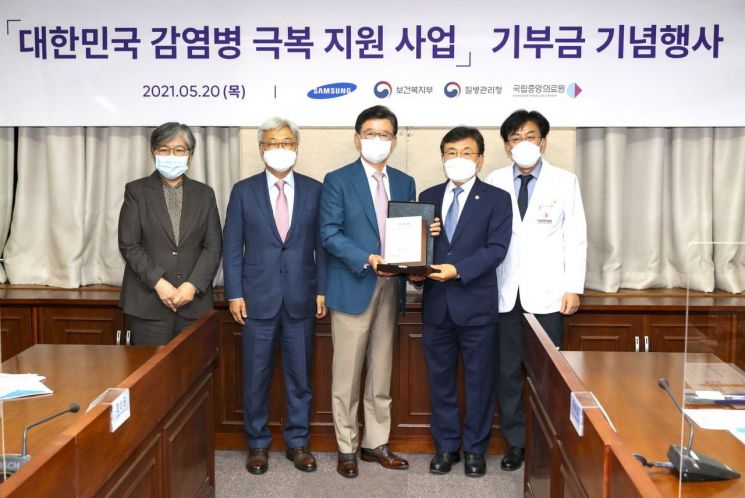 The Ministry of Health and Welfare, the Korea Disease Control and Prevention Agency, and the National Medical Center held a donation commemoration event for the "Korea Infectious Disease Overcoming Support Project" with the family of the late Lee Kun-hee, Chairman of Samsung Group, at the National Medical Center in May last year.
◆ From 'Samsung of Korea' to 'Samsung of the World'= The late Chairman Lee left Samsung not only the title of 'Samsung of Korea' but also 'Samsung of the World.' He strengthened Samsung’s management system by introducing advanced management systems and creating a corporate culture full of challenge and vitality, ensuring Samsung’s internal soundness as a world-class company.
In 1993, the late Chairman Lee declared the 'New Management of Samsung' and launched a sweeping innovation across all management sectors, which is regarded as a major turning point for Samsung. He regarded humanity, morality, manners, and etiquette as the most fundamental values that all Samsung employees should possess, shifting management focus from quantity to quality, breaking away from previous management practices that emphasized quantity.
The core of the New Management philosophy is to become a world-class company that contributes to human society by ▲having a clear understanding of reality and self-reflection, ▲possessing the will to change, ▲practicing quality-oriented management, and ▲providing products and services with the highest quality and best competitiveness.
Through these efforts, Samsung grew even during the unprecedented IMF crisis in 1997 and the financial crisis in 2009. Last year, Samsung’s brand value ranked 5th globally at $74.6 billion, and it recorded world-best products in 20 categories including smartphones, TVs, and memory semiconductors, firmly establishing itself as a world-class company.
In terms of business, Samsung blossomed the semiconductor industry. Judging that the semiconductor industry fits the cultural characteristics of Koreans and is essential for the future of the Korean and global economy, Samsung started the semiconductor business in 1974 in an environment that was almost barren. Since 1992, Samsung has maintained the number one market share in the global DRAM market.
© The Asia Business Daily(www.asiae.co.kr). All rights reserved.


















