[Asia Economy Reporter Bu Aeri] The total amount of jeonse deposit loans from 17 banks nationwide has surpassed 170 trillion won. Among the borrowers, those in their 20s and 30s who took out jeonse deposit loans number approximately 830,000, accounting for more than 60% of all borrowers (debtors). The outstanding balance of jeonse deposit loans held by people in their 20s and 30s also exceeded half of the total balance.
According to the 'Jeonse Deposit Loan Status' data received by Asia Economy on the 26th through the office of Lee Jong-bae, a member of the People Power Party, the outstanding balance of jeonse deposit loans as of the end of August reached 171.1 trillion won. This is an increase of more than 9 trillion won compared to the end of last year.
The outstanding balance of jeonse deposit loans has increased by an average of 31 trillion won annually over the past three years. The balance was 98.7 trillion won in 2019, which rose by 33.6 trillion won to 132.3 trillion won in 2020. In 2021, it increased by 29.7 trillion won to 162 trillion won compared to the previous year.
The total number of jeonse deposit loan debtors has also increased annually, exceeding 1.36 million. The number of debtors rose from 924,763 in 2019 to 1,144,514 in 2020, and 1,305,189 in 2021, increasing by an average of 190,000 each year. However, as of the end of August, the number was 1,361,039, an increase of 55,850 compared to the end of last year, showing a somewhat slowed growth trend. The rise in interest rates has increased the interest burden on jeonse deposit loans, which appears to have contributed to a growing demand for monthly rent.
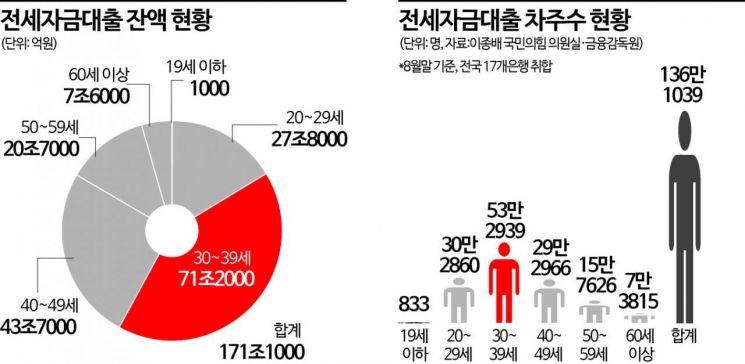
Among those who took out jeonse deposit loans, people in their 20s and 30s numbered 835,799 as of the end of August, accounting for 61% of the total. The number of borrowers receiving jeonse loans increased annually across generations. The number of debtors in their 20s and 30s increased by 60% (313,769 people) compared to 2019 (522,030 people), reaching 835,799. Debtors in their 40s through those aged 60 and above also showed increases across all age groups. The 40s group numbered 292,966, the 50s group 157,626, and those 60 and older 73,815, representing increases of 26%, 31%, and 50% respectively compared to 2019.
Looking at the outstanding balance of jeonse deposit loans, as of the end of August, the balance for those in their 20s and 30s was 99 trillion won, about 58% of the total balance. The 40s held 43.7 trillion won, the 50s 20.7 trillion won, and those 60 and older 7.6 trillion won. The teenage group was around 100 billion won.
Despite the continuous decrease in household loans due to rising interest rates, jeonse deposit loans continue to increase. The outstanding balance of jeonse deposit loans at the five major banks (KB Kookmin, Shinhan, Hana, Woori, NH Nonghyup) as of the end of September was 134.1976 trillion won, an increase of 28.96 billion won from the previous month (133.908 trillion won), showing a monthly upward trend. Compared to the beginning of this year, it increased by about 4.6824 trillion won. Kim Hyo-seon, NH Nonghyup’s senior real estate committee member, analyzed, "As the sales market has stagnated, the demand from tenants who prefer to stay in monthly rent or jeonse rather than owning a home seems to have continued."
With the upper limit of jeonse loan interest rates at commercial banks exceeding 7%, the interest burden has grown significantly. As the Bank of Korea is expected to raise the base interest rate again next month, there are predictions that loan interest rates could reach 8% within the year. The jeonse deposit loan interest rates (based on new COFIX 6-month linkage) at KB Kookmin, Shinhan, Hana, and Woori banks were between 4.76% and 7.085% annually as of the 25th. Compared to the end of last year (3.39% to 4.799%), the upper and lower bounds have risen by approximately 1.37 percentage points and 2.286 percentage points, respectively.
Rep. Lee said, "Since the 20s and 30s account for more than half of the jeonse deposit loans, the loan burden on young people must be considerable," adding, "It seems necessary for financial authorities to prepare measures to prevent young people from bearing excessive interest burdens."
© The Asia Business Daily(www.asiae.co.kr). All rights reserved.


















