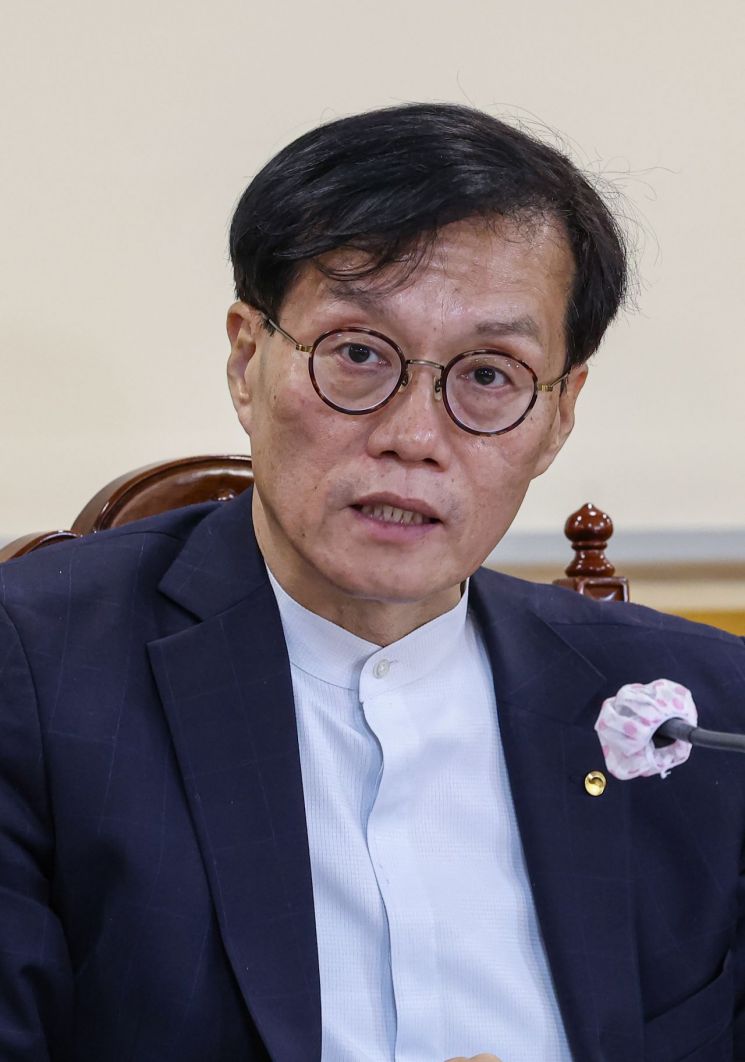
 Lee Chang-yong, Governor of the Bank of Korea, is answering questions from reporters at a press conference held after the emergency macroeconomic financial meeting at the Bankers' Hall in Jung-gu, Seoul, on the afternoon of the 23rd.
 [Image source=Yonhap News]
Lee Chang-yong, Governor of the Bank of Korea, said that the government's decision to supply more than 50 trillion won in liquidity to ease concerns over a credit market crunch triggered by Legoland would "have no direct impact on inflation."
Governor Lee made this remark on the 24th during a National Assembly audit by the Planning and Finance Committee, responding to a question from Lee Soo-jin, a member of the Democratic Party of Korea, about the impact of the credit market easing measures announced the previous day by the government and the Bank of Korea on inflation.
He said, "The measures announced yesterday regarding the credit market crunch are micro-level policies aimed at financial stability, and since the Bank of Korea is not directly supplying liquidity on a macro level, there will be no direct impact on inflation."
As concerns over a liquidity crisis grew due to the default of asset-backed commercial paper (ABCP) related to Legoland in Gangwon Province, the government and the Bank of Korea launched a liquidity supply program exceeding 50 trillion won and announced plans to include bank bonds and public institution bonds, in addition to government bonds, as eligible collateral securities.
When Hong Sung-guk, a Democratic Party lawmaker, requested additional measures that day, Governor Lee said, "Through this Monetary Policy Committee meeting, we will approve the eligible collateral loan system with the committee members so that banks can secure more liquidity," adding, "Even if the Bank of Korea does not directly supply liquidity, expanding the scope of eligible collateral bonds can reduce the scale of bank bond issuance by banks, and if a virtuous cycle occurs from that, we will observe how effective it is."
Regarding Yoo Dong-soo, a Democratic Party lawmaker, pointing out that "talks about revising October consumer prices make it seem difficult to reach a peak," Governor Lee assessed, "Recently, prices of food and other items have been rising again, and although oil prices have fallen, there is an impact from the exchange rate."
He further explained, "To prevent depreciation of the exchange rate (won value), we need to take various other measures, but those also come with many costs. For example, we cannot simply raise interest rates to stop the exchange rate from rising, and overall, since the exchange rate moves following international financial market trends, there is no way to change the major trend of the exchange rate."
Governor Lee emphasized, "We are preventing concentration phenomena in the foreign exchange market and are trying to control inflation for the time being through tight monetary policy," adding, "Since inflation causes pain to the people, we will respond by finding the best combination with the tools we have."
© The Asia Business Daily(www.asiae.co.kr). All rights reserved.

















