Mandatory Disclosure for 50 or More Households Instead of 100+
Transparency Strengthened for Blind Spot One-Rooms and Officetels Too
The criteria for mandatory disclosure of maintenance fees in multi-family housing will be expanded from the current 100 households or more to 50 households or more. For blind spots without disclosure obligations, such as one-room and multi-family houses (villas), supplementary measures will be prepared, including reflecting maintenance fee items in the standard lease contract.
On the 24th, the Ministry of Land, Infrastructure and Transport announced that it had prepared an "Improvement Plan to Eliminate Blind Spots and Enhance Transparency in Maintenance Fees" containing these details.
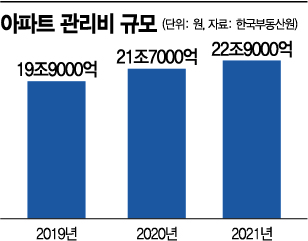
As of 2021, the total amount spent nationwide on apartment maintenance fees reached 23 trillion KRW annually, averaging about 180,000 KRW per household per month. However, under current law, only apartments with 100 or more households are required to disclose maintenance fee details, leaving residents of small-scale apartments unable to properly know how their fees are used.
In officetels and villas, where young people and early-career workers mainly reside, there have been issues of "opaque maintenance fees" exploiting institutional loopholes.
Accordingly, through legal amendments, the scope of mandatory disclosure of maintenance fees will be expanded, and the mandatory disclosure threshold for the Apartment Management Information System (K-apt) will be lowered from 150 households to 100 households. Additionally, for multi-family housing with 50 to less than 150 households, a new obligation to prepare, keep, and disclose accounting books will be established through amendments to the "Collective Building Act," strengthening residents' autonomous verification of maintenance fees.
Supplementary measures will also be implemented for blind spots such as one-room and officetel units. Maintenance fee items will be reflected in the standard housing lease contract, and in cooperation with the Ministry of Justice, certified real estate agents will be guided and promoted through the Real Estate Agents Association to inform tenants about maintenance fee-related matters during lease contracts.
Managers of officetels with 50 or more households will be required to prepare, keep, and disclose accounting books, and local government heads will be granted supervisory authority over accounting matters. Furthermore, to enable officetel residents to know specific maintenance fee items, detailed maintenance fee categories will be specified in the "Standard Management Regulations for Collective Buildings."
Along with this, the government plans to strengthen internal control procedures to prevent embezzlement of maintenance fees.
The procedure for apartment management office managers to verify monthly that the maintenance fee deposit balance matches the ledger amount will be elevated to a legal requirement, and if accounting is done manually, the resident representative meeting's auditor will be required to reconcile cash and deposit balances monthly.
Currently, to request a local government audit to check if apartment management is properly conducted, consent from more than 30% of all households is required; this consent rate will be lowered to "20% or more" because it is difficult for individual residents to secure a 30% consent rate.
When holding resident representative meetings, the law will be amended to allow recording, broadcasting, and observation to ensure transparency.
Also, to help residents judge whether apartment maintenance and repair costs are appropriate, the Apartment Management Information System (K-apt) will add a function to compare project costs by company and type of construction.
The scale of apartment maintenance and repair projects reached 717.3 billion KRW annually as of 2020, but residents have difficulty assessing appropriateness and tend to leave decisions to the management office.
Going forward, apartment management office managers must use K-apt's project cost comparison function to calculate appropriate estimated bid prices for maintenance and repair projects.
At the bidding stage, participating companies must submit an administrative disposition confirmation verifying no violations of the Fair Trade Act, and whether they are affiliated with housing management companies must be indicated in the bidding documents. At the evaluation stage, evaluation committee members will include not only the resident representative meeting and management entity but also residents and external evaluators.
Minister of Land, Infrastructure and Transport Won Hee-ryong said, "Maintenance fees, perceived as a second rent, impose a greater burden on vulnerable housing groups such as youth. We will promote multifaceted institutional improvements to eliminate blind spots in maintenance fee disclosure and enhance transparency."
© The Asia Business Daily(www.asiae.co.kr). All rights reserved.


















