User Command and Supervision Rules and Worker Attitudes Affect Differences
Germany and Spain Do Not Recognize Smoking Time as Working Hours... Japan Provides Smoking Cessation Leave to Smokers
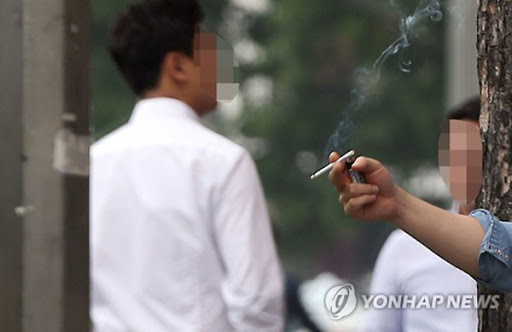
[Asia Economy Reporter Han Seung-gon] Mr. Lee, a middle manager in his 50s, has recently been frequently stressed due to the work attitudes of his subordinates. He said, "Some employees take so-called 'smoke breaks' when I try to assign tasks, which disrupts the workflow," adding, "We are preparing to set designated smoking times within the department."
Are employees who take short smoking breaks during work hours being negligent? While some criticize this as engaging in personal activities during work hours, others argue that briefly clearing one’s mind can actually improve work efficiency.
The conflict over smoking during work can be summarized as "some are working, while others are outside smoking." Mr. Kim, a company employee in his 30s who does not smoke, expressed dissatisfaction, saying, "When I look for junior employees, they are at the smoking area," and added, "They always go out when work piles up; I don’t know if they are just oblivious or if they really crave cigarettes that much."
Smokers have their rebuttals. They claim that smoking is not just a habit but a necessity to maintain work efficiency. Mr. Choi, a company employee in his 30s, said, "When my head feels stuffy, I smoke a cigarette at the rooftop smoking area," and added, "(Smoking) clears my mind for a short time, and I believe other smokers feel the same."
 Office workers are passing through the streets of Myeongdong, Jung-gu, Seoul. [Image source=Yonhap News]
'Some are working, while others are outside smoking'
If the issue of smoking during work hours were to be taken to court, what conclusion might be reached? In July 2015, the Seoul High Court ruled on a related case, stating that "'The duty of faithful labor' means that employees must diligently provide labor during working hours, and this duty is recognized as the most fundamental obligation of employees, even if not explicitly stated in employment rules or contracts."
This ruling implies that even if detailed rules about smoking are not included in the employment contract signed when an employee joins a company, there is still a legal obligation to work faithfully.
However, earlier in December 1994, the Supreme Court ruled that "The employer’s right to discipline employees is based on maintaining discipline and order within the scope necessary for smooth business operations."
For example, if using a smartphone during work does not interfere with job performance and does not constitute a breach of the duty of faithfulness under the employment contract, it may not be a valid reason for disciplinary action.
In summary, considering the rulings, whether smoking during work hours becomes an issue depends on the employer’s supervisory rules and the employee’s work attitude.
Conflicts between smokers and non-smokers in other countries
In Germany, according to related laws (Labor Time Act Article 4), employees are required to take breaks after a certain amount of working hours to work efficiently and avoid overtime. Break times can be freely decided by all employees but are not recognized as working hours, so no pay is given, and smoking time is treated the same.
There have also been cases where conflicts between management and employees arose. In February 2020, the Spanish energy company Galp did not recognize the time employees spent smoking or getting coffee as working hours. The Galp labor union sued the company, but the Spanish High Court ruled that Galp’s policy of deducting the time employees spend outside the workplace from working hours was legal, siding with the company.
Some companies have taken measures to accommodate non-smokers. In November 2017, the Tokyo-based online marketing company Piara introduced a "Smoke Holiday" system that grants up to six days of paid leave to non-smoking employees. Non-smokers raised concerns through the company’s internal grievance system that smokers frequently left their posts.
As the controversy grew, the company devised a kind of compromise. Considering that smoking employees often discuss work-related matters in the smoking room, instead of punishment, the company decided to compensate non-smoking employees. They also established rules for smokers. A company spokesperson said, "If employees who smoke successfully keep their promise (to quit smoking) for a year, they can receive an additional six days of paid leave."
Experts suggest that flexible responses should be possible depending on corporate culture and departmental circumstances. A human resources official from a company commented on the smoking controversy during work, saying, "This is an issue that can definitely arise among non-smokers," and added, "Employees probably know well whether their work attitude is poor, and whether they are working faithfully will be determined according to the manuals and rules established within the company. Considering these points, they should focus on their work."
© The Asia Business Daily(www.asiae.co.kr). All rights reserved.
![Clutching a Stolen Dior Bag, Saying "I Hate Being Poor but Real"... The Grotesque Con of a "Human Knockoff" [Slate]](https://cwcontent.asiae.co.kr/asiaresize/183/2026021902243444107_1771435474.jpg)

















