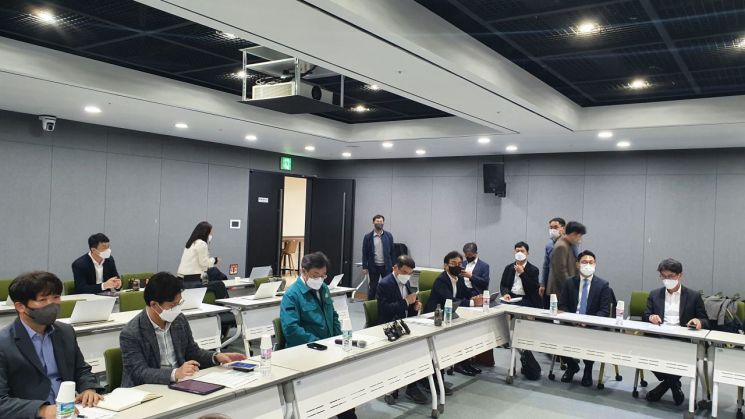
 On the 20th, participants of the 'Emergency Inspection Meeting for Domestic Data Center Operators' are discussing current issues.
[Asia Economy Reporter Oh Su-yeon] The Ministry of Science and ICT is set to conduct on-site inspections of Internet Data Centers (IDCs) to prepare for emergency situations. Based on the inspection results, the ministry plans to establish guidelines to ensure that IDCs can operate normally even during disasters.
On the 20th, Park Yoon-kyu, the 2nd Vice Minister of the Ministry of Science and ICT, held an 'Emergency Inspection Meeting for Domestic Data Center Operators' and stated, "We will develop practical and essential institutional improvement measures through thorough communication with the industry."
Kim Jeong-sam, Director of Information Security and Network Policy at the Ministry of Science and ICT, told reporters after the meeting, "We will recruit experts and, after the Ministry’s National Audit on the 24th, begin full-scale on-site inspections, institutional research, and studies of overseas cases."
IDC operators emphasized the need for disaster response guidelines during the meeting. Director Kim said, "Operators are considering whether their current response systems are adequate and have requested examples from the government and other companies. It is necessary to continuously check whether IDC disaster drills are being properly conducted."
Vice Minister Park also highlighted the importance of the guidelines. In his opening remarks, he said, "We plan to specify protection standards for power supply, fire safety, and other areas to ensure that data centers can operate without interruption during disasters, and to enable regular inspections and preparedness." He added, "Since many citizens experienced significant inconvenience and damage due to the interruption of major digital services, the government is taking this situation very seriously."
The government plans to create disaster response guidelines based on the inspections. Director Kim stated, "While some operators are performing well, others are still lacking, so comprehensive guidelines are necessary. The government and the Data Center Association are conducting research on these guidelines. It is also necessary to consider support measures to back up the guidelines."
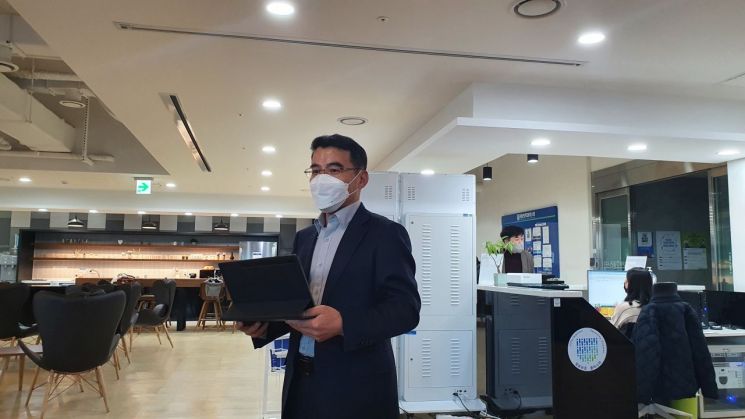 Kim Jeong-sam, Director of Information Security Network Policy at the Ministry of Science and ICT, is answering reporters' questions.
Earlier, on the 15th, a fire broke out at the SK C&C Pangyo Data Center, causing most Kakao services, including KakaoTalk, to go down. According to fire authorities and police, the fire started on the afternoon of the 15th in the electrical room of the SK C&C Pangyo Data Center due to a spark from a spare lithium-ion battery stored there. Since the fire originated from a lithium-ion battery, IDC operators are deeply concerned about battery-related issues.
Director Kim explained, "If a lithium-ion battery fire occurs, it must be submerged in water or allowed to burn out completely. Close monitoring is necessary, and although there is a Battery Management System (BMS) jointly developed by battery manufacturers and IT companies, human observation can miss some aspects, which is worrisome."
This is not the first IDC fire caused by lithium-ion battery overheating. In 2020, a fire occurred at KT Gangnam IDC due to lithium-ion batteries. Although it was quickly extinguished and did not lead to a major outage, the cause was similar. Subsequently, KT Cloud replaced all lithium-ion batteries with lead-acid and lithium iron phosphate batteries last year.
Director Kim shared, "KT Cloud shared their experience of replacing all batteries after the lithium-ion battery fire. One company decided not to use lithium-ion batteries at all across its entire group. However, all types of batteries carry risks. Due to structural issues of buildings, there are limits to replacing batteries, and operators are struggling. It is difficult to replace them all at once."
The Data Center Association estimates that about half of IDCs use lithium-ion batteries. Their energy density is more than twice that of lead-acid batteries, and their use has been increasing recently.
The meeting was attended by KT Cloud, LG Uplus, SK Broadband, LG CNS, Samsung SDS, Lotte Data Communication, Hana Financial TI, the Data Center Association, and the Korea Information and Communication Industry Research Institute.
Meanwhile, the Ministry of Science and ICT continues to hold 'Broadcasting and Communications Disaster Countermeasure Headquarters Inspection Meetings' to develop preventive measures.
© The Asia Business Daily(www.asiae.co.kr). All rights reserved.
![Clutching a Stolen Dior Bag, Saying "I Hate Being Poor but Real"... The Grotesque Con of a "Human Knockoff" [Slate]](https://cwcontent.asiae.co.kr/asiaresize/183/2026021902243444107_1771435474.jpg)

















