KMA and Korean Meteorological Society Publish '2022 Jangma White Paper' at Autumn Conference
Climate Change Causes Departure from Traditional Jangma Patterns... More Rainfall After Jangma
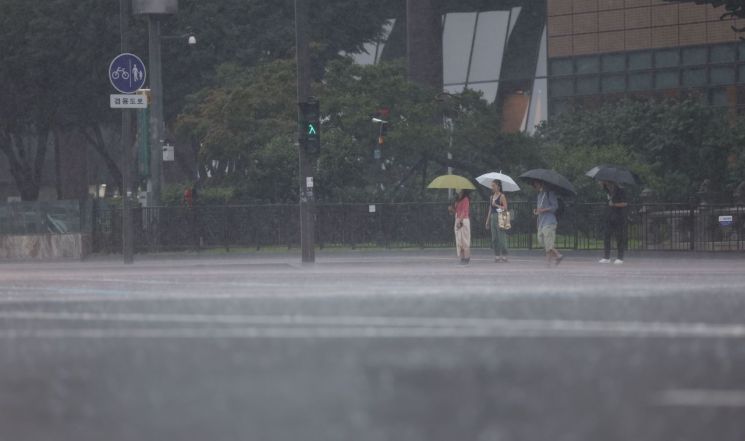
[Asia Economy Culture Young Intern Reporter] As climate change worsens, the Korea Meteorological Administration (KMA) has been troubled over whether it is appropriate to continue using the term "jangma" (monsoon) because in recent years the monsoon season has frequently deviated from traditional patterns.
On the 20th, the KMA held a special session titled "Is the Expression 'Jangma' Appropriate in the Era of Climate Crisis?" at the Kim Dae-jung Convention Center in Seo-gu, Gwangju, during the Korean Meteorological Society's autumn academic conference. At this event, the "2022 Jangma White Paper" was released, discussing whether it is appropriate to continue using the term "jangma" amid the blurred distinctions between summer monsoon rains, showers, and heavy downpours caused by climate change.
The "Jangma White Paper" was published for the first time in 10 years since 2012. The KMA stated, "Since the 2000s, the start of monsoon rainfall has gradually been delayed, and the end has also been postponed. This year, a second peak in rainfall appeared in early August after the monsoon." They added, "Especially since the 2010s, while the total monsoon rainfall has been decreasing, there is a tendency for heavy downpours exceeding 30mm per hour to increase."
Generally, jangma refers to a long period of rain that starts in mid-June and lasts until late July or early August across the country. According to the white paper, from 1990 to 2020, the average monsoon period in Korea's central, southern, and Jeju regions was 31.4 to 32.4 days, with actual rainy days ranging from 17.0 to 17.7 days. On average, about 655mm, roughly half of the annual rainfall of 1333mm, was concentrated during this period.
However, this year, only 42.2% of the total summer rainfall occurred during the monsoon season. Rainfall after the monsoon accounted for 49.8%, which was higher. The fact that more rain fell after the monsoon is also a changing characteristic of the monsoon. Since 1973, including this year, there have been a total of 20 instances where post-monsoon rainfall exceeded monsoon rainfall.
As the start and end dates of the monsoon have both been delayed recently, the boundary between the monsoon season and the "period of rainfall after the monsoon" has become ambiguous. With increased rainfall in early August, the first rainy season, the monsoon, which lasts from mid-June to late September, is followed by a "second rainy season" with rainfall comparable to the monsoon. This second rainy season is also called the "autumn monsoon."
In 2018, the monsoon in the central region started on June 26 and ended after just 16 days on July 11, differing from the traditional rule that the monsoon season lasts from late June to late July. In 2020, the central region experienced the longest monsoon on record, lasting 54 days from June 24 to August 16. This year, the central region saw 398.6mm of monsoon rain over 18.7 days, while the southern region had only 202.3mm over 15.6 days, showing a significant difference in rainfall amounts.
On this day, Jeong Yong-seung, director of the Korea University Atmospheric Environment Research Institute, said, "The duration of monsoon rainfall has changed significantly, and intermittent showers and localized heavy rains are becoming more frequent," adding, "A review of the long-used term 'jangma' is necessary." During the subsequent comprehensive discussion, Professor Jang Eun-cheol of Kongju National University stated, "Some in the academic community believe it is more appropriate to use the term 'rainy season,' which refers to the period of concentrated rainfall characteristic of subtropical climates."
© The Asia Business Daily(www.asiae.co.kr). All rights reserved.

















