[Asia Economy Reporter Lim Juhyung, Intern Reporter Song Hyundo] "It's not like we're doing this to save the country, so is there really a need to feel responsible?"
On the 16th, when the 'Kakao outage incident' caused by a data center fire was in full swing, a post from an employee refusing to diligently respond to the outage was uploaded on Kakao's page on the anonymous workplace community 'Blind.' The claim was that weekend work is practically 'unpaid' according to company regulations, so there is no need to work with a sense of responsibility.
The 'Kakao unpaid controversy' continued on the 17th. An employee who posted on Kakao's Blind page that day said, "Whether it's unpaid due to 'Nolgum' (Friday off) or unpaid based on labor-management negotiations, unpaid is unpaid," adding, "If Kakao goes under, I'll just change jobs, and if it doesn't, I only need to work as much as I get paid. If you overwork without intending to reduce, Kakao is 100% disappointed."
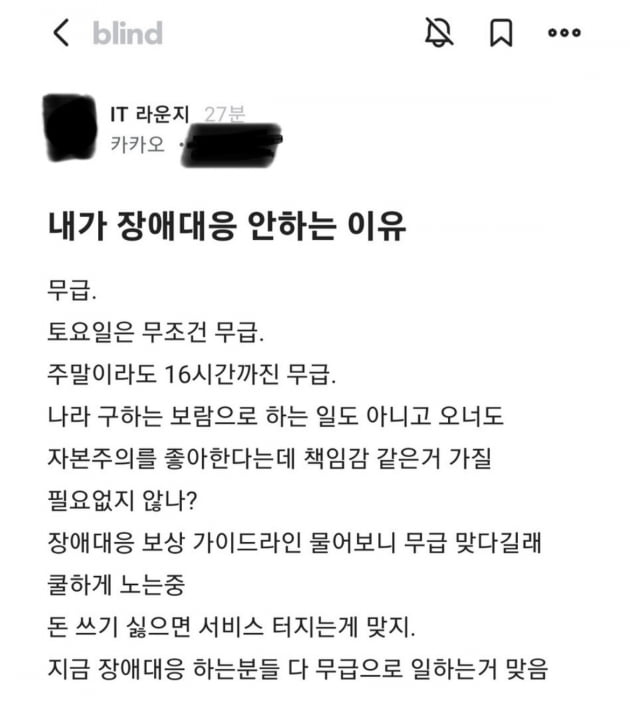
The 'unpaid' claim by some Kakao employees seems to stem from misunderstandings related to Kakao's unique welfare system. Since July, Kakao has been implementing the so-called 'Nolgum' system, which allows employees to take every other Friday off each month. In other words, applying Nolgum means Kakao employees lose 16 hours of regular working hours (two days) each month.
However, overtime pay is only applied after exceeding the statutory working hours. Therefore, Kakao employees must make up the 16 hours of working time each month before they can receive additional pay. That said, since there is no immediate change in monthly salary even if they work on weekends, employees may feel like they are working 'for free.'
Currently, it appears that dissatisfaction among Kakao employees has accumulated internally. Employee A told Asia Economy, "Kakao has over 100 subsidiaries, and each subsidiary offers different welfare benefits. The unpaid controversy arose in some affiliates implementing the 'Nolgum' system," adding, "There also seem to be different stories by department regarding allowance applications, and welfare gaps between departments have caused pent-up frustrations to explode all at once."
However, another employee B said, "Although many have complaints, the urgency to resolve the immediate service outage issue takes precedence," adding, "It's impossible to always be satisfied with the company, and rather, I think interdepartmental unity is better now than before."
Some suggest that this controversy reflects the perspective on 'labor' held by Kakao employees, mainly young people in their 20s and 30s. MZ generation workers are said to act based on firm personal 'compensation' regardless of the company's crisis situation.
 Among young generation workers, the so-called "quiet quitting" is becoming popular. / Photo by Yonhap News
The recently popular term among the MZ generation, so-called 'quiet quitting,' reflects this trend. Quiet quitting is a buzzword introduced by Zaid Flynn, a 20-something American engineer, through the social media platform TikTok, and it has resonated enough to be reported by foreign media such as The Washington Post (WP). According to Flynn, quiet quitting means "not feeling obligated to do more than what is assigned." In other words, there is no need to be enthusiastic about work unless the tasks directly benefit oneself within the organization.
Quiet quitting seems to have already become mainstream in Korea as well. In December last year, the job platform Saramin conducted a survey of 3,293 office workers on the theme "Just work as much as you get paid," and 70% of all respondents agreed.
By age group, the response from the 20s and 30s was particularly prominent. Among those who agreed, 78.1% were in their 20s and 77.1% in their 30s, significantly higher than 40s (59.2%) and 50s (40.1%).
Experts explain that a new work environment optimized for younger workers is necessary. Professor Kim Nando of Seoul National University's Department of Consumer Studies said at the 'Trend Korea 2023' book launch press conference on the 5th, "Phenomena like 'quiet quitting,' where employees do the minimum work, and 'big quitting,' where they refuse to return to the workplace, will make both organizations and individuals reconsider new ways of working," emphasizing, "For the MZ generation, a company where members can grow is more important than anything else."
Some express concern that the passive attitude of workers could negatively impact corporate growth. Professor Lee Eunhee of Inha University's Department of Consumer Studies pointed out, "Due to diversification of labor means and the prevalence of individualism, younger generations seem to prefer quiet quitting," adding, "However, an excessively lacking sense of ownership can ultimately hinder not only the company's profits but also personal development."
© The Asia Business Daily(www.asiae.co.kr). All rights reserved.
!["The Woman Who Threw Herself into the Water Clutching a Stolen Dior Bag"...A Grotesque Success Story That Shakes the Korean Psyche [Slate]](https://cwcontent.asiae.co.kr/asiaresize/183/2026021902243444107_1771435474.jpg)


















