Lam Research and Applied Materials Announce Estimated Revenue Decline
Netherlands ASML States "Impact on European Companies 'Considerably Limited'"
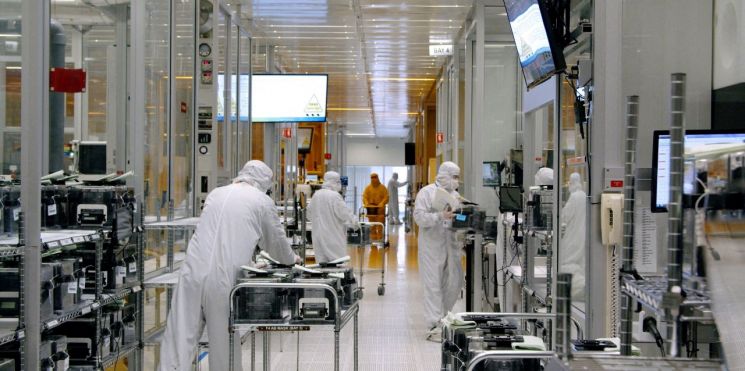
[Asia Economy Reporter Jeong Hyunjin] Since the Biden administration announced export control measures on semiconductor exports to China, U.S. semiconductor equipment companies have warned that their earnings will be hit one after another. The Dutch ASML, a "super subcontractor" that manufactures extreme ultraviolet (EUV) lithography equipment essential for advanced semiconductor production, stated that the impact of the measures would be "limited," suggesting that the effects of the measures will vary among semiconductor equipment companies.
According to Bloomberg and others on the 19th (local time), U.S. semiconductor equipment company Lam Research announced in its earnings report that it expects a sales hit of $2 billion to $2.5 billion (approximately 2.9 trillion to 3.6 trillion KRW) next year due to the export controls. China accounts for 30% of Lam Research's sales.
Timothy Archer, Chairman and CEO of Lam Research, said, "We are taking the necessary steps to fully comply with the regulations and have suspended necessary transportation and support." Bloomberg reported that Lam Research, which focuses on semiconductor etching processes and has many transactions with Chinese customers, is expected to be significantly affected by the export controls. Earlier, foreign media reported that Lam Research took measures such as withdrawing employees dispatched to China's representative memory semiconductor company Yangtze Memory Technologies Co. (YMTC) and suspending support.
Doug Bettinger, CFO of Lam Research, said that sales for October to December are expected to be around $5.1 billion, and without the export controls to China, the figure would have been much higher. He also said that losing high-profit customers in China would reduce the gross profit margin. He added, "There are currently additional restrictions on certain customers in China, and sales in China are expected to decrease significantly as we move into next year."
Lam Research's outlook came after Applied Materials, the world's largest semiconductor equipment company based in the U.S., recently forecasted a decline in sales in China.
Applied Materials announced on the 12th that due to the export control measures to China, its net sales for Q4 of fiscal year 2022 (August to October) would be hit by $250 million to $550 million (approximately 360 billion to 790 billion KRW). Accordingly, it revised its net sales forecast downward from the previously announced $6.25 billion to $7.05 billion to $6.15 billion to $6.65 billion. The company added, "We are seeking the necessary additional export licenses."
While U.S. companies have expressed concerns one after another, ASML, a key European semiconductor equipment company, showed a contrasting response. ASML, when announcing its Q3 earnings the day before, assessed that the impact of U.S. export controls on China would be "fairly limited." ASML CEO Peter Wennink estimated that the total indirect impact of the U.S. measures would be about 5% of orders. ASML stated, "The fact that we are a European company with limited U.S. technology makes the direct impact of these measures on us fairly limited."
ASML said it cannot sell EUV equipment to Chinese customers but can sell mature process equipment, which involves relatively less advanced technology. ASML has not sold EUV equipment to China due to the Dutch government's refusal to grant export licenses under U.S. pressure. Subsequently, China actively purchased deep ultraviolet (DUV) lithography equipment, an older model of EUV, and expanded semiconductor production starting from mature processes. In July, reports emerged that the U.S. was pressuring ASML not to sell DUV equipment to China as well.
Bloomberg evaluated the contrasting assessments from U.S. and European companies in the semiconductor equipment market by stating, "While the Biden administration's export restrictions on China are impacting the semiconductor equipment industry, the pain does not seem to be evenly distributed."
© The Asia Business Daily(www.asiae.co.kr). All rights reserved.
![Clutching a Stolen Dior Bag, Saying "I Hate Being Poor but Real"... The Grotesque Con of a "Human Knockoff" [Slate]](https://cwcontent.asiae.co.kr/asiaresize/183/2026021902243444107_1771435474.jpg)
















