White House Provides Grants to 20 Companies in 12 States
Aiming to Establish Commercial Critical Mineral Development Facilities
Also Announces U.S. Battery Raw Materials Initiative
Partner Alliances and Resource Deposit Exploration
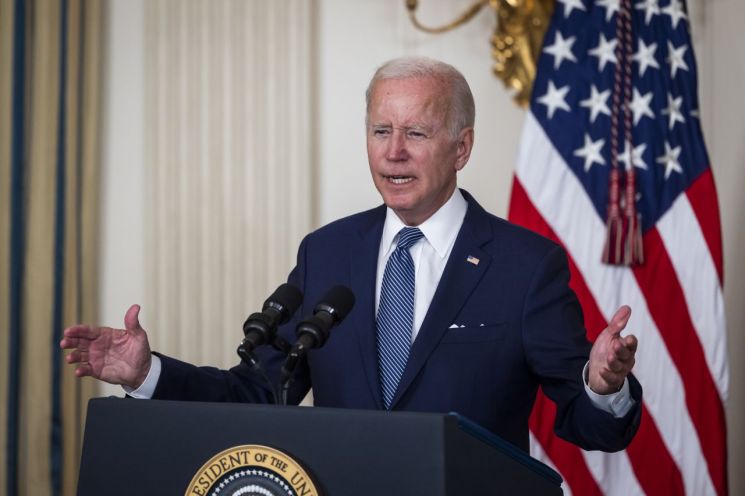
[Asia Economy Reporter Lee Ji-eun] The U.S. administration under President Joe Biden has announced plans to provide $2.8 billion in subsidies to promote domestic production of electric vehicle (EV) battery raw materials and strengthen battery supply chains with allied countries.
On the 19th (local time), the White House announced that based on the Department of Energy's Infrastructure Law, it will allocate $2.8 billion (approximately 4 trillion KRW) to 20 manufacturers across 12 states in the U.S.
The funds provided by the Department of Energy will be matched with private capital from companies, increasing the total to $9 billion, which will be invested in developing and producing EV battery raw materials such as graphite and lithium.
The White House expects that this investment will enable the production of lithium for batteries sufficient to supply 2 million EVs annually, graphite for 1.2 million vehicles, and nickel for 400,000 vehicles per year. Additionally, through this project, large-scale commercial lithium electrolyte salt production facilities will be established in the U.S., and electrode binder facilities capable of meeting 45% of domestic EV battery binder demand by 2030 will be developed.
The White House has set a goal to increase EV sales to half of all new vehicle sales by 2030 and announced plans to replace 600,000 cars and trucks with EVs by 2035.
Energy Secretary Jennifer Granholm stated in a press release, "Producing advanced batteries and components domestically will increase demand for EVs and accelerate the industrial transition away from fossil fuels," adding, "This will create more well-paying jobs across the United States." The White House projects that this investment will create a total of 8,000 jobs.
Alongside this, President Biden also announced a whole-of-government initiative called the "American Battery Raw Materials Initiative" to secure critical minerals for EVs reliably. Led by the White House coordination council and involving the Departments of Energy, Interior, and State, this initiative includes plans to strengthen critical mineral supply chains and energy security by partnering with global partners and allies through the Global Infrastructure and Investment Partnership (PGII).
PGII is an expanded version of the "Build Back Better World (B3W)" initiative unveiled by the U.S. at the G7 summit in June, aiming to invest $600 billion in infrastructure projects in developing countries by 2027. It is viewed as a policy aimed at countering China's Belt and Road Initiative (一帶一路).
The White House explained that, together with partner allies, it plans to locate battery resource deposits and diversify global supply chains to raise labor standards related to mineral mining.
Furthermore, the White House made clear its intention to reduce resource dependence on China through this initiative. It stated, "Currently, China controls a significant portion of the critical mineral supply chain. Without capabilities in mining, processing, and recycling, the U.S. will face setbacks in EV development and ultimately become dependent on foreign supply chains."
Earlier, in April, President Biden invoked the Defense Production Act (DPA) to reduce dependence on China for essential minerals and announced plans to provide funding to U.S. companies producing lithium, nickel, and other materials.
A senior U.S. government official told major foreign media, "The global economy is shifting from fossil fuels to clean energy," adding, "In this context, we cannot rely on China for critical mineral production as we once relied on dictator Vladimir Putin's oil."
© The Asia Business Daily(www.asiae.co.kr). All rights reserved.
![Clutching a Stolen Dior Bag, Saying "I Hate Being Poor but Real"... The Grotesque Con of a "Human Knockoff" [Slate]](https://cwcontent.asiae.co.kr/asiaresize/183/2026021902243444107_1771435474.jpg)
















