Google Removes "Chinese" from Kimchi Cabbage Translation
Seo Kyungduk: "Proper Labeling and Translation Needed to Counter China's Kimchi Project"
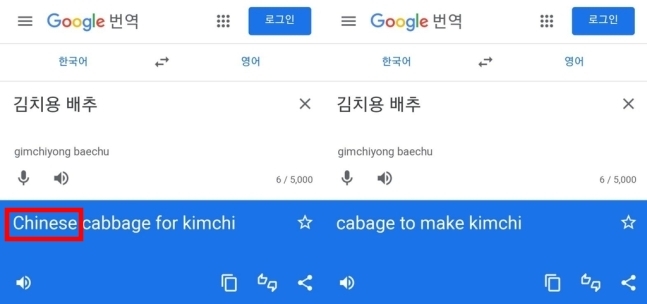 Before correction (left) and after correction results of Google Translate. Photo by Google Translate capture
[Asia Economy, Kim Jeongwan] It has been confirmed that Google has removed the term "Chinese" from the English translation of "cabbage for Kimchi" in Google Translate.
Seo Kyungduk, a professor at Sungshin Women's University, stated on his social media account on the 19th, "Recently, when translating 'cabbage for Kimchi' into English using Google Translate-which is the most widely used translation tool worldwide-the result was 'Chinese cabbage for Kimchi,' which sparked significant controversy. After raising objections to Google together with many others, the translation has now been corrected to 'Cabbage to make Kimchi,' with 'Chinese' removed."
However, Professor Seo also expressed some disappointment, saying, "It's unfortunate that it hasn't been changed to the more accurate term 'Kimchi cabbage.' In order to firmly counter China's Kimchi project, it is extremely important to correct the basic labeling and translation of Kimchi properly from the start."
Professor Seo has consistently pointed out issues with Google's labeling of "Kimchi." In June, he also noted that when translating "Kimchi" (in Korean) and "kimchi" (in English) into Chinese using Google Translate, the result was incorrectly given as "pao cai (泡菜)" instead of "xin qi (辛奇)." Regarding this, Professor Seo said, "We are requesting that it be corrected to 'xin qi (辛奇),'" and urged netizens to participate in this effort.
He further explained, "If you check the result for 'pao cai (泡菜)' in Google Translate, you can click 'Rate translation' at the bottom right, then click 'Suggest an edit,' delete '泡菜,' and change it to '辛奇' before submitting it to Google. This is a very effective way to help correct the translation."
He also added, "The Codex Alimentarius Commission (CODEX) has already officially designated 'Kimchi cabbage' as the proper name for cabbage used in Kimchi. In 2013, domestically grown cabbage, which had previously been classified under 'Chinese cabbage' in international food classifications, was officially listed separately as 'Kimchi cabbage.'"
© The Asia Business Daily(www.asiae.co.kr). All rights reserved.

















