Deployment of Revolutionary Guards for Riot Control
Longest Protests Since 1979 Iranian Revolution
Economic Hardship Worsens Amid US Nuclear Deal Collapse Concerns
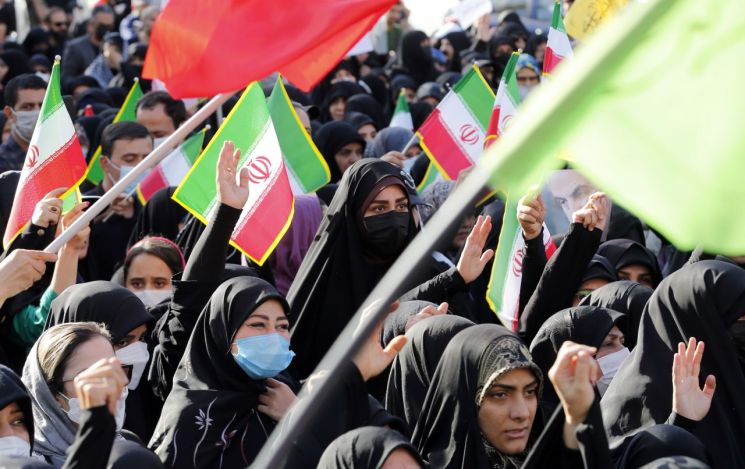
[Asia Economy Reporter Hyunwoo Lee] Despite lasting over a month, Iran's anti-government protests show no signs of abating, raising concerns that what began as simple civilian demonstrations could escalate into a revolution aimed at overthrowing the regime. The restoration talks of the nuclear agreement (JCPOA ? Joint Comprehensive Plan of Action) with the United States, which had raised hopes for easing economic difficulties, have again fallen into uncertainty amid suspicions of arms deals with Russia, likely intensifying the grievances of citizens suffering from worsening living conditions.
In particular, the Kurdish population residing near the border with Iraq has begun armed resistance, raising the possibility of a large-scale civil war. If Iran's political instability, as the leading Shia Islamic country, prolongs, it is expected to significantly impact the political situations across the Middle East, including Iraq, Syria, and Yemen.
◇Protests Spreading Like Wildfire... Deployment of Revolutionary Guards
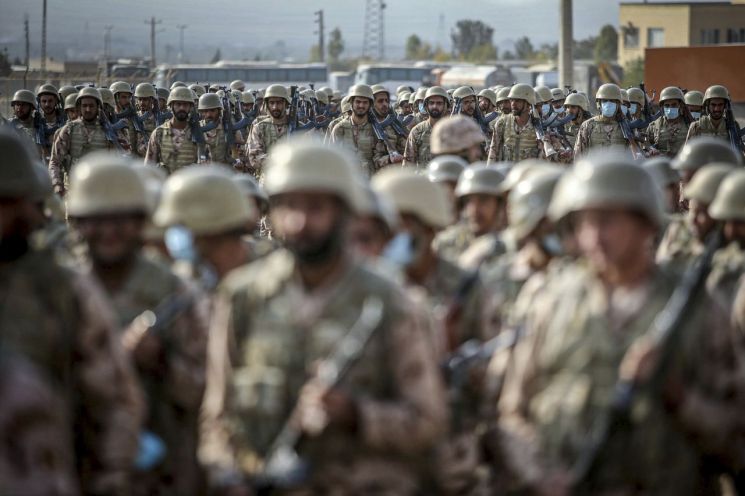
According to the New York Times (NYT) on the 17th (local time), the Iranian government deployed Revolutionary Guard forces to major cities, including the capital Tehran, to suppress the protests. Until now, the police and the Basij militia under the Revolutionary Guards had been responsible for quelling demonstrations, but due to difficulties in controlling nationwide protests, the main Revolutionary Guard units were deployed.
The Revolutionary Guards are Iran's elite forces tasked with special operations during wartime and protecting high-ranking officials. The NYT pointed out that their deployment to suppress protests is evidence that the Iranian regime perceives a significant threat.
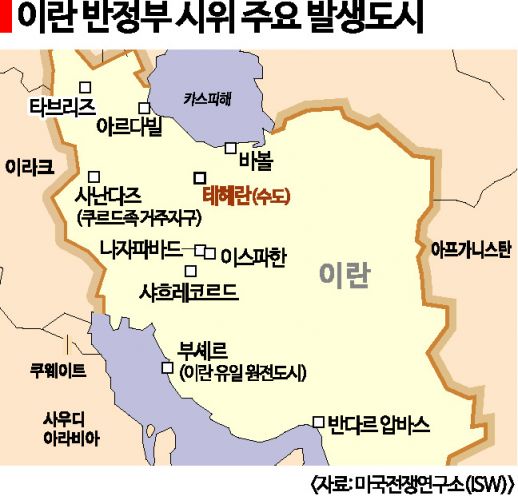
Iran's anti-government protests have been occurring simultaneously in 31 provinces and over 80 cities for more than a month. Large-scale demonstrations have taken place not only in major cities such as Tehran, Isfahan, and Tabriz but also in Bushehr, home to Iran's only nuclear power plant. So far, over 230 people have died and more than 7,000 have been arrested nationwide.
The so-called "Hijab protests," triggered by the suspicious death of 22-year-old Mahsa Amini, who was under police investigation for improper hijab wearing on the 13th of last month, have gradually expanded into anti-regime demonstrations demanding the overthrow of the system. These protests are the longest-lasting since the 1979 Iranian Revolution.
Some officials have expressed concerns that the protests are increasingly turning into an anti-regime revolution demanding regime change, potentially leading to a large-scale democratization movement similar to the 2011 "Arab Spring." Tehran Governor Mohsen Mansouri stated, "The protests have essentially become revolutionary and seem to be targeting regime change."
◇Nuclear Talks Stalled... Fears of Worsening Economic Hardship
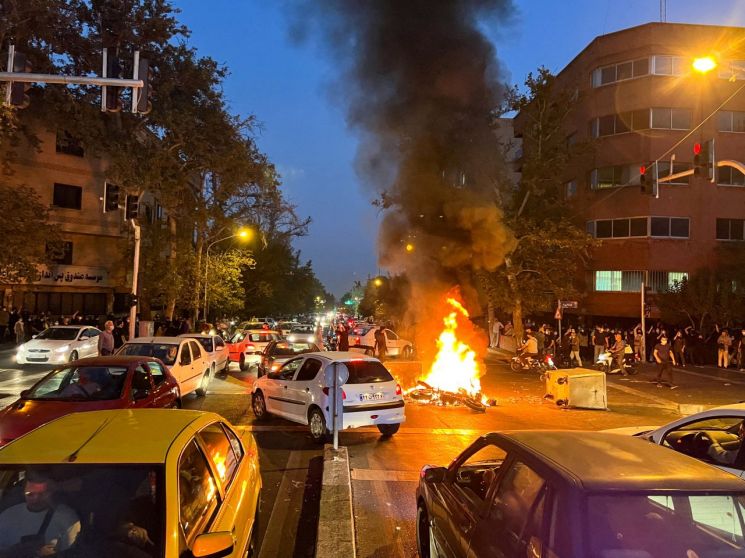
The primary reason the hijab protests have expanded into anti-regime demonstrations is the prolonged economic hardship causing severe living difficulties. The problem is that the nuclear agreement restoration talks with the United States have again stalled, potentially worsening the economic crisis.
Until last month, there was growing optimism that a deal was imminent, but after evidence emerged that Iran supplied drones to Russia, the U.S. reversed its stance, threatening additional sanctions.
On the 17th, White House spokesperson Karine Jean-Pierre said at a press briefing, "Despite all reports that drones believed to be from Iran attacked Kyiv city, Iran continues to lie," adding, "Iran is not truthful on this issue and denies providing weapons to Russia for use in Ukraine," strongly criticizing Iran.
The U.S. has made it clear that the nuclear agreement restoration talks with Iran have returned to a deadlock. Earlier, on the 12th, U.S. State Department spokesperson Ned Price said at a briefing, "We are paying attention to the universal rights of the Iranian people to peaceful protest, assembly, and freedom of expression, and the U.S. supports their courage," but added, "A nuclear deal with Iran is not imminent, and their demands are unrealistic."
With the nuclear deal restoration talks at risk of collapse, Iran's economic difficulties are expected to deepen. Iranian economist Vahid Shakaki Shahri warned in an interview with local media Faraar News, "Iran's inflation rate has exceeded 42% this year. If the nuclear deal restoration is concluded and U.S. sanctions are lifted, inflation is expected to fall to the 20% range, and economic growth to reach around 5%. However, if sanctions relief becomes impossible, economic growth will drop to near zero, and inflation will exceed 50%."
◇Armed Kurdish Resistance Raises Possibility of Civil War Expansion
In particular, concerns have arisen that Kurdish rebel forces in northeastern Iran may join with Iraqi Kurds in armed resistance, potentially triggering a large-scale civil war.
According to the U.S. Institute for the Study of War (ISW), on the 16th, the Iranian Revolutionary Guards issued a statement warning that they are conducting airstrikes in Kurdistan, the Kurdish-inhabited border area with Iraq, and threatened to resume attacks if Kurdish rebel forces do not disarm.
Deterioration in relations with Iraq, where a Kurdish president was elected, is also anticipated. On the 13th, the Iraqi parliament elected Kurdish politician Abdul Latif Rashid as the new president. Immediately after his election, President Rashid nominated Mohammed Shia al-Sudani, from the pro-Iranian Shia political coalition CF, as the new prime minister, forming a coalition government between Kurds and Iraqi Shias.
If Iran's political instability prolongs, the influence of various armed groups supported by Iran across the Middle East is expected to weaken, significantly shaking the region's overall political landscape. According to CNN, Iran exerts influence over countries known as the "Shiite belt," including Iraq, Syria, Lebanon, and Yemen, while confronting Saudi Arabia, the leading Sunni power with which it is hostile.
© The Asia Business Daily(www.asiae.co.kr). All rights reserved.



















