[Seoul District News] Seongdong-gu Wins 1st Place in Advanced City Sector Excellent Policy, Highly Rated for Sustainable Smart Inclusive City Policy & Solving Urban Issues with Life-Closely Smart Services in Safety, Traffic, Welfare, Leading COVID-19 Prevention... Gwanak-gu Wins 2022 Korea City Award Special Prize... Geumcheon-gu Opens Online Classes at Autonomous Decentralization University Geumcheon Campus... Eunpyeong-gu Consulting Service for Discovering Village Agendas by Resident Autonomy Association Until End of This Month... Gangnam-gu Hosts 'Healthy Walking Experience' Event at Yangjaecheon on 31st
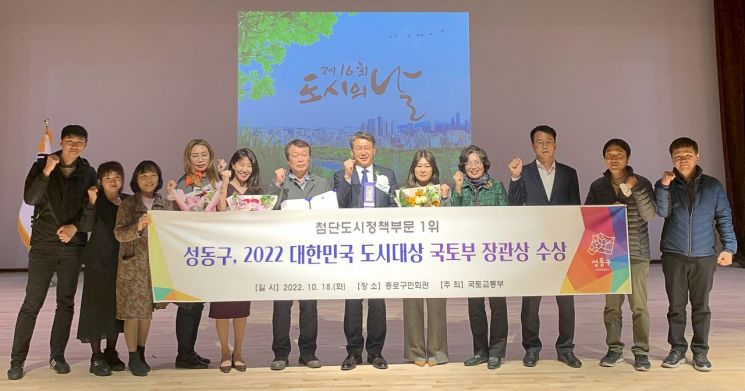 On the 18th, residents and officials are taking a commemorative photo for receiving the Minister of Land, Infrastructure and Transport Award in the advanced city sector. (Center: Deputy Mayor Yubo-hwa)
[Asia Economy Reporter Park Jong-il] Seongdong-gu (Mayor Jung Won-oh) announced on the 18th that it won the Minister of Land, Infrastructure and Transport Award as the 1st place in the Advanced City Policy category at the 2022 Korea Urban Awards.
The Korea Urban Awards is the most prestigious award program in the field of urban policy in Korea. It evaluates the sustainability and level of living infrastructure of cities according to the Act on the Planning and Use of National Territory, and has been awarded to local governments with excellent results.
The Urban Awards selects and awards cities that excel in implementing urban policy projects in 3 to 4 fields each year, reflecting changes in domestic urban planning conditions and global urban planning trends, along with a comprehensive evaluation of sustainability indicators.
Seongdong-gu was selected as an excellent case in advanced city policy and received the highest award, the Minister of Land, Infrastructure and Transport Award, at the award ceremony held at Jongno-gu Citizens' Hall on the 18th. This award was given in recognition of Seongdong-gu's establishment of a smart inclusive city where no one is excluded, based on a smart city, and for operating a smart city integrated control center and big data center, as well as installing smart shelters and smart crosswalks.
Seongdong-gu operates a smart city integrated control center and a big data center for scientific policy decisions based on smart city infrastructure (communication networks, CCTV). Based on the analysis of collected urban data, it provides life-oriented smart integrated services in all fields such as transportation, safety, welfare, and environment.
In particular, in the transportation sector, the installation of smart crosswalks, right-turn vehicle traffic alerts, and public transportation information kiosks has reduced speed violations in school zones by 7.7% compared to before installation, and the compliance rate with crosswalk stop lines has improved by 84.3%.
Additionally, the smart shelters equipped with cutting-edge features such as bus arrival notifications, heating and cooling, and public wireless internet have provided convenience to transportation-vulnerable groups, with cumulative users exceeding 3 million since installation in 2020.
Furthermore, amid the accelerated digital transformation in all areas due to the COVID-19 pandemic over the past two years, Seongdong-gu took the lead in preventing the spread of COVID-19 by introducing the Seongdong-type mobile electronic registry and establishing a waiting number guidance system at screening clinics.
In addition, various smart projects embracing socially vulnerable groups are being promoted in areas such as care for elderly living alone, dementia and child disappearance prevention services, and IoT parking sharing.
Jung Won-oh, Mayor of Seongdong-gu, said, “Our efforts to improve inconveniences in daily life using smart technology have been recognized externally, achieving results again following the Ministry of Land, Infrastructure and Transport’s smart city certification in 2021. We will continue to strive so that no resident is excluded and everyone can enjoy a smart inclusive city through communication.”
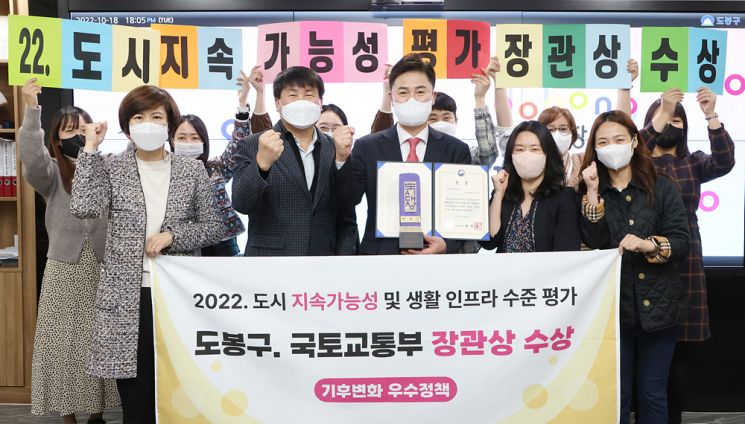 Dobong-gu received the Minister of Land, Infrastructure and Transport Award in the 2022 Urban Sustainability and Living Infrastructure Level Evaluation. Oh Eon-seok, Mayor of Dobong-gu, and staff from the Dobong-gu Sustainable Development Department Photo by [Photographer's Name]
Dobong-gu (Mayor Oh Eon-seok) received the Minister of Land, Infrastructure and Transport Award at the 'Korea Urban Awards' hosted by the Ministry of Land, Infrastructure and Transport, held at Jongno-gu Citizens' Hall on the 18th.
The ‘Korea Urban Awards’ is an honor given annually by the Ministry of Land, Infrastructure and Transport to local governments nationwide based on evaluations of urban sustainability and living infrastructure levels among 229 local governments.
The evaluation is divided into the ‘Indicator Evaluation’ based on statistical data and the ‘Excellent Policy’ based on qualitative evaluation. This year, the Excellent Policy category focused on urban regeneration, climate change, and advanced city fields.
Dobong-gu received high evaluations in both the indicator and excellent policy categories, underwent document and on-site inspections, and ultimately won the Minister’s Award for excellent policy in the ‘Climate Crisis Response’ field.
Oh Eon-seok, Mayor of Dobong-gu, said, “This award is meaningful as it recognizes Dobong-gu’s efforts toward sustainable regional development externally. We will continue to strive to become a sustainable Dobong-gu by improving local living infrastructure.”
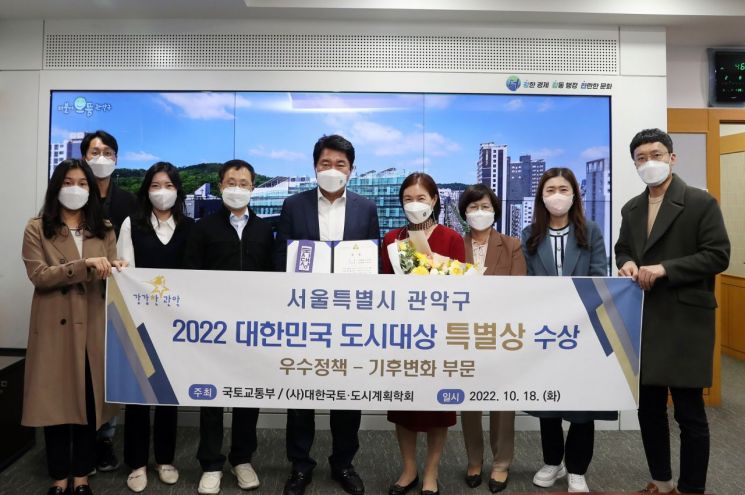
Gwanak-gu (Mayor Park Jun-hee) was honored with a special award in the climate change category of the '2022 Korea Urban Awards' for excellent policies.
Hosted by the Ministry of Land, Infrastructure and Transport, the Korea Urban Awards evaluates 229 basic local governments nationwide on urban sustainability and living infrastructure levels, awarding those with outstanding achievements.
Since the launch of the 7th local government, Gwanak-gu has been recognized for creating a resource-circulating city that practices environmental activities and reduces carbon emissions through public-private cooperation involving residents and administration, and was selected as a special award recipient in the climate change category of the excellent policy evaluation.
Outstanding cases include ▲creating resource-circulating and carbon-neutral villages through revitalizing village communities ▲a compensation system for transparent PET bottles and milk cartons in preparation for the 2026 ban on direct landfill of metropolitan area landfill waste ▲operation of smart recycling bins using smart technology ▲the first production and distribution of exclusive recycling bags among Seoul’s autonomous districts ▲and expansion of customized recycling stations.
In particular, by creating resource-circulating villages that conduct natural circulation education and experiences at the village community level and energy campaigns to reduce greenhouse gases, Gwanak-gu contributed to the creation of a ‘sustainable clean Gwanak where people and nature coexist.’
An official from the district said, “Due to Gwanak-gu’s characteristic of having the highest proportion of single-person households nationwide, disposable waste output is relatively high, but thanks to the efforts of the district and residents, the recycling sorting rate has increased from 58.3% in 2020 to 65.9%.”
Meanwhile, the district is promoting a ‘Detailed Implementation Plan for Climate Change Response’ consisting of 38 projects in five major areas aiming to reduce greenhouse gases by 40% by 2030 compared to 2018, including ▲conversion to low-carbon zero-energy buildings ▲promotion of eco-friendly vehicles and expansion of electric vehicle charging infrastructure ▲acceleration of renewable energy supply such as solar power ▲and activation of eco-friendly urban agriculture.
Through the establishment of greenhouse gas reduction strategies, Gwanak-gu aims to achieve ‘carbon neutrality’ by 2050, effectively reducing CO2 emissions to zero throughout the district.
Additionally, by 2028, the district plans to build the ‘Gwanak-Dongjak Joint Resource Circulation Center,’ an advanced waste treatment facility, to solidify its position as a resource-circulating city.
Mayor Park Jun-hee said, “In the 8th local government term, Gwanak-gu aims to be a ‘clean, safe living place and sustainable resource-circulating city.’ We will do our best to prepare for the climate change crisis by establishing various policies and implementing systematic and effective projects. We also ask residents to actively participate in recycling and waste separation in daily life.”
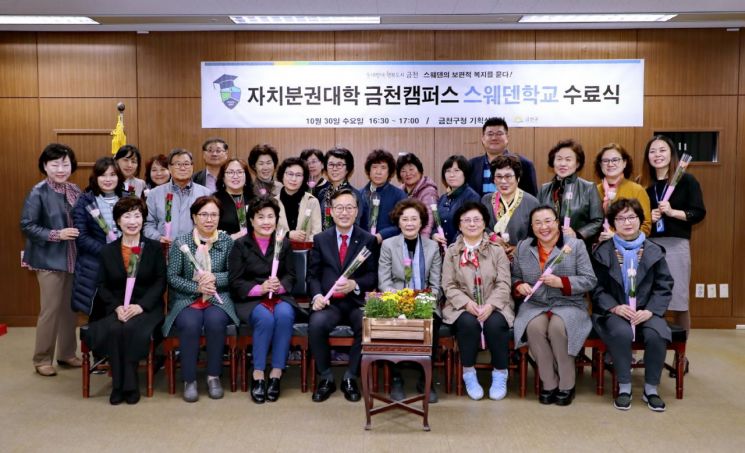
Geumcheon-gu (Mayor Yoo Sung-hoon) will open the Local Era, Opening with Autonomy and Decentralization course at the Autonomy and Decentralization University Geumcheon Campus.
The Autonomy and Decentralization University is an annual education program designed to cultivate leaders in autonomy and decentralization who practice local autonomy in daily life.
This education will provide an opportunity to share various thoughts about the ‘region’ we live in and the ‘local era,’ and to explore what the local era looks like together.
The course will be conducted online via the Autonomy and Decentralization University YouTube channel for six weeks from November 8 to December 16. Participants will attend about 15 lectures covering topics such as ▲the local era opened by autonomy and decentralization ▲local extinction (population extinction) ▲local era and region-led growth ▲pros and cons of local policies ▲various cities - changing localities (mega city, small city) ▲local systems of various countries ▲and local era and local governments. Participants must score 60 or above on online midterm and final exams to receive a certificate.
The lectures are free and open to anyone. Applications can be submitted by visiting the Planning and Budget Division of Geumcheon-gu Office by October 27 or by downloading the application form from the ‘Notices’ section on the Geumcheon-gu Office website and submitting it via email.
Mayor Yoo Sung-hoon of Geumcheon-gu said, “Through various lectures by local autonomy experts and policy stakeholders, we hope residents, the core of autonomy and decentralization, will grow into autonomy leaders of Geumcheon-gu.”
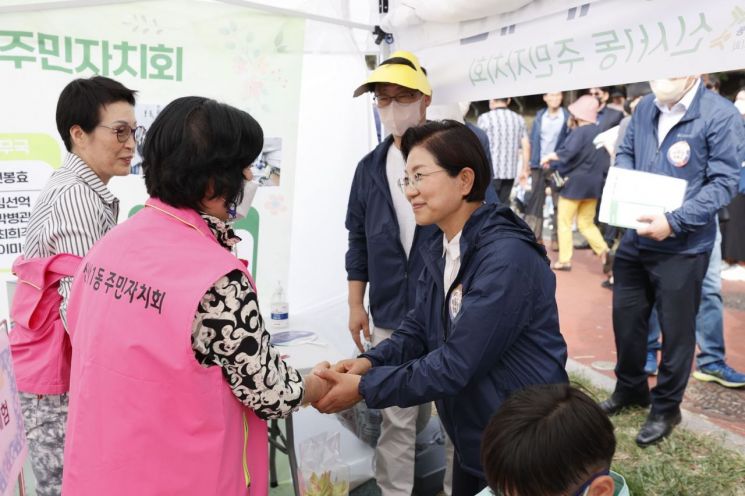
Eunpyeong-gu (Mayor Kim Mi-kyung) is conducting consulting services to discover village agendas for the Residents’ Autonomy Committee until the end of this month.
Through consulting, five neighborhoods including Galhyeon 2-dong and Susaek-dong will be selected to discover specialized mid- to long-term village agendas and compile related data to culminate in the development of the Residents’ Autonomy Committee.
The Residents’ Autonomy Committee is a resident-led organization that discovers and solves local issues by residents themselves. It encompasses the roles of various village communities such as the existing Residents’ Autonomy Committee and Residents’ Participatory Budget Committee, realizing practical local autonomy and decentralization through resident participation.
Eunpyeong-gu was the first in Seoul to enact the ‘Basic Ordinance on Resident Participation’ and the first nationwide to conduct ‘mobile voting for resident-proposed projects,’ expanding the foundation for practical resident participation.
At the end of last year, the ordinance was fully revised to expand the operation of the Residents’ Autonomy Committee, and in June this year, an administrative office dedicated to the Residents’ Autonomy Committee was established to strengthen autonomy and stable operation, laying the foundation unique to Eunpyeong-gu.
In August and September, a ‘Residents’ General Assembly’ was held to gather residents’ opinions, discover village agendas, and allow residents to directly select necessary projects for the village.
The scale of projects has also greatly increased from 54 projects worth 600 million KRW last year to 132 projects worth 1.8 billion KRW this year. The district plans to gradually expand this to further activate resident autonomy.
Lee Sang-hoon, Chairman of the Residents’ Autonomy Council, said, “A foundation for resident participation has been established through participatory budgeting and village community projects. We will strive to realize practical autonomy and decentralization where residents themselves design and decide the village through the Residents’ Autonomy Committee.”
Kim Mi-kyung, Mayor of Eunpyeong-gu, said, “Resident autonomy is the flower of village democracy where local residents are the owners. We will continue efforts so that residents can take a big step closer to village democracy.”

Gangnam-gu (Mayor Cho Sung-myung) will hold a ‘Healthy Walking Experience’ event at Yangjaecheon on the 31st to mark Obesity Prevention Day (October 11). The district is recruiting 300 participants on a first-come, first-served basis through the public health center website until the 29th.
The experience event will be held from 2 PM to 5 PM on the 31st under the Yeongdong 5 Bridge south end bridge at Yangjaecheon (toward Gaepo-dong Station exits 2 and 3). Participants will walk approximately 6 km (about 1 hour and 30 minutes) and compare blood sugar levels before and after exercise to experience the effect of exercise on blood sugar control and recognize the importance of exercise. Sports socks, stretching bands, and other exercise supplies will be given as prizes to participants and those who complete the course.
This event, limited to 300 participants on a first-come, first-served basis, is free for all Gangnam-gu residents. Those who wish to participate can apply online through the education application section on the Gangnam-gu Public Health Center website or by scanning the QR code on the poster.
Mayor Cho Sung-myung of Gangnam-gu said, “I hope this healthy walking experience will help Gangnam-gu residents make exercise a habit and live healthier lives. We will continue to work hard to prevent obesity, a chronic disease of modern people, and ensure steady health management through various health support projects for residents.”
© The Asia Business Daily(www.asiae.co.kr). All rights reserved.
!["The Woman Who Threw Herself into the Water Clutching a Stolen Dior Bag"...A Grotesque Success Story That Shakes the Korean Psyche [Slate]](https://cwcontent.asiae.co.kr/asiaresize/183/2026021902243444107_1771435474.jpg)


















