'10th Sobujang Competitiveness Enhancement Committee' Meeting Held
Deliberation and Resolution on 'New Government Sobujang Policy Direction'
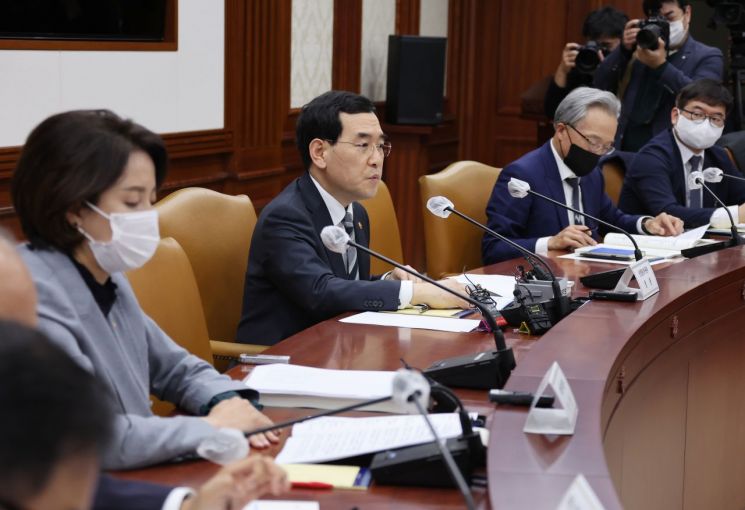 Minister Lee Chang-yang speaking at the Materials, Parts, and Equipment Competitiveness Enhancement Committee
 (Seoul=Yonhap News) Photo by Kim Seung-doo = Minister Lee Chang-yang of the Ministry of Trade, Industry and Energy is speaking at the 'Materials, Parts, and Equipment Competitiveness Enhancement Committee' held at the Government Seoul Office on October 18, 2022.
kimsdoo@yna.co.kr
(End)
<Copyright(c) Yonhap News Agency, Unauthorized reproduction and redistribution prohibited>
[Asia Economy Sejong=Reporter Lee Jun-hyung] The government is expanding the number of core strategic technologies from the existing 100 to 150 to stabilize supply chains. The government also plans to revise the "Special Measures Act for Strengthening the Competitiveness of Materials, Parts, and Equipment Industry (SoBuJang Special Act)," established in response to Japan's export regulations in 2019, within this year to introduce a new category called "Supply Chain Stabilization Items." This is seen as a sign that the SoBuJang policy under the Yoon Seok-yeol administration is being fully activated.
The Ministry of Trade, Industry and Energy announced on the afternoon of the 18th that it held the "10th SoBuJang Competitiveness Enhancement Committee" at the Government Complex Seoul. The committee reviewed and approved the "New Government SoBuJang Industry Policy Direction." The new government policy direction includes the direction of SoBuJang policies that the Yoon Seok-yeol administration will pursue over the next five years. A senior official from the Ministry of Trade, Industry and Energy said, "The 10th SoBuJang Competitiveness Enhancement Committee was the first held since the launch of the Yoon Seok-yeol government, and it is significant in that it presented the policy direction for the next five years," adding, "The system was supplemented to respond more effectively to the all-around supply chain crisis."
The core of the new government policy direction is the expansion of core strategic technologies. Previously, the government designated 100 technologies as core strategic technologies in 2020 to respond to Japan's export regulations. However, considering that the existing core strategic technologies were established under a SoBuJang policy framework focused on Japan, 50 additional core strategic technologies were added.
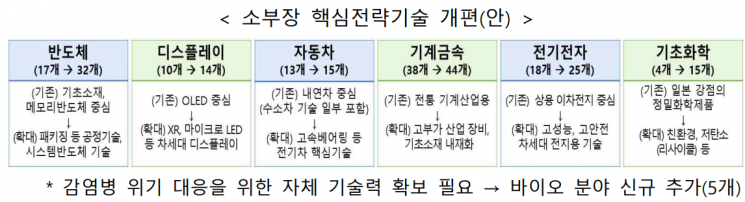 Revised Plan for Core Strategies in Materials, Parts, and Equipment Technologies.
 [Photo by Ministry of Trade, Industry and Energy]
Core Strategic Technologies in Semiconductors Doubled
Specifically, the number of core strategic technologies in the semiconductor field will expand from the existing 17 to 32. This includes newly designated core strategic technologies ranging from materials related to semiconductor processes such as hydrogen fluoride to process technologies such as packaging post-process and deposition. Not only memory semiconductors but also system semiconductor technologies have been designated as core strategic technologies.
The number of core strategic technologies in the display field increased from 10 to 14. The government expanded and reorganized the core strategic technologies to include not only organic light-emitting diode (OLED) technology, which is the main model of domestic display companies, but also next-generation display technologies such as micro light-emitting diode (LED).
In the automotive field, two technologies, high-speed bearings for drive motors and next-generation wiring harnesses, which are considered core technologies for future vehicles, were newly designated as core strategic technologies. In the bio field, which previously had zero core strategic technologies, five technologies were newly designated. The Ministry of Trade, Industry and Energy explained that the importance of technological capabilities for infectious disease response increased due to the COVID-19 pandemic, leading to the new designation of core strategic technologies in the bio sector.
The Ministry of Trade, Industry and Energy will announce the 150 core strategic technologies confirmed on this day within this week. The ministry plans to provide focused support such as granting the qualification to apply for the "Top Company" status to companies holding core strategic technologies and applying special exemptions from environmental and employment regulations. A ministry official explained, "We significantly increased core strategic technologies considering global supply chains including China and advanced future industries," adding, "We will periodically review and reorganize core strategic technologies to flexibly respond to the rapidly changing supply chain environment."
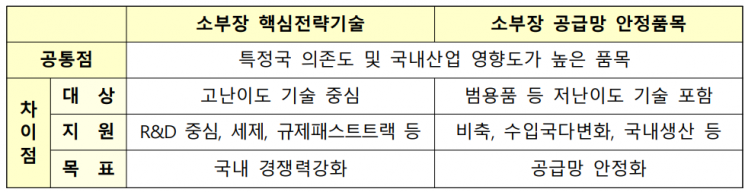 Comparison of Core Strategic Technologies in Materials, Parts, and Equipment and Stable Supply Chain Items.
 [Photo by Ministry of Trade, Industry and Energy]
'SoBuJang Special Act' to be Revised Within the Year
The government also decided to revise the SoBuJang Special Act within this year. The SoBuJang Special Act, implemented since 2020, was created in response to Japan's export regulations in 2019. The core of the amendment is the establishment of "Supply Chain Stabilization Items." These items are raw materials and general-purpose products with high dependence on specific countries and significant impact on domestic industries but low technological levels. An example is the element phosphorus, which experienced shortages last year. The Ministry of Trade, Industry and Energy plans to support stockpiling, diversification of import countries, and domestic production of supply chain stabilization items.
The supply chain monitoring system will also be strengthened. The ministry plans to mobilize the government’s overseas networks such as overseas diplomatic missions, KOTRA, and the Korea International Trade Association to collect and analyze domestic and international supply chain information. Additionally, it will establish its own global value chain (GVC) analysis system to detect early signs of supply chain crises and respond accordingly.
Meanwhile, the committee newly approved nine SoBuJang cooperation models on this day. The SoBuJang cooperation model is a system that supports research and development (R&D) and commercialization of core strategic technology items through cooperation between demand companies and supply companies. Among the nine newly approved cooperation models, four projects discovered by the ministry’s working group include power semiconductors for electric vehicle fast charging and pressure sensors for future vehicles. The ministry plans to support R&D funds worth about 90 billion KRW over the next 4 to 5 years for the cooperation models and provide tax benefits, manpower, and regulatory exemptions.
Minister Lee Chang-yang of the Ministry of Trade, Industry and Energy said, "In the situation where the global supply chain is being reorganized, securing a stable SoBuJang supply chain is a key factor determining our industrial competitiveness," adding, "Based on the new government policy direction confirmed today, we plan to carry out follow-up measures without fail."
© The Asia Business Daily(www.asiae.co.kr). All rights reserved.
![From Hostess to Organ Seller to High Society... The Grotesque Scam of a "Human Counterfeit" Shaking the Korean Psyche [Slate]](https://cwcontent.asiae.co.kr/asiaresize/183/2026021902243444107_1771435474.jpg)


















