COVID-19 Cases Increase at 'Doubling' Level
Jeong Gi-seok: "38 Million People Have Decreased Immunity, Elderly Need Vaccination"
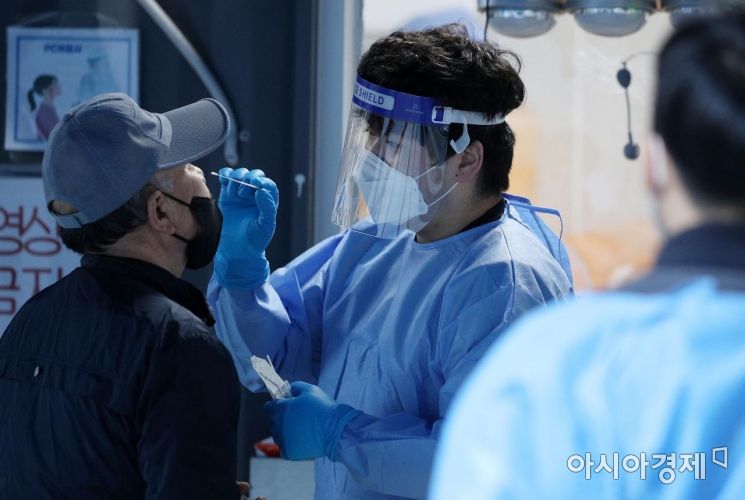 On the 18th, as the number of new COVID-19 cases more than doubled compared to last week, soaring to over 33,000, citizens are getting tested at the screening clinic of Yongsan-gu Public Health Center in Seoul. Photo by Hyunmin Kim kimhyun81@
[Asia Economy Reporter Yoon Seul-gi] Although the number of confirmed COVID-19 cases has recently stabilized at around 20,000, a 'doubling' phenomenon has appeared, with cases more than doubling compared to last week after three months, indicating signs of a resurgence. Experts have advised vaccination for the elderly, warning of a possible winter resurgence.
According to the Central Disease Control Headquarters, as of midnight on the 18th, the number of new COVID-19 confirmed cases was 33,248. This is more than double the number from last week (15,466 on the 11th), marking the first time in three months since July 18. Over the past week, daily cases were 30,519 → 26,950 → 23,583 → 22,844 → 21,469 → 11,040 → 33,248, averaging 24,236 cases per day.
Of these, 33,161 cases were domestic, and 87 were imported. The cumulative number of confirmed cases stands at 25.16 million. There are 247 severe cases, and 6 deaths were reported, bringing the total death toll to 28,856. The fatality rate (deaths relative to total confirmed cases) is 0.11%.
The problem is that while most quarantine measures have been relaxed, vaccination rates have not significantly increased. In fact, the COVID-19 vaccination rate decreases with each subsequent dose: the first dose coverage is 87.9%, the second dose 87.0%, but the third dose is only 65.5%, and the fourth dose just 14.6%.
Vaccination rates for the Omicron-targeted COVID-19 vaccine are also low. Although Moderna's Omicron variant BA.1 bivalent vaccine began administration on the 11th, the vaccination rate is about 0.5%.
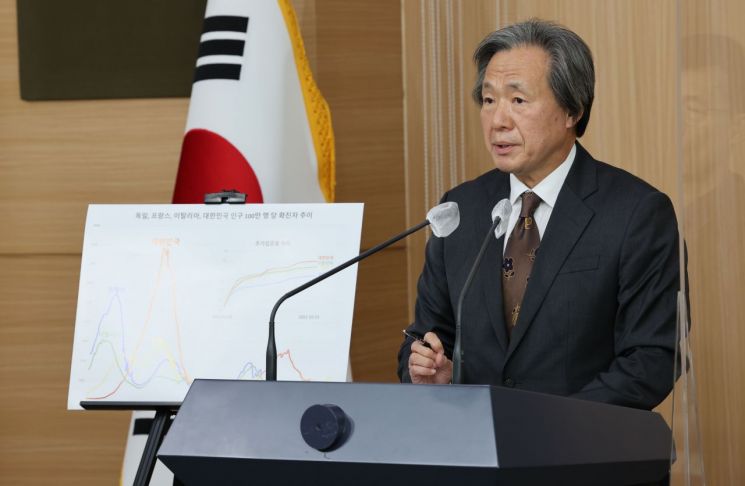 Jung Ki-seok, Head of the COVID-19 Special Response Team and Chair of the National Infectious Disease Crisis Response Advisory Committee, is explaining the results of the National Infectious Disease Crisis Response Advisory Committee meeting on the 17th at the Government Seoul Office Annex in Jongno-gu, Seoul. [Image source=Yonhap News]
The government's official advisory body, the National Infectious Disease Crisis Response Advisory Committee (Advisory Committee), expressed concern that the 7th wave of COVID-19 could occur in December as winter approaches.
At a regular briefing on the 17th, Jeong Gi-seok, head of the COVID-19 Special Response Team and chair of the National Infectious Disease Crisis Response Advisory Committee, said, "Looking at the national epidemic trends, increases in confirmed cases in European countries have typically been reflected in Korea one to two months later. Recently, these countries have seen an increase in cases," adding, "Although the increase is not yet large, based on past patterns, Korea is expected to see a rise in confirmed cases soon."
Chairman Jeong emphasized the importance of vaccination to reduce the scale of the 7th wave of COVID-19. He stated, "About 13 million people will have immunity by December. Conversely, the remaining 38 million do not have adequate immunity," urging, "Therefore, high-risk groups aged 60 and over should participate in receiving the updated booster vaccine."
© The Asia Business Daily(www.asiae.co.kr). All rights reserved.
![Clutching a Stolen Dior Bag, Saying "I Hate Being Poor but Real"... The Grotesque Con of a "Human Knockoff" [Slate]](https://cwcontent.asiae.co.kr/asiaresize/183/2026021902243444107_1771435474.jpg)

















