Uijeongbu Citizens Hold Nationwide Rally Urging Kim Geun-sik to Withdraw Residency
Jeers of "Expel from Ansan" Erupt at Jo Doo-soon's Release
'Sex Offender Residence Restriction' Policy Fails to Pass National Assembly Due to Basic Rights Infringement
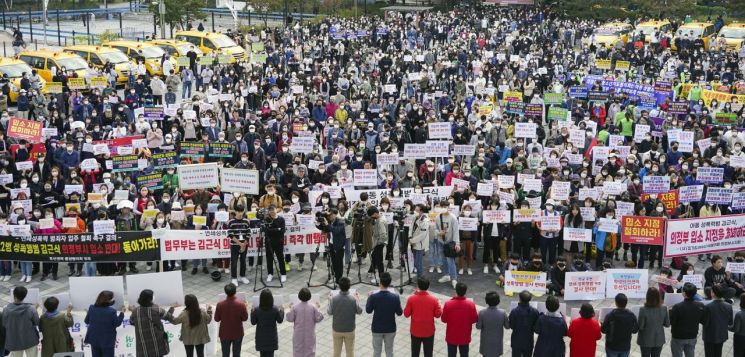 On the 16th, citizens of Uijeongbu held a rally in front of Uijeongbu City Hall opposing the residence of child sex offender Kim Geun-sik in Uijeongbu. Photo by Yonhap News
[Asia Economy Culture Intern Reporter Young In] On the 13th, it was revealed that minor sex offender Kim Geun-sik was to be admitted to the Korea Ministry of Justice Protection and Welfare Corporation Gyeonggi Northern Branch in Uijeongbu City. Kim Geun-sik, who served 15 years for sexually assaulting 11 minors and was released after completing his sentence, hoped to reside in Uijeongbu after his release. Anxiety among parents and residents grew mainly through communities such as the Uijeongbu Mom Cafe, putting Uijeongbu on high alert.
Eventually, Kim Dong-geun, mayor of Uijeongbu, held an emergency countermeasure meeting, and Uijeongbu citizens held a large-scale rally. The Uijeongbu city government issued a joint statement demanding the withdrawal of Kim Geun-sik's admission to Uijeongbu, and citizens held an anti-residence rally in front of the Korea Ministry of Justice Protection and Welfare Corporation Gyeonggi Northern Branch, announcing a nationwide civic urging resolution meeting. Citizens of Uijeongbu breathed a sigh of relief when Kim Geun-sik was re-arrested a day before his release due to additional crime charges revealed 16 years ago.
When Jo Doo-soon was released in 2020, Ansan citizens held anti-residence rallies, throwing insults and eggs. Jo Doo-soon was released on the morning of December 12, 2020, after serving a 12-year sentence. After being released from Seoul Southern Prison in Guro-gu, Seoul, in a government vehicle, he was met with jeers and insults from Ansan citizens from early morning. Eggs were thrown from various places, and slogans such as "Expel him from Ansan" continued.
As controversies arise over the residence of sex offenders after their release, opposition from nearby residents is also intensifying. Although the Ministry of Justice announced plans to monitor offenders by equipping them with electronic location tracking devices (electronic anklets) and assigning probation officers, villagers remain uneasy, citing "high recidivism rates of sex offenders and the presence of daycare centers and schools nearby." Some citizens expressed frustration, saying, "Why should I have to move?" In fact, after Jo Doo-soon settled in Ansan, Gyeonggi Province, families with children moved away, leading to the closure of nearby daycare centers.
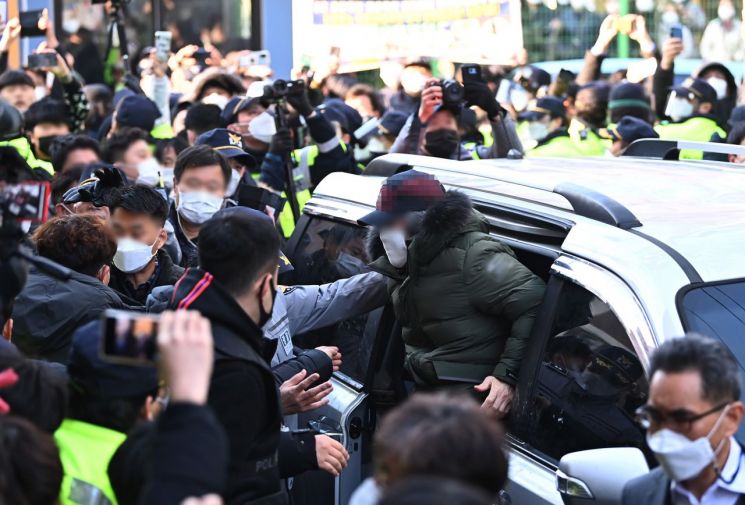 On December 12, 2020, child sex offender Jo Doo-soon, who was released after serving his sentence, arrived at his residence in Ansan, Gyeonggi Province, and got out of the official vehicle. Residents shouted, "Expel him from Ansan." Photo by Yonhap News
Currently, the Ministry of Gender Equality and Family manages the personal information of sex offenders through 'Sex Offender Notification e.' According to a survey as of the end of August, 57% of minor education facilities nationwide are located within 1 km of the residences of 3,844 'publicly disclosed' sex offenders. Among these, 62% of daycare centers, 52% of kindergartens, and 46% of elementary schools are near sex offenders' residences. Additionally, an analysis by the Korea Institute of Criminology and Justice in 2019 showed that 54.7% of child and adolescent sex crimes occurred in the same area as the offender's residence.
Two years ago, Mr. A, who received a mail notification that a sex offender lived near his home, said, "I was surprised that a rape attempt offender lived closer than I thought." He added, "There are elementary and middle schools nearby; is it acceptable to let a sex offender live here? If this criminal said he lives in our neighborhood, it's truly horrifying. If I had known earlier, I would have joined the protest."
As public anxiety grows, the political sphere has introduced various sex offender residence restriction policies as part of the 'Jo Doo-soon Prevention Act.' Go Young-in, a member of the Democratic Party of Korea, proposed a bill to prohibit child sex offenders from moving within 200 meters of their residence. Another Democratic Party member, Jung Chun-sook, proposed a bill preventing offenders from entering within a 1 km radius of the victim's home. However, most focus on 'not allowing offenders to leave their homes' or 'distance from the victim's home.' These bills have not progressed due to concerns that they infringe on constitutional rights to freedom of residence and movement.
Experts say that in densely populated South Korea, it is difficult to create designated residential areas for offenders that avoid educational facilities scattered nationwide. Moreover, forcing sex offenders into areas lacking basic living conditions may increase psychological pressure and the risk of reoffending. However, residents argue that to prevent secondary harm, at least offenders should not be allowed to return to the same neighborhood as the victims.
© The Asia Business Daily(www.asiae.co.kr). All rights reserved.


















