[Seoul District News] Construction Resumed After 185 Days Through Active Mediation by Gangdong-gu and Seoul City... Gangbuk-gu Establishes Residential Maintenance Division & Adjusts Functions Among Departments in Urban Management Bureau to Respond to Housing Maintenance Demand & Focuses on Urban Public Housing Complex Projects, Redevelopment, Reconstruction, and Moa Town... Yeongdeungpo-gu Mandates Installation of Flood Prevention Barriers in New Buildings... Geumcheon-gu Develops Electronic Braille Generation Service on Main and Sub Websites
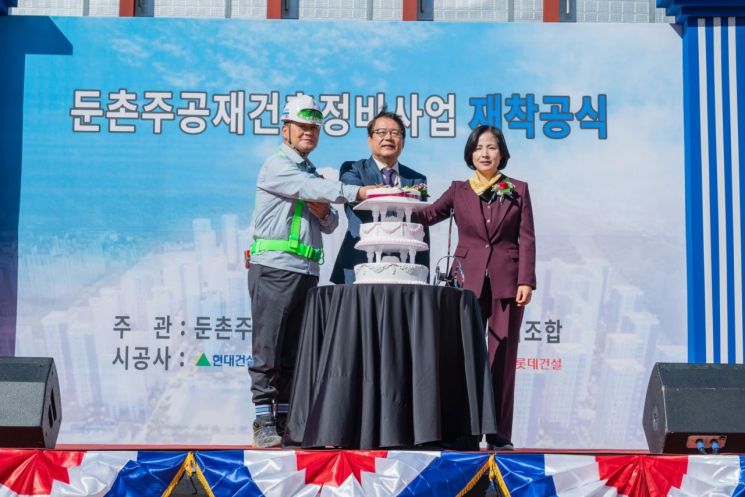
[Asia Economy Reporter Park Jong-il] Gangdong-gu (Mayor Lee Soo-hee) announced on the 18th that the reconstruction work of Dunchon Jugong Apartment has resumed as of the 17th.
The reconstruction of Dunchon Jugong Apartment is the largest reconstruction project in Korea, involving the construction of up to 35 floors, 85 apartment buildings, and 12,032 households, attracting nationwide attention.
The reconstruction work began in December 2019, but due to disputes over the change of construction contract between the association and the construction consortium (Hyundai Engineering & Construction, Daewoo Engineering & Construction, Lotte Engineering & Construction, Hyundai Development Company) in June 2020, the construction was halted on April 15th this year (progress rate 52%, 23 floors above ground).
With the suspension of construction, the property damage and anxiety of about 6,100 association members who had relocated increased, and it also had a significant negative impact on the housing supply policies of the government and Seoul city.
In response, Gangdong-gu and Seoul city actively mediated to resume construction. Through Seoul city’s continuous efforts, a path to resolve the conflict was opened, and Gangdong-gu also actively mediated and held meetings to resume construction. On July 29th, through practical consultations with the association, the Dunchon Jugong Association Normalization Committee, and the construction consortium, an agreement for project normalization was reached 105 days after the construction stoppage.
Furthermore, on August 11th, Gangdong-gu led the official signing of the ‘Agreement between Dunchon Jugong Apartment Reconstruction Association and Construction Consortium’.
After the official signing of the agreement, on August 12th, the district quickly formed the ‘Dunchon Jugong Project Normalization TF Team’ and has been holding meetings regularly to act as a mediator, making reasonable and prompt decisions on the opinions and demands of each party including the association, construction companies, and maintenance firms.
According to the contents of the agreement, the district provided active administrative support on matters discussed in the TF team meetings such as the election management plan for appointing the association’s executive body, the formation of the election management committee for electing association executives, withdrawal of lawsuits against the construction companies, and matters related to holding the general meeting. The association also actively implemented these, leading to the decision to resume construction at the general meeting held on October 15th.
Lee Soo-hee, Mayor of Gangdong-gu, stated, “The shared desire of Gangdong-gu, Seoul city, and the association for the prompt normalization of Dunchon Jugong Apartment minimized the construction suspension period,” and added, “We plan to continuously operate the Dunchon Jugong Apartment Project Normalization TF Team until the construction is safely completed.”
She also said, “We will spare no effort in providing active administrative support so that Dunchon Jugong Apartment can be developed into the best apartment complex serving as the gateway to Gangdong-gu.”
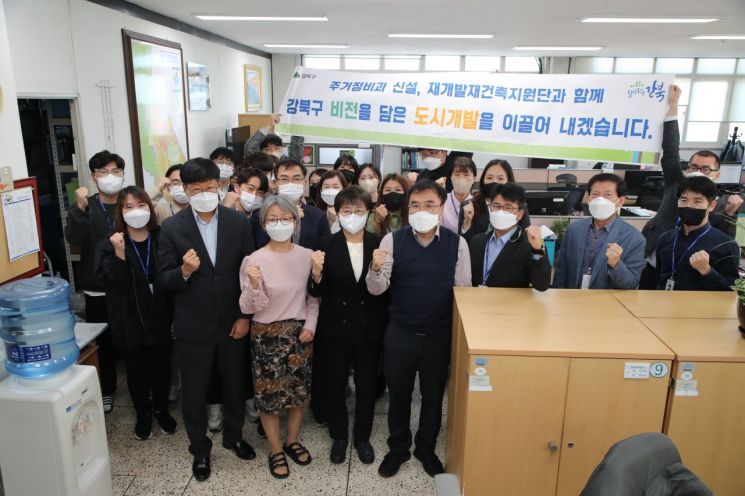
Gangbuk-gu (Mayor Lee Soon-hee) carried out an administrative reorganization as of October 17th to strengthen the promotion of housing redevelopment and reconstruction projects and other maintenance projects.
The main changes include the establishment of the Residential Maintenance Division and the abolition of the Urban Regeneration Division. A district official explained, “We adjusted the functions between departments within the Urban Management Bureau to actively respond to the increasing demand for housing maintenance projects.”
The Residential Maintenance Division consists of four teams: Residential Maintenance Administration Team, Redevelopment and Reconstruction Team 1, Redevelopment and Reconstruction Team 2, and Moa Housing Team, focusing on housing maintenance projects.
The redevelopment, reconstruction, street housing, and Moa Town projects previously handled by the Housing Division are now managed by the integrated Redevelopment and Reconstruction Teams 1 and 2 and the Moa Housing Team under the Residential Maintenance Division. The Urban Public Housing Complex Project and other housing maintenance projects are promoted by the Residential Maintenance Administration Team.
Urban regeneration projects have been transferred to the Housing Division and Urban Planning Division to align with changes in administrative demand. Sustainable development and urban revitalization projects are handled by the Housing Environment Improvement Team in the Housing Division; residential regeneration and New Deal projects are transferred to the Residential Regeneration Team in the Housing Division; and urban regeneration support projects are promoted by the Residential Environment Management Team in the Urban Planning Division.
While continuing urban regeneration projects, the focus will be on housing maintenance projects to meet residents’ needs. Additionally, the Balanced Development Team in the Urban Planning Division has been renamed the Redevelopment Promotion Team to actively support redevelopment projects.
Lee Soon-hee, Mayor of Gangbuk-gu, said, “This reorganization was implemented to establish a performance-oriented organizational system that supports the execution of the 8th term administration’s pledges,” and added, “Together with the Residential Maintenance Division and the Redevelopment and Reconstruction Support Group, we will efficiently promote Gangbuk-gu’s maintenance projects.”
Prior to this reorganization, on August 1st, Gangbuk-gu also established organizations such as the Redevelopment and Reconstruction Support Group directly under the mayor, the New Gangbuk Line Promotion TF Team, and the Municipal Children’s Hospital Construction Support TF Team to promote key projects of the 8th term administration.
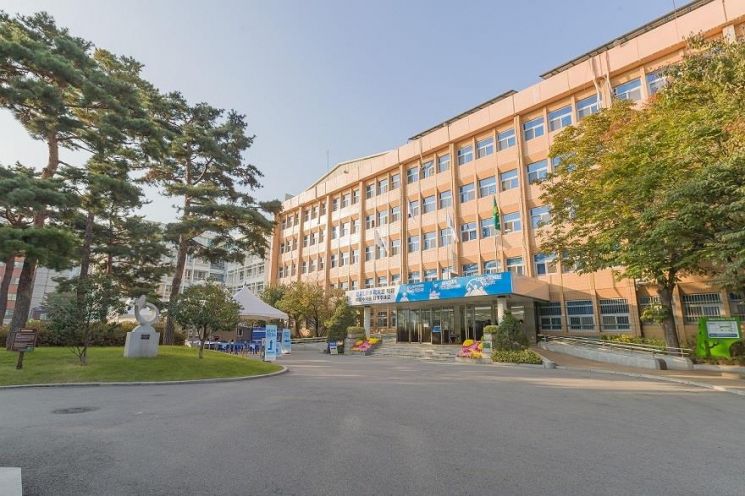
Yeongdeungpo-gu (Mayor Choi Ho-kwon) announced that starting October 13th, flood prevention barriers must be mandatorily installed in newly constructed buildings within the district to prevent flood damage caused by heavy rainfall.
To respond to localized heavy rain due to climate change and prevent basement flooding caused by sudden inflow of rainwater like the Pohang Apartment underground parking lot accident, the district added the obligation to install flood prevention barriers in new buildings with basements as a general condition for building permits, effective from October 13th.
The target includes all newly constructed buildings with basements in the district. Building owners must mandatorily install flood prevention barriers at entrances to underground parking lots, sunken areas, and basement stairwells connected from the ground level to the basement.
The district will continue safety inspections on existing buildings to minimize basement flood damage. Especially, during inspections of 886 medium and large buildings next year, experts such as architects will assess basement flood risk, and owners of high-risk buildings will be actively encouraged to install flood prevention barriers.
Additionally, the district plans to separately support the installation of flood prevention barriers in underground parking lots of existing apartment complexes. For complexes applying for support, up to 50% of the total installation cost, with a maximum of 30 million KRW, will be subsidized to actively respond to flood prevention during summer heavy rains.
Furthermore, the district has actively inspected underground spaces of 12 small apartment complexes located in low-lying areas near rivers to prepare for flooding and fire risks related to electrical facilities. A joint inspection team including external experts such as architects and electrical engineers checked the possibility of relocating underground electrical facilities (substations) to above ground, and inspected flood barriers and automatic drainage pump facilities.
Choi Ho-kwon, Mayor of Yeongdeungpo-gu, said, “Protecting the lives and safety of residents requires thorough preparation in many ways,” and added, “Starting with the mandatory installation of flood prevention barriers, we will actively promote disaster prevention projects so that residents can enjoy a safe daily life.”
Geumcheon-gu (Mayor Yoo Sung-hoon) announced that it will provide an electronic braille generation service for the visually impaired on its official website.
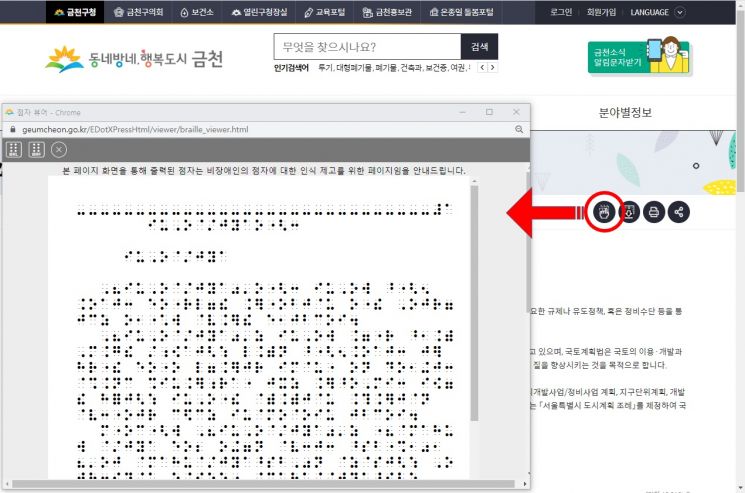
The ‘Electronic Braille Generation Service’ converts various civil service information and district news provided on the website into braille files so that visually impaired people can easily access them. Through braille, specific information such as numbers and tables that are difficult to understand by voice alone can be accurately read.
Geumcheon-gu created an electronic braille menu at the top right corner of each content. When users click the electronic braille view menu on the website, the information is converted into electronic braille and can be checked using braille information terminals owned by visually impaired people. Also, by downloading files for braille printer output, the content can be immediately read in braille print.
The electronic braille generation service is provided not only on the Geumcheon-gu main website but also on sub-portals such as the Open Mayor’s Office, Health Center, and Education Portal.
Yoo Sung-hoon, Mayor of Geumcheon-gu, said, “I hope the electronic braille generation service will improve web accessibility for the visually impaired and help bridge the information gap,” and added, “We will continue to operate a website that anyone can easily and conveniently use to fulfill residents’ right to know.”
© The Asia Business Daily(www.asiae.co.kr). All rights reserved.



















