International Comparison of Major Korean Labor Indicators from 2000 to 2021
[Asia Economy Reporter Kim Pyeonghwa] South Korea's employment rate has dropped by six ranks compared to the year 2000. The proportion of involuntary part-time workers exceeded 40% of all part-time workers, indicating an increase in undesirable jobs. This is the highest level in the world. Since key indicators such as employment rate, economic activity participation rate, and labor productivity remain in the lower ranks, there are calls for labor reforms to create jobs and improve productivity.
On the 18th, the Federation of Korean Industries (FKI) announced these findings by comparing international labor indicator rankings from 2000 to last year. This survey analyzed key labor indicators among OECD countries with complete data during the period.
Employment Rate Ranking Falls While Perceived Unemployment Rate Rises
According to the FKI, although South Korea's employment rate increased numerically from 2000 to last year, its ranking among countries dropped by six places. The employment rate rose from 61.5% in 2000 to 66.5% last year, an increase of 5.0 percentage points, but the ranking fell from 23rd to 29th. By gender, the male employment rate ranking fell from 12th in 2016 to 19th last year. The female employment rate ranking dropped four places from 27th in 2000 to 31st last year. The gender employment rate gap ranking also declined three places from 28th to 31st during the same period.
The FKI evaluated that "to raise the employment rate, it is necessary to foster the service sector, which has a high employment inducement effect," and "expand part-time work systems and work-family balance policies to increase female employment."
The unemployment rate decreased from 4.6% in 2000 to 3.6% last year. During the same period, the ranking improved by eight places from 12th to 4th. Youth unemployment also fell from 8.1% in 2000 to 7.8% last year, with the ranking rising five places from 14th to 9th.
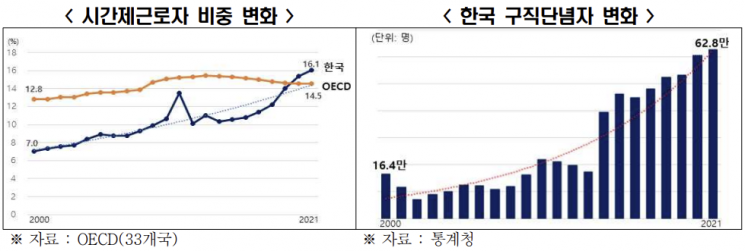
However, the FKI explained that although the rise in unemployment ranking indicates improvement in the indicator, it does not reflect the perceived employment situation. The perceived unemployment rate felt by the public increased from 11% in 2017 to 13.3% last year. This is due to an increase in undesirable jobs such as involuntary part-time workers. In particular, involuntary part-time workers accounted for 40.1% of all part-time workers last year, exceeding the OECD 33-country average of 21.0%, marking the highest level worldwide. The number of discouraged job seekers who gave up looking for work also rose from 164,000 in 2000 to 628,000 last year.
South Korea's Economic Activity Participation Rate and Labor Productivity Also in OECD Lower Ranks
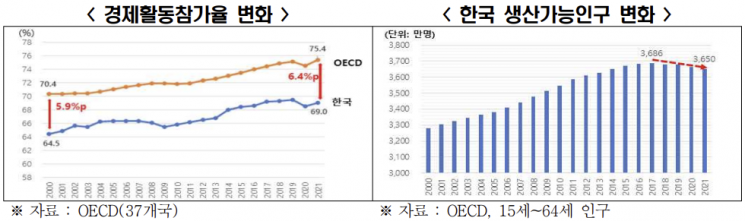
South Korea's economic activity participation rate increased from 64.5% in 2000 to 69.0% last year, but its ranking among 37 OECD countries fell by two places from 29th to 31st. By gender, the male participation rate ranking dropped three places from 25th to 28th, and the female ranking fell one place from 30th to 31st. The FKI argued that since the working-age population has been declining since 2017, labor market flexibility and strengthened vocational training are needed to encourage more people to participate in the labor market and raise the economic activity participation rate.
Hourly labor productivity increased 2.2 times from $19.9 (approximately 28,576 KRW) in 2000 to $42.7 (approximately 61,317 KRW) last year. The ranking also rose five places from 34th to 29th. However, the FKI noted that since South Korea still ranks in the lower tier among 38 OECD countries, improvement is necessary. The continuous decline in labor productivity growth rate is also a challenge. The FKI pointed out the need for systems such as job- and performance-based wage structures, performance- and achievement-based personnel management, and flexible working hours to improve productivity.
The average annual wage increased from $29,505 (approximately 42,369,180 KRW) in 2000 to $42,747 (approximately 61,384,692 KRW) last year. The ranking among 34 OECD countries rose from 24th to 20th. This was due to a sharp rise in the minimum wage since 2017, which generally increased wages. The FKI stated that while appropriate wage increases are necessary, rapid wage hikes that are disconnected from productivity could weaken corporate competitiveness in the long term. They warned that this could lead to unemployment and requires caution.
Choo Kwang-ho, head of the FKI Economic Headquarters, said, "Although some aspects such as labor productivity have improved since 2000, it is difficult to say that South Korea's labor indicators have improved compared to other countries overall," and suggested, "A flexible and advanced labor market is needed to create jobs and improve productivity."
© The Asia Business Daily(www.asiae.co.kr). All rights reserved.


















