Deterring Crises and Conflicts through Poetic Commentary and Strategic Deterrence
Concerns over Potential Arms Race among Nations
[Asia Economy Senior Reporter Cho Young-shin] Xi Jinping, General Secretary of the Communist Party of China (also President of the State and Chairman of the Central Military Commission, hereinafter referred to as President), announced at the work report of the '20th National Congress of the Communist Party (20th Party Congress)' held on the 16th that he will establish a 'strategic deterrence' system.
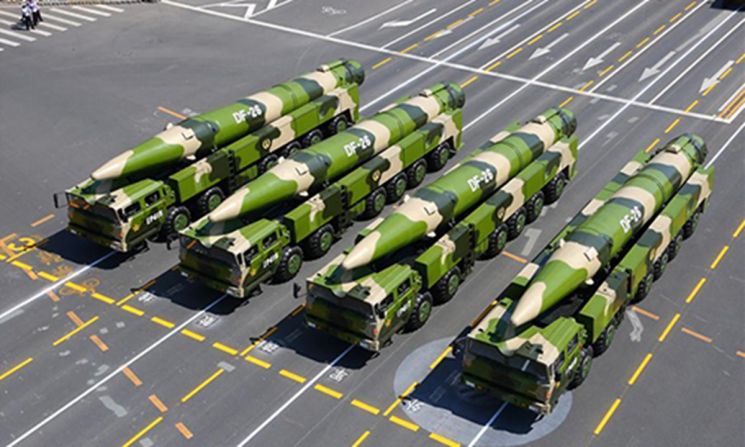
President Xi emphasized, "We will comprehensively strengthen the readiness posture to improve the combat capabilities of the People's Liberation Army." He further reiterated, "We will suppress crises and conflicts through building a strong strategic deterrence system, accelerating unmanned intelligent combat, and scientific and technological development."
President Xi added, "Making the People's Liberation Army the world's top military is a strategic requirement for building a modern socialist country," and "We will achieve the goal of the 100th anniversary of the founding of the army as planned." The strategic deterrence system mentioned by President Xi appears to refer to 'tactical nuclear weapons' (nuclear weapons with lower destructive power than strategic nuclear weapons).
These remarks by President Xi came in the process of emphasizing 'defense and military modernization by 2027.' The Chinese People's Liberation Army will mark its 100th anniversary in 2027. China has repeatedly stated that it will have the world's best defense capability through military modernization by 2027. The terms informatization, intelligence, and unmanned have been consistently mentioned, so they are not new. However, the term strategic deterrence appeared for the first time.
Among Chinese military experts, interpretations of the term strategic deterrence have also begun to emerge.
Song Zhongping, a Chinese military expert, analyzed, "Nuclear weapons are essential strategic resources for war deterrence," and "The strong deterrence system mentioned by President Xi may refer to strategic or tactical nuclear weapons."
The exact number of nuclear warheads China possesses is unknown, but China is one of the countries with many nuclear weapons, following Russia and the United States.
China possesses Dongfeng (DF) series missiles such as the DF-11A ballistic missile and the DF-15A ballistic missile. In particular, it has developed and deployed the DF-17 medium-range missile with a range of about 2,500 km, the DF-16 short-range missile, and the DF-10A cruise missile. If tactical nuclear warheads are mounted on the Dongfeng series missiles, nuclear attacks can be carried out from short to long ranges.
The strong strategic deterrence system construction mentioned by President Xi is also interpreted as a kind of warning to the United States.
As President Xi reiterated military modernization at the 20th Party Congress, concerns are emerging that China will further strengthen its military power through increased defense budget and other measures.
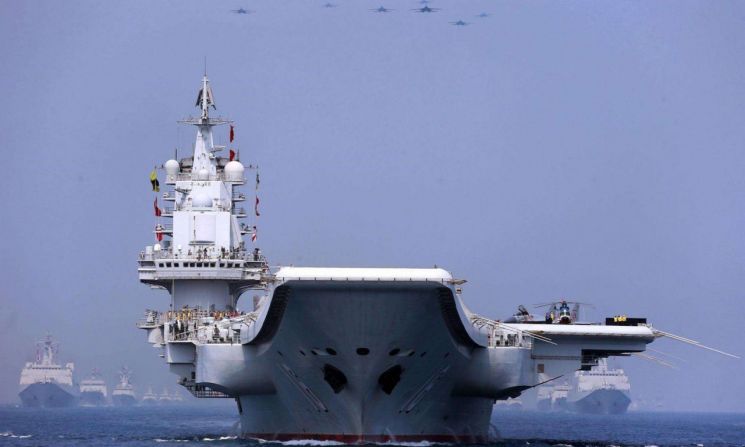
The Chinese government increased its defense budget by 7.1% compared to the previous year to 1.45045 trillion yuan (approximately 289.5 trillion Korean won) this year. China increased its defense budget by 6.6% and 6.8% in 2020 and 2021, respectively. China emphasizes that its defense budget maintains about 1.3% of its Gross Domestic Product (GDP). Chinese authorities explain that this is only about half of the global average of 2.6%. Considering that China's GDP grows every year, the reality is that China's defense budget steadily increases annually.
If China formalizes the establishment of a strategic deterrence system including tactical nuclear weapons, it cannot be ruled out that Western countries such as the United States and Europe will rush to increase their military expenditures. Germany is a representative country in this regard. The German Bundestag approved a special defense fund of 100 billion euros (140 trillion Korean won) in June. With the fund secured, Germany will fulfill its NATO commitment to spend 2% of GDP on defense by 2024.
Japan is also creating an atmosphere to increase its defense budget. Nobuo Kishi, Japan's Cabinet Prime Minister's security advisor, stated in an interview with Japan's Yomiuri Shimbun last month that Japan should allocate more than 2% of its GDP to defense spending. Advisor Kishi mentioned China, Russia, and North Korea, arguing that Japan must spend more than 2% of its GDP on defense to complete its defense capabilities, thus fueling the push for increased defense spending.
© The Asia Business Daily(www.asiae.co.kr). All rights reserved.


















