Ministry of Science and ICT Emphasized Importance of Data Centers
But Internet Industry Opposition and Legal System Deficiencies Cause Setback
Atmosphere Changes After Pangyo Data Center Fire
Calls for Strengthened Data Center Management and Security Raised
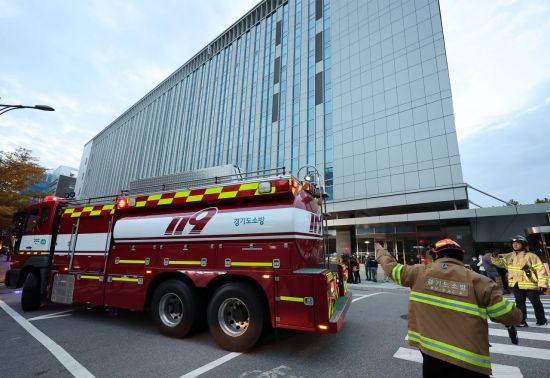 On the afternoon of the 15th, firefighters were busy moving around Building A of the SK Pangyo Campus in Sampyeong-dong, Bundang-gu, Seongnam-si, Gyeonggi Province, where a fire broke out. [Image source=Yonhap News]
[Asia Economy Reporter Cha Min-young] The so-called 'Data Center Act (Amendment to the Basic Act on Broadcasting and Communications Development),' which was shelved at the threshold of the 20th National Assembly's Legislation and Judiciary Committee in 2020 due to the Kakao outage caused by the fire at the Pangyo data center, is gaining attention again. The need to strengthen security management for data centers, which was previously shelved due to opposition from the internet industry over 'double regulation' and criticisms of an inadequate legal framework, is being raised once more.
A data center is a storage facility that stores, manages, and processes data. It is classified into three types: for self-use, rental, and lease, with most being used through rental or lease. Among domestic content providers (CPs), Naver, which established a center in Chuncheon in 2014, is almost the only case using its own data center. In the recent case of Kakao, damage occurred due to a fire while renting a data center from SK C&C.
The amendment focuses on designating private Internet Data Centers (IDCs) as national disaster management facilities, similar to broadcasting and communication facilities, under the national broadcasting and communication disaster management basic plan. It aims to allow the government to conduct equipment reporting and inspections according to standards set by the government.
The internet industry, which opposed the amendment, argued that it is unfair for private businesses building data centers to be subject to the same regulations as licensed telecommunications operators or broadcasters. There were even concerns that the government might inspect data contained in IDCs. Fears of reverse discrimination against foreign companies such as Amazon Web Services (AWS) and Google were also raised.
Criticism of double regulation was also voiced in the National Assembly. Large domestic IDCs are already designated as 'major information and communication facilities' under the Information and Communications Infrastructure Protection Act and are managed accordingly, so it was argued that regulation under the Infrastructure Protection Act or the Information and Communications Network Act would suffice.
At the time, Choi Ki-young, Minister of Science and ICT, explained at the Legislation and Judiciary Committee, "Data centers are a vital issue for the public as their disruption during disasters can cause enormous damage to people's lives," and added, "How to quickly recover and prepare for disasters is included in the Basic Act on Broadcasting and Communications Development, so it is not redundant." However, the committee did not accept this, mindful of opposition from private small and medium-sized businesses.
However, following this incident, voices calling for strengthened security inspections of data centers are emerging, and the atmosphere seems to be shifting. A Ministry of Science and ICT official said, "We expect the bill to be reintroduced following the Kakao outage incident," adding, "Since the legal framework was pointed out as insufficient regarding access by general CPs who are tenants of data centers at that time, legislation should be carried out to supplement this."
© The Asia Business Daily(www.asiae.co.kr). All rights reserved.

















