Increase in Market Size Due to COVID-19 Contactless Consumption Growth and Hallyu
[Asia Economy Reporter Jeon Jin-young] The so-called "reverse direct purchase" (reverse direct buying), where overseas consumers buy products from domestic online shopping malls, surpassed 40 million transactions last year. This is the highest record since the start of reverse direct buying. The related market appears to have grown rapidly thanks to the increase in non-face-to-face consumption due to COVID-19 and the popularity of the Korean Wave.
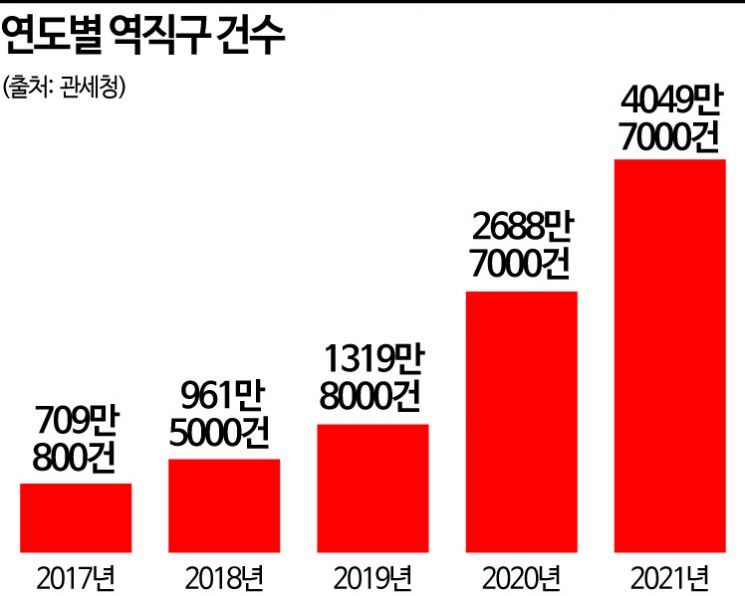
According to data submitted by the Korea Customs Service to Han Byung-do, a member of the National Assembly's Planning and Finance Committee from the Democratic Party of Korea, the number of overseas reverse direct purchase transactions last year was 40.497 million. This is an increase of 13.61 million transactions (50.6%) compared to the previous year (26.887 million transactions).
The annual number of reverse direct purchase transactions has been increasing every year, from 7.098 million in 2017 to 9.615 million in 2018, 13.198 million in 2019, and 26.887 million in 2020. By product category, cosmetics accounted for the highest proportion, ranking first among the top reverse direct purchase items for five consecutive years. Following that were clothing and electronic devices.
The activation of reverse direct buying is analyzed to be influenced by the increase in non-face-to-face consumption caused by the COVID-19 situation, which blocked overseas travel, and the "Korean Wave" driven by the popularity of Korean dramas. In fact, many countries where reverse direct buying is active are in Asia, where Korean dramas and other content are popular. By country, Japan had the highest number with 20.748 million transactions, followed by China (6.857 million), Singapore (3.461 million), and the United States (2.193 million).
As a result, the scale of individual direct purchases is also increasing. Among users who directly purchased overseas goods for personal consumption, the top 20 individuals had an average monthly purchase frequency of 101 transactions and a purchase amount of $6,269 last year, which exceeded 106 transactions and $13,194,000 by September this year.
The duty-free industry views reverse direct buying as a new lifeline amid the stagnation caused by COVID-19. Lotte Duty Free opened a reverse direct purchase section in June, selling products from over 220 brands to consumers in nine countries including the United States, Japan, China, and Singapore, providing services to the largest number of countries. Shinsegae Duty Free also sells about 3,000 products and partnered with an Alibaba subsidiary for delivery within China. Shilla Duty Free has also started reverse direct purchase services targeting China.
An industry official said, "The industry is facing difficulties due to unresolved restrictions in China and persistent high exchange rates," adding, "Considering the reliability of Korean duty-free shops, product and price competitiveness, it is expected that they can gain an advantage in the direct purchase market."
© The Asia Business Daily(www.asiae.co.kr). All rights reserved.
![Clutching a Stolen Dior Bag, Saying "I Hate Being Poor but Real"... The Grotesque Con of a "Human Knockoff" [Slate]](https://cwcontent.asiae.co.kr/asiaresize/183/2026021902243444107_1771435474.jpg)
















