Egypt Government Restricts Dollar Usage and Raises Import Barriers
Leading to Shortages in Food and Medicine Supplies
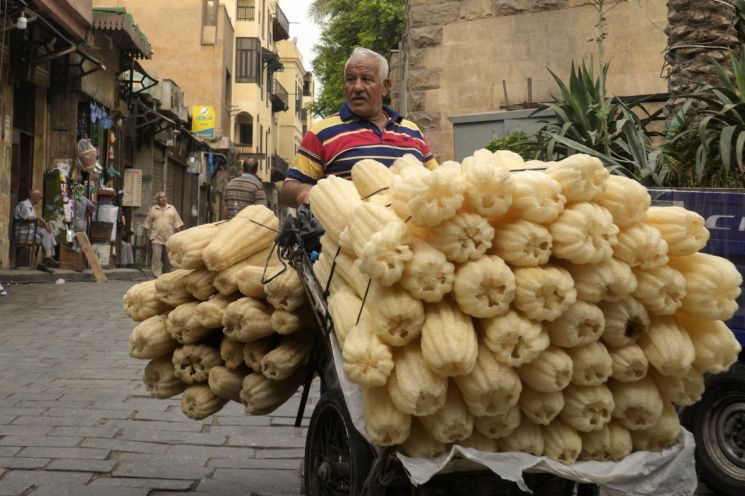 A merchant is selling loofahs in Cairo, Egypt, on the 8th of last month (local time). Photo by AP Yonhap News
[Asia Economy Reporter Hwang Sumi] The possibility of an economic recession is increasing in emerging countries with high dollar dependence. This is due to the continued strength of the US dollar, which has raised import prices and steadily increased the proportion of dollar-denominated debt.
The Egyptian government has restricted the use of dollars to defend its foreign exchange reserves. However, it has been criticized for failing to achieve significant results and instead fueling an import crisis.
According to a recent report by the Wall Street Journal (WSJ), the Egyptian government imposed restrictions in March on importers' use of dollars and made it difficult for bank customers to withdraw dollars.
This is a result of increased funding costs due to the US's high-intensity tightening and strong dollar. According to the WSJ, Egypt's foreign debt to be repaid over the coming years amounts to $158 billion (approximately 228 trillion KRW). In particular, dollars are urgently needed to purchase grain and defend the Egyptian pound, the country's currency.
However, the Egyptian government's foreign exchange management policy appears to have little effect. Egypt's foreign exchange reserves decreased from about $41 billion in February to $33 billion in August. The value of the Egyptian pound has fallen by 20% compared to the beginning of the year, and Egypt's inflation rate this year reached 15%, the highest in four years.
Especially, the increased import barriers have led to shortages of supplies such as medicines and foodstuffs. Due to the strong dollar causing global price increases in food and gas, importers are struggling because they lack dollars to use for imports. Ahmed Ali, who runs a pharmacy in Cairo, told the WSJ, "I have to tell customers every day that the medicine they want is not available."
Staple foods for Egyptians, such as bread and pasta, are also under threat. Karim Abu Gali, chairman of the Grain Committee of the Egyptian Industrial Federation, said, "Wheat prices rose by about 20% last month alone, and private companies that did not receive dollar supplies are unable to import, causing a severe blow to the grain industry." The impact of reduced imports seems to be spreading to products such as European kitchenware, French cheese, and American cars.
In response, some importers are demanding rapid dollar supply from the government and are expecting broader measures from the central bank, the WSJ reported.
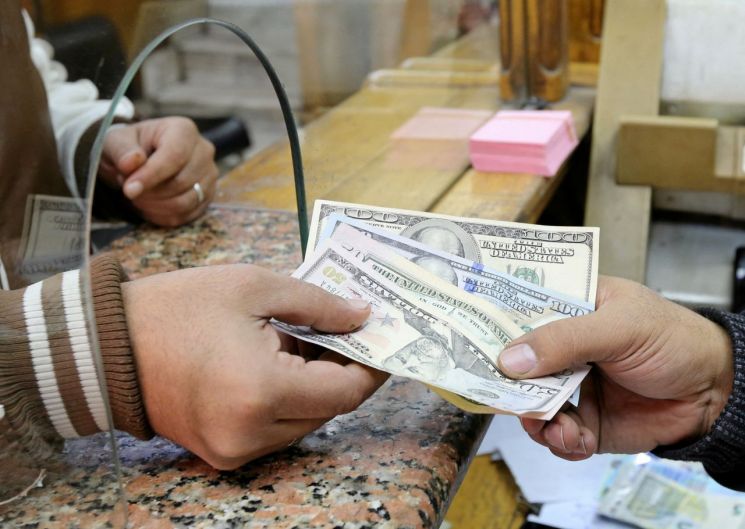 Exchanging US dollars for Egyptian pounds at a currency exchange office in Cairo, Egypt. Photo by Reuters Yonhap News
The Egyptian government is pinning its hopes on additional loans from the International Monetary Fund (IMF). Known as the IMF's second-largest debtor after Argentina, Egypt has been negotiating additional loans since March. If the negotiations are finalized, it is expected to receive a loan of $6 billion (approximately 8.65 trillion KRW).
However, some economic experts criticize that Egypt has already entered a recession due to private sector contraction and an increase in the impoverished population. They point out that Egypt's import problems are further undermining corporate confidence and hitting consumer spending.
Meanwhile, amid soaring energy and food prices caused by the COVID-19 pandemic and Russia's invasion of Ukraine, the continued strength of the dollar is making it difficult for emerging countries to raise funds through private financial markets. As a result, the scale of loans provided by the IMF and the World Bank (WB) to various countries has increased to record levels. Former US Federal Reserve Chairman Ben Bernanke warned on the 10th, "Capital outflows from emerging countries due to the strong dollar and the European energy crisis could lead to a global financial crisis."
© The Asia Business Daily(www.asiae.co.kr). All rights reserved.
![Clutching a Stolen Dior Bag, Saying "I Hate Being Poor but Real"... The Grotesque Con of a "Human Knockoff" [Slate]](https://cwcontent.asiae.co.kr/asiaresize/183/2026021902243444107_1771435474.jpg)

















