Afghan Women Barred from University Entrance Exams in Engineering and Economics
Number of Female Applicants in Laghman Province Drops Sharply from 1,200 to 182
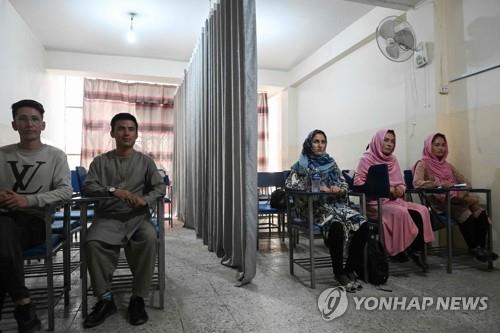 The Taliban, who are ruling Afghanistan, have begun to impose restrictions even on female students' choice of university majors.
 The photo shows Afghan university students attending classes in a gender-segregated classroom. Photo by AFP Yonhap News
[Asia Economy Reporter Kim Hyunjung] The Taliban in Afghanistan, who have been perpetrating severe educational discrimination against women, have now begun to impose restrictions on the choice of majors for women at public universities.
According to the British BBC and others on the 15th (local time), in the recent university entrance exams held in Afghanistan, female candidates were completely barred from applying for certain majors. The majors prohibited for women vary depending on the school and region, but most include engineering, economics, journalism, veterinary medicine, and agriculture. Majors available to women include literature, midwifery, and nursing.
In an interview with the BBC, Fatima (19, pseudonym), a university entrance exam candidate at Nangarhar University in the east, tearfully said, "I went to the exam hall with high hopes, but when I looked at the major selection sheet, I couldn't find the major I wanted." Female students could only choose from 7 out of 13 faculties at Nangarhar University, making it impossible to select majors such as journalism, engineering, and economics. As a result, her dream of becoming a journalist was shattered by the Taliban's new policy. There are some universities where women can major in journalism, but the Taliban divided the country into several regions, and female students are prohibited from studying outside their own region.
Fatima was unable to complete her final year at school after the Taliban took power in August last year and schools were closed. She and her friends had no choice but to prepare for the university entrance exam through group study sessions at home. After much hardship, they heard the news that the Taliban decided to allow girls who were in their final year of school to take the university entrance exam, but the joy was short-lived. She said, "My dream was to become a TV or radio reporter, but now I want to fight for women's rights."
Abdul Qadir Kamush, head of the examination department at the Taliban government's Ministry of Higher Education, told the BBC, "Female students can choose their desired major except for 3 to 4, and since separate classes must be provided for women, in some regions where there are few female applicants, women were not allowed to apply for certain courses."
This year in Afghanistan, it is estimated that 100,000 students, including 30,000 women, took the university entrance exam. Generally, it takes 2 to 3 months for the exam results to be announced, but since the Taliban took power, even that timeline is uncertain. The exams were conducted by separating students by gender according to Taliban rules, with male and female students taking exams at different times, and in some provinces with many applicants, the exams were held over 2 to 3 days.
Human rights activists believe that unless the Taliban reopen secondary schools for female students in grades 6 to 12, the number of female applicants to universities will dramatically decrease in the future. In fact, in Laghman Province, about 1,200 students took the university entrance exam last year, but this year the number dropped to 182.
The issue of women's human rights in Afghanistan has been a serious concern for the international community for decades, but it has worsened significantly since the Taliban took power. Although the Taliban initially promised to respect women's rights, in reality, since September last year, only male students have been allowed to attend secondary schools, and some universities have implemented gender-segregated classes. They have also abolished the Ministry of Women’s Affairs and reinstated the morality police enforcing strict Sharia law, actions that contradict their initial promises.
© The Asia Business Daily(www.asiae.co.kr). All rights reserved.
![Clutching a Stolen Dior Bag, Saying "I Hate Being Poor but Real"... The Grotesque Con of a "Human Knockoff" [Slate]](https://cwcontent.asiae.co.kr/asiaresize/183/2026021902243444107_1771435474.jpg)
















