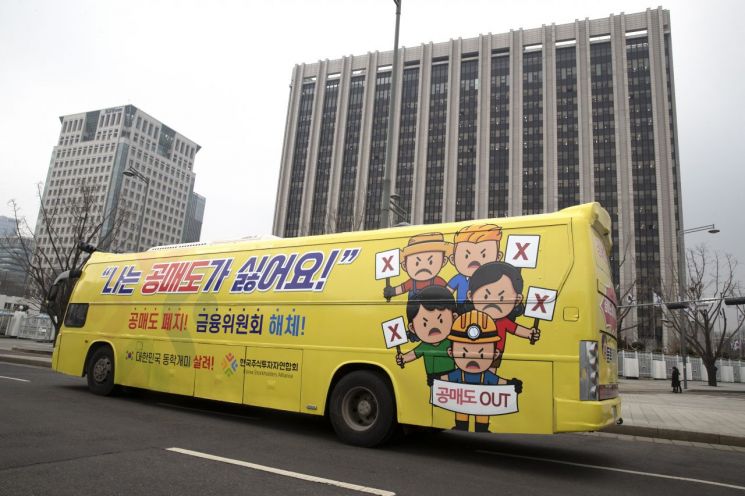
[Asia Economy Reporter Lee Seon-ae] Following the release of the September Consumer Price Index (CPI), an unusual rollercoaster trend in the U.S. stock market has been attributed to short-sellers covering their positions, intensifying calls in Korea to ban short selling.
According to the Korea Exchange on the 15th, the average daily short selling transaction value has surged this month. The average daily short selling transaction value on the KOSPI reached approximately 574 billion KRW (as of the 12th), marking about a 17% increase compared to last month’s 490.7 billion KRW. Compared to August’s 349.4 billion KRW, it has risen sharply by about 64%. During this summer’s "bear market rally" period, it remained in the mid-300 billion KRW range but has surged further as the market has taken on a more pronounced downward trend.
As a result, individual investors’ concerns that the increase in short selling is exacerbating the already unstable market risks are reaching new heights. Moreover, analyses suggesting that the rollercoaster movement in the U.S. stock market after the CPI announcement was due to short sellers covering their positions have amplified demands for a short selling ban.
On the 13th (local time), the New York Stock Exchange plunged sharply after the CPI exceeded expectations but then rebounded rapidly, ultimately closing higher after a rollercoaster session. The Dow Jones Industrial Average fluctuated about 1,400 points intraday, and the S&P 500 experienced its largest daily volatility since March 2020. This is a highly unusual phenomenon. Bloomberg analyzed that the sharp rebound and eventual surge in the U.S. stock market were due to short sellers hastily covering their short positions. Short selling is a trading technique where investors borrow shares of stocks expected to decline in price, sell them, and then repurchase them at a lower price to return the borrowed shares, profiting from the difference. Matt Maley, Chief Market Strategist at Miller Tabak, said, "Too many investors expected a crash immediately after the CPI release, and when the bottom was not visible, short sellers panicked." He added, "In such a situation, when the market suddenly rebounded sharply, short sellers had to cover their shorts to limit losses, which fueled the rally." Bloomberg also reported that the "Goldman Sachs Short Selling Basket," composed of stocks with the highest short interest, fell 5.4% that day but eventually closed up 1.4%.
Experts advise caution when investing in stocks with increased short selling. Analyses indicate that stocks targeted by short sellers are often those whose earnings outlooks do not support their current prices. According to Eugene Investment & Securities, among listed companies with a market capitalization of over 1 trillion KRW as of the end of last month, the 30 stocks with the highest cumulative short selling balances underperformed the KOSPI by 5 percentage points over 3 to 6 months. Researcher Kang Song-cheol of Eugene Investment & Securities explained, "Reasons for accumulating short selling include high valuations and concerns over intensified industry competition," adding, "It could also be due to specific negative factors related to the companies."
KB Securities forecasted that if a short selling ban is implemented, some stocks might rise due to short covering, where short sellers buy back shares to close their positions. They advised focusing on stocks with a high proportion of short selling in trading and a large balance of loaned shares. Researcher Kim Min-gyu of KB Securities said, "Looking back at past cases, there is no clear evidence that banning short selling stopped the stock market decline," but added, "From an individual stock perspective, it is necessary to prepare for short covering candidates in advance." He explained, "Although short covering often accompanies stock price increases, the timing of profits varied. In 2011, profits occurred within the first week after the short selling ban, and in 2020, high returns were seen after one month. Based on these two cases, buying stocks with high loan balances and active short selling at the time of the ban and waiting for the first month of short covering is advisable." However, he added, "In the 2008 case, if the market continued to decline after the short selling ban, short covering did not translate into profits."
Stocks with high short covering potential include LG Innotek, OCI, S-1 Corporation, KEPCO Engineering & Construction, GS Engineering & Construction, LS ELECTRIC, SK Chemicals, DL, and GKL. On the KOSDAQ, EcoPro BM, L&F, JYP Entertainment, Alteogen, and Paradise were suggested. These were selected by comparing the proportion of short selling in trading and the balance of loaned shares expected to be returned.
© The Asia Business Daily(www.asiae.co.kr). All rights reserved.

















