Some States and Cities Push to Abolish Exemptions...Strong Opposition from Employers
42 States in the U.S. Pay Restaurant Workers Less Than the Legal Minimum Wage
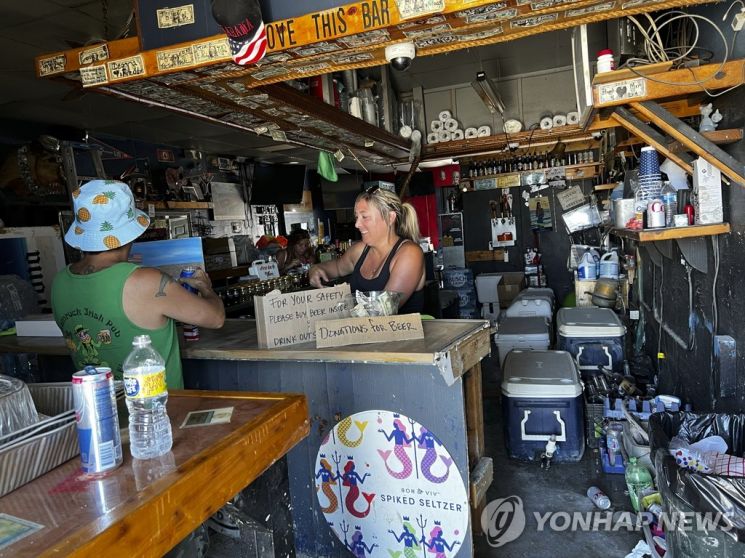 In the United States, where tipping culture exists, there is growing social controversy over whether tips should be included when calculating the minimum wage. The photo is not related to the specific content of the article. Photo by Yonhap News
[Asia Economy Reporter Bang Je-il] One of the unique cultures in the United States is the 'tip.' In the U.S., most waitstaff who take orders and serve food in restaurants make a living primarily from tips received from customers. The tipping culture, which is rare in other countries, constitutes a significant portion of the employees' income. It is not uncommon for waitstaff to earn more from tips than from the wages paid by restaurant owners.
In the U.S., where this tipping culture exists, there is growing social controversy over whether tips should be included when calculating the minimum wage. According to the New York Times (NYT) on the 13th (local time), disputes are ongoing nationwide regarding wage regulations for restaurant waitstaff and bartenders who receive tips from customers.
Currently, in 42 out of the 50 U.S. states, excluding 8 states, employers are allowed to set the base wage for tipped workers below the legal minimum wage. This means that as long as the sum of tips and base wage meets or exceeds the legal minimum wage, it is acceptable.
The NYT cited economists' estimates that at least 5.5 million workers nationwide are subject to this provision, known as the 'tip credit' or 'sub-minimum wage.' The article pointed out that this provision often causes workers to suffer unfair losses. In other words, the tipping culture has a high potential to be a 'poison' to workers in the U.S.
◆ Frequent Cases Where Combined Tips and Base Wage Fall Below Legal Minimum Wage
Especially when business is not doing well, it is common for the combined amount of tips received from customers and the base wage paid by employers to fall below the legal minimum wage.
Employers are obligated to compensate the difference when wages fall below the legal minimum, but in practice, this is often not fulfilled. The NYT also pointed out that it is difficult to track how the money received as tips is handled and distributed.
Terrence Rice, a bartender from Cleveland who has worked in the food service industry since 1999, told the NYT, "In all the time I've been doing this job, I've never met anyone who was compensated that way, not even once."
David Weil, a professor at Brandeis University, told the NYT in an interview, "(The tipping culture and legal minimum wage) revenue structure is inherently like that," adding, "The problem is very serious." He served as the director of the Wage and Hour Division (WHD) of the U.S. Department of Labor from 2014 to early 2017 during the Barack Obama administration.
Due to the problems inherent in the tipping culture, legislative efforts and petitions to abolish this system are emerging in various places. The main obstacle is strong opposition from employers. Especially since both employees and employers faced difficult times during the approximately two years of the COVID-19 pandemic starting in 2020, when customer visits to restaurants decreased, there is a significant gap in opinions between the two sides.
◆ The System Itself Is Unfair to Workers, Employers and Workers Are in Standoff
In Washington, D.C., the U.S. capital, a proposal to abolish the sub-minimum wage for tipped workers by 2027 will be put to a public vote in November this year. In Portland, Maine, a ballot initiative proposes abolishing the sub-minimum wage and raising the regular minimum wage to $18 per hour (about 25,700 KRW) over three years.
In Michigan, the sub-minimum wage for tipped workers will be abolished starting February next year, and the minimum wage will increase from the current $9.87 (about 14,100 KRW) to $12 (about 17,100 KRW) per hour. An employee of a food service company in Michigan said, "When thinking about what positive impact this measure could potentially have on us, I can't predict anything."
In New York State, since 2019, car washers, hairdressers, and nail salon workers have been excluded from the sub-minimum wage provision. However, it still applies to restaurant and bar workers.
Some progressive state legislators are working hard to draft bills aiming to abolish this system by the end of 2025, but bill submission is still distant. Democratic Governor Kathy Hochul has not clearly stated her position on the issue.
Employers who pay sub-minimum wages to tipped workers must meet quite strict work condition requirements according to regulations. However, the NYT reported that inspections or audits to ensure compliance with these regulations are rarely conducted.
According to a 2012 U.S. Department of Labor survey, 83.8% of the surveyed food service establishments had labor law violations, with a large portion related to tips.
The National Restaurant Association (NRA), representing about 500,000 restaurants nationwide, argued that while there are cases of employers illegally underpaying tipped workers, these cases are exaggerated, and the current system generally works well.
Ryan Steig, a labor law specialist attorney at Centurion Trial Attorneys in San Diego, California, pointed out, "The legal regulations applied to tipped workers are so ambiguous that even well-intentioned employers can make mistakes." He added, "The system itself is unfairly structured against workers, and you have to sacrifice your tips to fulfill the employer's minimum wage payment obligations."
© The Asia Business Daily(www.asiae.co.kr). All rights reserved.

















