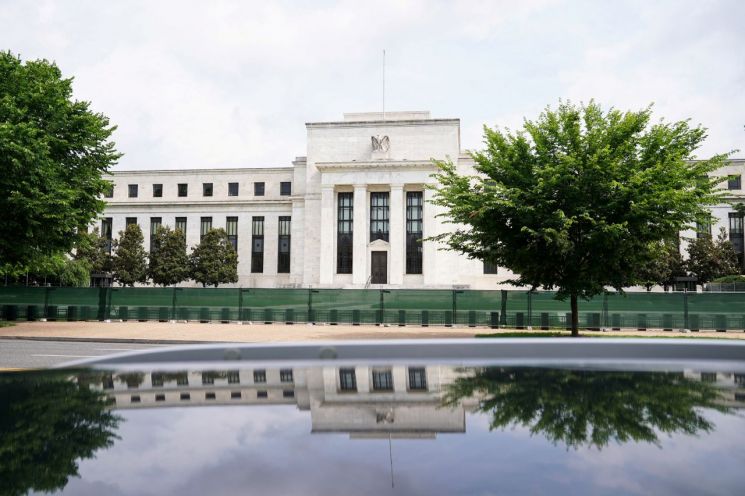
[Asia Economy New York=Special Correspondent Joselgina] Despite consecutive tightening measures, the U.S. core Consumer Price Index (CPI) rose at the fastest pace in 40 years, leading to forecasts that the central bank, the Federal Reserve (Fed), may raise the benchmark interest rate to the 5% range. This is an extraordinary measure to prevent entrenched high inflation.
On the 13th (local time), investment bank Barclays raised its U.S. interest rate forecast to 5.0-5.25% in February next year through an investor note following the September CPI announcement, stating, "More aggressive and preemptive Fed rate hikes may continue." This is 2.0 percentage points higher than the current rate (3.0-3.25%). Previously, the upper bound of next year's rate forecast revealed by the Fed's dot plot was 4.6%.
According to the Chicago Mercantile Exchange (CME) FedWatch, traders in the federal funds (FF) futures market are pricing in a 38.8% chance that rates will rise to the 5% level by March next year. This figure surged sharply from 6.1% the previous day. Tom Di Galloma, Executive Director at Seaport Global Holdings, acknowledged the possibility of rates reaching the 5% range and expressed concern that "it could be a negative factor for the economy."
In this process, there is also talk of a 1.0 percentage point rate hike in November or five consecutive giant steps (0.75 percentage point rate hikes) through December. Currently, the futures market reflects over 97% and 66% probabilities for giant steps in November and December, respectively. In this case, with five consecutive giant steps, U.S. interest rates would rise to 4.5-4.75% by the end of this year. Along with this, the futures market saw the reappearance of a 2.9% chance of a 1.0 percentage point hike in November, which had been 0% until the previous day, as expectations for a Fed pivot (policy shift) faded.
The sharp rise in tightening concerns is largely due to persistently high inflation. According to the U.S. Department of Labor, the September CPI rose 8.2% year-on-year and 0.4% month-on-month, exceeding market expectations. In particular, the core CPI excluding energy and food surged 6.6% compared to a year ago, marking the highest level since August 1982. Additionally, robust labor market indicators such as the unemployment claims released that day add weight to the Fed's future tightening stance.
Meanwhile, the International Monetary Fund (IMF), which recently lowered its growth forecast, supported the tightening moves by central banks including the Fed despite concerns over economic slowdown. Kristalina Georgieva, Managing Director, stated that day, "We cannot let inflation become a runaway train," and emphasized, "Central banks must take action." She pointed out, "While rate hikes come at a cost to growth, failing to tighten enough to control inflation causes greater damage to growth."
© The Asia Business Daily(www.asiae.co.kr). All rights reserved.

















