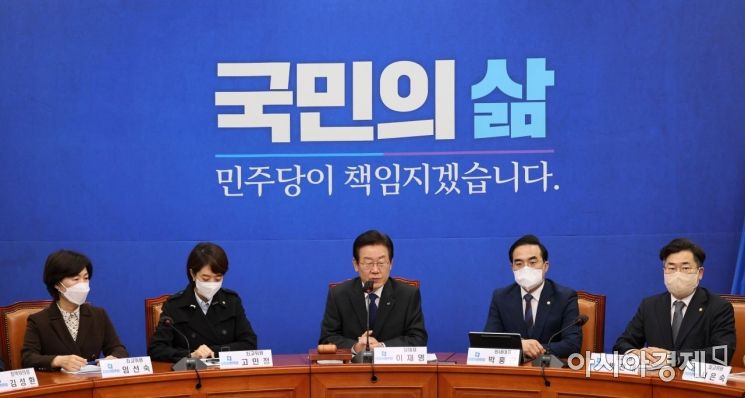
 Lee Jae-myung, leader of the Democratic Party of Korea, is attending the Supreme Council meeting held at the National Assembly on the 14th and delivering an opening remark. Photo by Yoon Dong-joo doso7@
[Asia Economy Reporter Lim Hye-seon] As the conflict over mandatory internet network usage fees escalates into a full-scale confrontation between domestic Internet Service Providers (ISPs) and overseas Content Providers (CPs) such as Google, the opposition party is stepping in to mediate. The Democratic Party of Korea has decided to push forward legislation mandating network usage fees and has begun behind-the-scenes efforts to make it a party consensus.
Opposition Holds Closed Meeting on 'Network Usage Fee Law'
According to a key National Assembly official on the 14th, Park Hong-geun, the floor leader of the Democratic Party, held a closed meeting on the 12th regarding bills related to 'network usage fees.' Attendees included Cho Seung-rae, the opposition party's ranking member of the Science, Technology, Broadcasting and Communications Committee; Ahn Jeong-sang, senior expert of the Democratic Party; Kim Seong-hwan, chairman of the Policy Committee; and Kim Byung-wook, senior vice chairman of the Policy Committee. Park Hong-geun presided over the meeting because there were divided opinions within the party on the controversial mandatory network usage fee bill, and he deemed it necessary to organize these views.
Currently, seven amendments to the Telecommunications Business Act have been proposed in the National Assembly, aiming to impose network usage fees on content providers with high data usage such as Google (YouTube) and Netflix. Domestic telecom companies have demanded legislation for years, claiming that "Google and Netflix are free-riding by not paying fair network usage fees." If the bill passes, Google and Netflix, which have so far refused to pay network usage fees, will be required to pay telecom companies. Overseas content providers worry that paying network usage fees will lead to increased costs and a decline in service quality.
During the meeting, it was agreed to pursue legislation mandating network usage fees while minimizing harm to small content providers and creators. A National Assembly official said, "We are looking for ways to minimize damage to content providers without undermining the purpose of the mandatory network usage fee bill," adding, "We are also considering a method where telecom companies that collect network usage fees establish a fund to support small content providers and creators." It is known that the meeting participants plan to organize the related matters through the Policy Committee and then discuss them with party leader Lee Jae-myung.
Party Leader Lee Jae-myung Points Out "Seems Problematic," Sparking Internal Conflict
Until August this year, legislation mandating network usage fees was effectively a party consensus. This is because pushing for mandatory network usage fees was a campaign pledge of party leader Lee Jae-myung during his presidential candidacy and one of the Democratic Party's 22nd National Assembly livelihood legislative tasks. However, the atmosphere changed after Lee Jae-myung pointed out on Twitter that "there seem to be problems with the network usage fee law." Furthermore, public opinion worsened as over 250,000 people signed a petition opposing the network usage fee legislation, prompting both ruling and opposition parties to adopt a cautious stance. In particular, the Democratic Party is experiencing a situation where even Jeong Cheong-rae, chairman of the Culture, Sports and Tourism Committee, has expressed opposition, leading to a tense atmosphere among lawmakers.
The Ministry of Culture, Sports and Tourism and the Culture, Sports and Tourism Committee have also expressed opinions that the legislation could increase burdens on content creators, emphasizing the need for thorough consultation.
The public relations battle between telecom companies and overseas content providers is intensifying. Google has pointed out issues with the mandatory network usage fee law through YouTube, and Twitch, a game streaming platform operated by Amazon in the U.S., lowered the video quality of its service in South Korea from 1080p (Full HD) to 720p (HD) on the 30th of last month, citing "increased operating costs in South Korea" as the reason. As public opinion grew that telecom companies would unfairly collect network usage fees at the expense of consumers, telecom companies also launched a joint response.
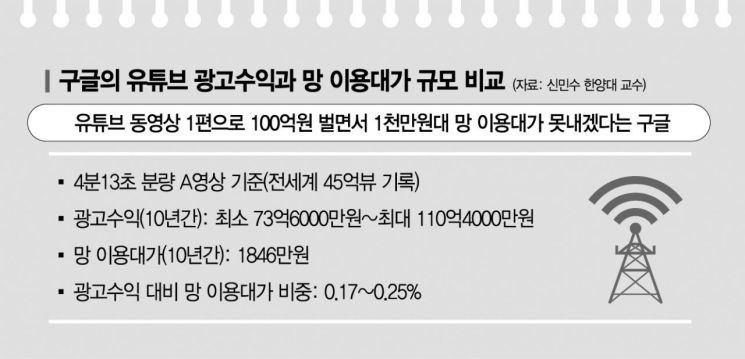
Telecom companies claim that Google's recent suggestion that it might change its business operations in Korea regarding network usage fees is a ploy to avoid paying fees by holding YouTubers hostage. They estimated that Google earned advertising revenue of 7.4 billion to 11 billion KRW over 10 years from a domestic YouTube hit video (4.5 billion views), while the network usage fee paid was only 18.48 million KRW. This amounts to just 0.17% to 0.25% of Google's advertising revenue. Google accounts for 27.1% of total domestic traffic, and Netflix accounts for 7.2%.
A National Assembly official said, "Google's behavior has been significantly distorted, and we are considering how to resolve misunderstandings," adding, "It will not be easy to proceed quickly, but we are carefully examining the issue to ensure that the public does not suffer any harm."
© The Asia Business Daily(www.asiae.co.kr). All rights reserved.


















