Thinner Retinal Nerve Fiber Layer and Fewer Teeth Increase Dementia Risk
Higher Risk of Macular Degeneration and Alzheimer's Disease
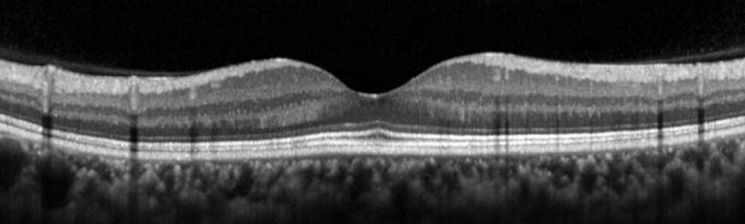 Optical coherence tomography images precisely analyzing retinal thickness. Researchers at Bundang Seoul National University Hospital confirmed that the thinner the retinal nerve fiber layer thickness, the higher the risk of developing cognitive impairment in the future.
 [Photo by Bundang Seoul National University Hospital]
Currently, dementia research is broadly conducted within three frameworks: identifying causes and mechanisms, prediction and prevention, and diagnosis and treatment. Identifying the causes of dementia is the fundamental starting point for discovering effective treatments, and the development of diagnostic technologies helps accelerate the timing of treatment by quickly identifying patients, thereby preventing the progression of dementia. In terms of treatment, active efforts are underway, including cognitive intervention therapy and drug development.
However, experts unanimously emphasize the importance of "prevention" in responding to dementia. Since the factors causing dementia are so diverse, there is a need to manage them in advance through healthy lifestyle habits. While the importance of sleep and exercise is already widely recognized, research confirming the correlation between various diseases and dementia and utilizing them as predictive factors is actively being conducted in the medical field. Recently, domestic researchers have also presented noteworthy research results on this topic.
"Eye Health Closely Linked to Dementia"
One of the body organs recently gaining attention in the medical community for its association with dementia is the eye. The eye is connected to the brain via the optic nerve and is often called the "window to the mind." Research is actively being conducted not only on the correlation between certain eye diseases and dementia but also on identifying factors in the eye that can predict dementia risk.
Recently, a domestic research team released notable findings. Professor Woo Se-jun from the Department of Ophthalmology and Professor Kim Ki-woong from the Department of Psychiatry at Bundang Seoul National University Hospital revealed through a large-scale study that the thinner the thickness of the retinal nerve fiber layer in the macula, the higher the risk of future cognitive impairment. The retina is the innermost layer of nerve cells in the eye that detects light, processes visual information, and transmits it to the brain. The research team measured the initial retinal thickness of 430 elderly individuals and analyzed differences in cognitive test results over five years according to retinal thickness.
The results showed that when the thickness of the nerve fiber layer in the retina was in the lowest 25% (231㎛ or less), the probability of developing dementia was about five times higher. Professor Woo explained, "We have demonstrated that measuring the thickness of the macular nerve fiber layer can predict the risk of cognitive impairment based on this measurement."
Additionally, research has shown that being diagnosed with macular degeneration increases the risk of Alzheimer's and Parkinson's diseases. Macular degeneration is a degenerative disease occurring in the macula (the center of the retina) that causes vision loss.
Professor Ji Dong-hyun's team from the Department of Ophthalmology at The Catholic University of Korea St. Vincent's Hospital analyzed data from 300,000 adults aged 50 and older in Korea and found that patients diagnosed with macular degeneration had a 1.48 times higher risk of developing Alzheimer's disease and a 1.46 times higher risk of developing Parkinson's disease compared to the general population. Professor Ji emphasized, "Patients diagnosed with macular degeneration have a higher risk of Alzheimer's and Parkinson's diseases regardless of lifestyle habits. Such patients should not neglect regular check-ups with this in mind."
Tooth Loss Also Increases Dementia Risk
Alongside the eyes, teeth are also gaining attention for their association with dementia. Reduced chewing ability can lead to poor nutrient absorption, and chronic periodontitis can cause damage to the central nervous system.
Recently, research has gone a step further, showing that elderly individuals who neglect tooth loss have an increased risk of developing dementia. A research team led by Professors Cha Jae-guk, Park Jin-young, and Ko Kyung-ah from Yonsei University College of Dentistry investigated the correlation between tooth loss and dementia occurrence in 488 patients aged 60 and older. They found that the rate of neglected tooth loss in the dementia group was 56.48%, nearly 14 percentage points higher than in the control group.
Professor Cha explained the significance of this study, saying, "Teeth are easily lost with aging, but if neglected, it becomes difficult to chew food properly, which can increase the risk of dementia. Maintaining chewing ability through treatments such as implants and prosthetics is important for dementia prevention."
© The Asia Business Daily(www.asiae.co.kr). All rights reserved.

















