Global TV Sales Hit Lowest Since 2010
Only Large OLEDs Thrive Amid Panel Supply and High-Definition TV Demand
Samsung-LG OLED Panel Collaboration Talks Raised
[Asia Economy Reporter Han Yeju] Amid the global slowdown in TV demand, the market for ultra-large organic light-emitting diode (OLED) TVs of 70 inches and above is drawing attention for its "solo growth." This is due to increasing demand for high-definition large screens in North America, the largest TV market. Next year, not only LG Display but also Samsung Display is expected to produce 70-inch OLED panels, signaling an intense competition between Samsung Electronics and LG Electronics.
According to market research firm Omdia on the 13th, global TV sales in the first half of this year totaled 92.6 million units, down 6.6% compared to the same period last year. The sales revenue was $47.5 billion (67.78 trillion KRW), a 12.5% decrease from the previous year. This decline is greater than Omdia's earlier estimate in March, which projected a 2.2% drop in global TV shipments this year compared to last year. TV sales this year are expected to be the lowest since 2010.
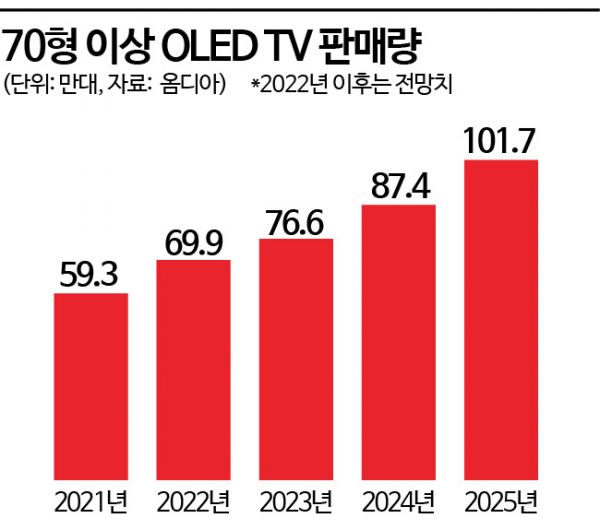
On the other hand, due to increased panel supply and expanding demand for high-definition TV viewing, the ultra-large OLED TV market is expected to thrive alone. Sales of 70-inch and larger ultra-large OLED TVs are estimated to reach 699,000 units this year, a 17.9% increase from last year's 593,000 units. Omdia forecasts that sales of ultra-large OLED TVs will continue to grow annually and exceed 1 million units by 2025.
In fact, in the North American region, OLED TVs sized over 65 inches, especially 77-inch models, are becoming the mainstream trend. While the absolute sales volume is higher for 65-inch TVs, 77-inch TVs have recently shown a high sales growth rate. In the North American market last year, sales of 70-79 inch OLED TVs (241,500 units) surged vertically by 160% compared to the previous year, recording a significant growth rate.
Baek Seonpil, Executive Director in charge of TV CX (Customer Experience) at LG Electronics' HE (Home Entertainment) Business Division, said, "Although 65-inch OLED TVs still sell the most, looking at this year, the sales growth rate of 77-inch OLED TVs is the highest," adding, "It can be interpreted that the mainstream size is shifting to 77 inches."
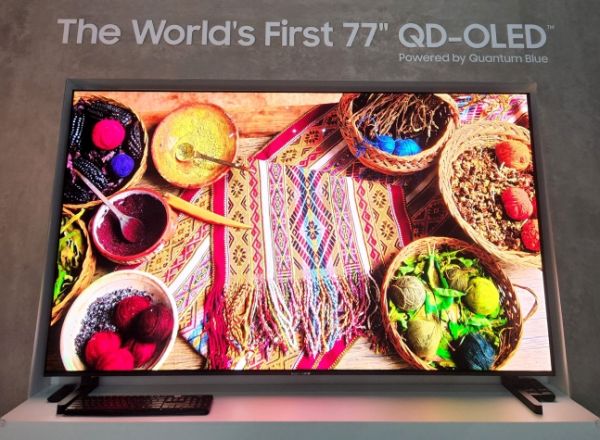
Currently, LG Display is the only company producing ultra-large OLED TV panels of 70 inches and above. Samsung Electronics receives OLED panels for TVs only from its display subsidiary, Samsung Display, but the supply has not been sufficient to enable meaningful sales. However, Samsung Display has announced plans to supply 77-inch panels starting next year, suggesting that healthy competition will continue to expand the market share. There is also talk that the world's largest IT exhibition, CES in the United States, held in January next year, would be an ideal venue for Samsung Electronics to introduce TVs using these panels to the North American market.
In this process, discussions on panel supply with LG Display, which had been halted, are being raised again. This is because if Samsung Electronics wants to expand its OLED TV lineup to 77 inches, relying solely on Samsung Display for panels may result in insufficient quantities. Han Jonghee, Vice Chairman and Head of Samsung Electronics' DX (Device Experience) Division, said at IFA 2022, the world's largest consumer electronics show held in Germany in early September, "We naturally need to increase QD display production capacity, and if consumers want and seek it, we can also strengthen the lineup," adding, "(Negotiations with LG Display) are always being looked at with an open mind, so we will inform you once a decision is made."
LG Display is also looking forward to collaboration with Samsung Electronics. Cooperation with Samsung Electronics, the world's number one, is expected to be a great help not only in terms of panel shipment volume but also profitability. LG Display, which has increased related facility investments in Paju, Korea, and Guangzhou, China, plans to produce more than 1 million ultra-large OLED panels of 70 inches and above this year, a 60% increase compared to the previous year.
An industry insider said, "As supply increases, the average price of OLED TVs is falling. Accordingly, more customers are choosing OLED over liquid crystal display (LCD) TVs," adding, "Demand to watch online video service (OTT) content on high-definition large screens is also increasing, so the ultra-large OLED TV market will continue to grow."
© The Asia Business Daily(www.asiae.co.kr). All rights reserved.


















