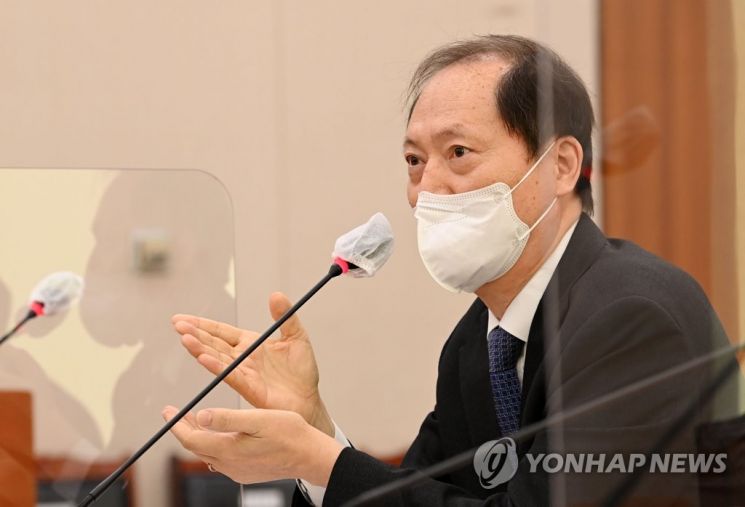
 Lee Wankyu, the head of the Ministry of Legislation, is responding to a lawmaker's question during the National Assembly Legislation and Judiciary Committee's audit of the Ministry of Legislation held on the morning of the 13th.
[Asia Economy Reporter Choi Seok-jin, Legal Affairs Specialist] Lee Wan-gyu, head of the Ministry of Legislation, reiterated his position that the enforcement decree known as 'Geomsuwonbok' (restoration of the prosecution's investigative authority) ? specifically, the 'Regulations on the Scope of Crimes for Prosecutors to Initiate Investigations' (Presidential Decree) and the enforcement decree establishing the Police Bureau within the Ministry of the Interior and Safety ? are legally sound as they are based on legal delegation.
On the morning of the 13th, during the National Assembly Legislation and Judiciary Committee's audit of the Ministry of Legislation, Lee responded in this manner to opposition lawmakers' questions criticizing the Yoon Seok-yeol administration's 'enforcement decree politics.'
On that day, Park Beom-gye, a member of the Democratic Party of Korea, pointed out, "A new government can pursue different policies, but it must not enact policies that override the Constitution and laws," adding, "After the enactment of the 'Geomsuwanbak' law, the Ministry of Justice, through the active unconstitutional interpretations and reviews by Minister Han Dong-hoon and Lee Wan-gyu of the Ministry of Legislation, included so-called abuse of power crimes and election crimes under corruption crimes."
In response, Lee said, "I cannot agree with the member's assertion that the Ministry of Justice's or my interpretation of this presidential decree is unconstitutional," and countered, "Because, in my view, it is very consistent with the Constitution and laws."
Lee explained, "When the prosecution's investigative authority was defined in 2020, a provision was created in the Prosecutors' Office Act delegating authority to the presidential decree. Ultimately, the specific types of crimes had to be determined by presidential decree," adding, "When delegating authority, specific criteria should have been set so that the general public could clearly understand it. However, terms like economic crimes and corruption crimes were used as broad concepts, making it impossible to know what crimes fall under economic crimes. This issue has not yet been resolved."
He stated, "According to the principle of legality in criminal procedure, essential matters related to citizens' fundamental rights must be stipulated by law. The investigative subject and scope must be determined by laws enacted by the National Assembly, which is the principle of parliamentary reservation," and said, "I believe the members did not consider broad delegation."
The current Article 4(1)(1)(a) of the Prosecutors' Office Act, amended under the leadership of the Democratic Party, stipulates that prosecutors may initiate investigations into "important crimes such as corruption crimes and economic crimes as determined by presidential decree."
Previously, the law included "corruption crimes, economic crimes, public official crimes, election crimes, defense business crimes, large-scale disasters, and other important crimes as determined by presidential decree," but it deleted the four categories of public official crimes, election crimes, defense business crimes, and large-scale disasters, while retaining the phrase delegating the specific types of crimes to presidential decree as "important crimes as determined by presidential decree."
Because the Prosecutors' Office Act itself delegates the determination of specific types of crimes that prosecutors may initiate investigations into to presidential decree, regardless of before or after the amendment, Lee's position is that whether the government increases or decreases the crimes prosecutors can investigate through revising the presidential decree, it is a lawful action based on legal delegation.
Democratic Party lawmaker Park Joo-min pointed out, "Considering the legislative purpose of the amended law and the statements of the Speaker of the National Assembly at the time of the proposal, the legislator's intent and purpose were to reduce the scope of direct prosecution by the prosecution," and said, "Then the enforcement decree should be made in a way that respects that."
When Lee responded, "The intentions of the members when the legislation was promoted are not necessarily those of the legislators. The thoughts of Democratic Party lawmakers when promoting legislation are not the legislators' intent," Park pressed, "I don't understand. Then, if the National Assembly voted and Democratic Party lawmakers met the quorum and passed it, does that mean it is not the legislator's intent? If only one party participates and passes it, does that mean it is not the legislator's intent?"
Lee replied, "That's not the case. If you look at the legislative process until the decision, the bill initially proposed by the Democratic Party was to completely eliminate the prosecution's investigative authority," adding, "The final conclusion was not that."
Park asked, "You cannot create purposes contrary to the legislative intent in the enforcement decree, can you?"
Lee answered, "It's a misunderstanding of legislative technique. Initially, the plan was to completely eliminate the prosecution's investigative authority, but the opposing party opposed it, and there was also much public opposition," adding, "Through that process, discussions resumed, and so-called supplementary investigative authority was recognized, and regarding investigative initiation rights, two out of six categories were left. Ultimately, an agreement was reached. Even while leaving two categories, the existing law was left as is without making those two categories more specific."
He continued, "It is true that four categories disappeared. The current presidential decree also does not regulate those four crimes. However, presidential decrees can change at any time. If you want to say that, you should not have delegated the scope of crimes for prosecutors to initiate investigations to the presidential decree in the first place," and argued, "Delegating to the presidential decree to decide within that scope and then claiming that changing that delegation violates the law is wrong."
During the audit, a sharp exchange also took place between Democratic Party lawmaker Choi Kang-wook and Lee.
Choi said, "Director, you emphasized substantive rule of law," and added, "You said in your inaugural speech that you want to be remembered as the head of the Ministry of Legislation who established substantive rule of law."
Choi continued, "What you are saying now is, 'Rule of law is systemically assisting those in power to govern the country according to the intent of the delegation,' which you said in an interview with a media outlet."
Lee responded, "I think that is somewhat distorted."
When Choi presented a question related to 'rule of law' from the social studies section of the 2018 March joint academic assessment for high school sophomores, Lee said, "Please ask the question," and retorted, "I am also the head of a central administrative agency. You should ask questions related to other state affairs rather than in that manner during the audit."
Choi said, "The Yoon Seok-yeol administration's enforcement decree governance shows a consistent pattern, and the Ministry of Legislation is rather putting a legal veneer on the enforcement decrees, which is problematic," adding, "Shouldn't the Ministry of Legislation exercise substantive control over things like nullifying the legislator's legislative intent set by law, unusually shortening the legislative notice period, claiming enforcement decrees exceed the scope of the law, thereby expanding the authority of the relevant department and concentrating all authority in the president?"
Lee replied, "If enforcement decrees exceed the law, it is naturally the Ministry of Legislation's duty to control that," and said, "You showed a screen saying I said this about substantive rule of law when I took office, but I never said that. It seems edited and distorted," adding, "I never said supporting and assisting those in power is substantive rule of law. Rather, I said substantive rule of law means controlling those in power when they violate the Constitution or laws according to the spirit of the Constitution and ensuring they comply with it, and I said I would work accordingly."
He added, "Recently, regarding the Police Bureau issue and the presidential decree on prosecutors' investigative initiation, you are assuming the enforcement decree exceeds the law, but I believe it is a lawful action that does not exceed the scope of the law."
On that day, Lee also clearly stated his position on the Police Bureau facility issue.
He said, "Some professors related to police security misunderstand the Government Organization Act," emphasizing, "Disaster and safety, which fall under the minister's jurisdiction, are directly handled by the Ministry of the Interior and Safety organization."
He continued, "When the scale is large and an external agency is established, that work is excluded from the minister's duties. The minister directly handles security but sets up an external agency, so the jurisdiction becomes the National Police Agency's," adding, "However, just because security is not specified does not mean the minister cannot command. Regarding command and supervision, Article 7(4) of the Government Organization Act states that the minister can directly command external agencies on major policy formulation."
Lee said, "This measure is also based on that provision," and claimed, "The minister has the authority to recommend personnel appointments for senior police officers. The Ministry of the Interior and Safety minister's authority is also stipulated by law."
He added, "The enforcement decree was made to specify these matters, so there is no problem," and reiterated, "No separate legal basis is needed. It does not violate the principle of legality in administrative organization."
© The Asia Business Daily(www.asiae.co.kr). All rights reserved.
![Clutching a Stolen Dior Bag, Saying "I Hate Being Poor but Real"... The Grotesque Con of a "Human Knockoff" [Slate]](https://cwcontent.asiae.co.kr/asiaresize/183/2026021902243444107_1771435474.jpg)











