Claimed at the joint press conference of the three telecom companies on the 12th
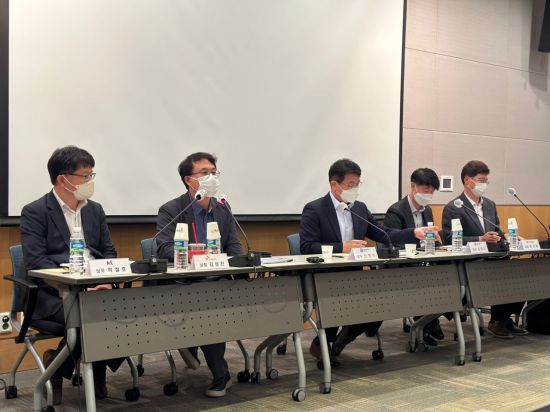 The Korea Telecommunications Operators Association (KTOA) held a press conference on the 12th at the Federation of Korean Industries building in Yeouido, Seoul, jointly with the three mobile carriers, on the topic "Is it okay for global big tech companies to free-ride on networks like this?" From the left, Park Cheol-ho, Executive Director of KT; Kim Seong-jin, Manager of SK Broadband; Shin Min-su, Professor at Hanyang University; Kim Young-soo, Officer at LG Uplus; and Yoon Sang-pil, Executive Director of KTOA, are having a Q&A session. Photo by Cha Min-young
[Asia Economy Reporter Cha Min-young] A claim has been raised that the network usage fees Google (YouTube) must pay, as it opposes legislative discussions on the 'mandatory network usage fee,' amount to only 0.17% to 0.25% of the advertising revenue it earns from videos worldwide. This conclusion directly contradicts Google's assertion that the passage of the bill would impose a huge financial burden, potentially disadvantaging content creators.
The Korea Telecommunications Operators Association (KTOA) held a press briefing titled "Is it okay for global big tech to free-ride on networks like this?" on the 12th at the Federation of Korean Industries Conference Center in Yeouido, Seoul, jointly with KT, SK Broadband, and LG Uplus.
"Network Usage Fee = CP's Operating Cost"
Professor Shin Min-su of Hanyang University's Business Administration Department, who spoke at the event, explained using the example of a popular domestic YouTube video lasting 4 minutes and 13 seconds that has garnered 4.5 billion views worldwide. Professor Shin assumed the video was viewed in full HD with a resolution of 1080p. In this case, the total traffic volume over 10 years can be estimated by multiplying the playback time by the traffic generated per second, resulting in approximately 499,449 TB. Accordingly, the amount Google would pay domestic Internet Service Providers (ISPs) for transmitting this video is calculated to be 18.46 million KRW.
So, how much advertising revenue did Google earn from this video? Professor Shin assumed that the YouTuber earned 2 to 3 KRW per view. The revenue split between Google and the creator was assumed to be 45:55, which is a market-known condition. Under these assumptions, the YouTuber with 4.5 billion views would have earned between 9 billion and 13.5 billion KRW, and Google would have earned an estimated 7.36 billion to 11.04 billion KRW.
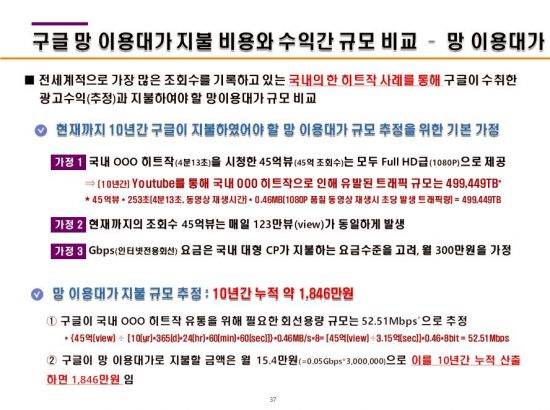 Estimated advertising revenue and network usage fees over 10 years from one popular Google video (4.5 billion views) by Professor Shin Minsu of Hanyang University
While Google takes about 7.4 billion KRW over 10 years, it pays only about 18.5 million KRW to domestic ISPs as network usage fees. Professor Shin explained, "The ratio of network usage fees paid relative to the revenue Google earned is only 0.17% to 0.25%," adding, "Network usage fees are operating costs that Content Providers (CPs) must bear to provide their core service of content distribution." In fact, a domestic internet company A accounts for network usage fees under operating expenses in their accounting, including 'line costs' and other expenses.
Conflicts with CPs' Claims of "Excessive Network Usage Fees"
Professor Shin's argument conflicts with the CPs' claims that excessive network usage fees threaten business sustainability and reduce investment in content creators. Gautam Anand, Vice President of YouTube Asia-Pacific, suggested the possibility of halting investment in a blog post following a legislative hearing on the 20th of last month, stating, "Internet service providers imposing double burdens on content companies will disadvantage content companies and creators," and warned, "If the law is amended, we may have to consider difficult decisions such as changing business operations in Korea."
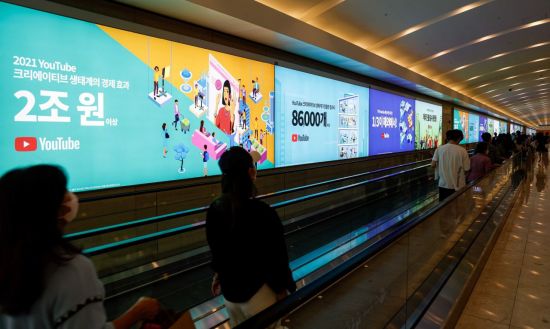 On the 28th of last month, a Google YouTube advertisement opposing the recent Network Usage Fee Act was displayed in a large shopping mall in Yeouido, Seoul, and the underground passage connecting to the subway. Photo by Jinhyung Kang aymsdream@
Popular domestic site Twitch also mentioned cost burdens on the 30th of last month and lowered its maximum resolution from 1080p to 720p. This announcement came just one day after Twitch posted about it on their blog on the 29th. Although Twitch did not specify the reasons for the increased costs, this move is interpreted as a response to ongoing legislative discussions on network usage fees in the National Assembly. According to the current amendment to the Telecommunications Business Act, domestic and foreign CPs are also responsible for providing stable internet services. However, Twitch was excluded from violations because it did not meet the obligation criteria of having an average daily user count (UV) exceeding 1 million for three months in the previous year (October to December 2021) and occupying more than 1% of total domestic traffic.
Despite Twitch's actions, which are seen as disrespectful to Korean consumers, sympathy arose in online communities blaming "everything on network usage fees." For example, a claim that "Twitch pays about 50 billion KRW to domestic telecom companies as network usage fees" has become accepted as fact in online communities. However, this claim remains unverified. The amounts individual CPs pay as network usage fees are generally not disclosed due to non-disclosure agreements (NDAs). A report by Daishin Securities on AfreecaTV vaguely stated, "Twitch is known to pay about 50 billion KRW annually in network usage fees," but this was recycled as concrete evidence supporting rumors in communities. Twitch itself has never disclosed the exact payment amount.
Blind Spot Due to Lack of Actual Surveys... Need for Legislative Supplementation
The lack of transparent disclosure of network usage fees by individual companies is considered a blind spot, as it prevents clear identification of damages to telecom companies caused by foreign CPs not paying network usage fees. Although actual surveys are needed, as pointed out by Democratic Party lawmaker Jang Kyung-tae and others, the Ministry of Science and ICT cannot request unified data submission from domestic telecom companies because these are contractual matters between businesses. This is why calls for legislative supplementation are emerging. Kim Sung-jin, SK Broadband's CR Manager, said, "If the law provides a basis, we will actively cooperate," adding, "Even now, due to NDAs with other CPs, we cannot disclose directly, but we have indexed the network usage fee unit prices between foreign CPs and domestic CPs and shared them with some lawmakers' offices."
Meanwhile, amid ongoing conflicts between domestic ISPs and global CPs over network usage fees, traffic directed at YouTube continues to increase. According to the Ministry of Science and ICT, the share of the top three foreign internet service providers' traffic among domestic internet providers rose from 33.9% in 2020 to 37.8% in 2021. YouTube ranked first with 27.1%, followed by Netflix at 7.2%, and Facebook at 3.5%. According to data calculated by the big data analysis platform Mobile Index in September, based on domestic Android OS and iOS users, the number of YouTube users in Korea was 41.83 million, estimated to be 81% of the total population.
© The Asia Business Daily(www.asiae.co.kr). All rights reserved.
![User Who Sold Erroneously Deposited Bitcoins to Repay Debt and Fund Entertainment... What Did the Supreme Court Decide in 2021? [Legal Issue Check]](https://cwcontent.asiae.co.kr/asiaresize/183/2026020910431234020_1770601391.png)


















