"Transition to IT-Based Mobility Company... Providing New Customer Experience"
Expanding from 10 Million Vehicles by Year-End to 20 Million by 2025
20% Cost Reduction by Shortening Vehicle Development Period
New Business Opportunities in Post-Sales Revenue Models
Investing 18 Trillion KRW to Strengthen SW Competitiveness... Expanding Workforce and Organization
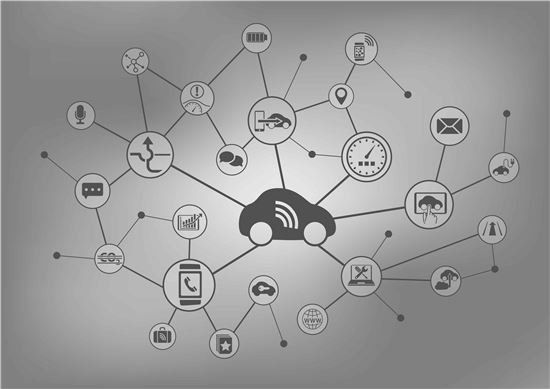 Connected Car Concept Diagram
[Asia Economy Reporter Choi Dae-yeol] Starting in 2025, all models of Hyundai Motor Company and Kia will come standard with over-the-air (OTA) update functionality. As vehicles become fully controllable through software, it will be possible to keep them always up to date without having to visit a service center. With the entire process of manufacturing and using cars shifting to a software-centric approach, the company has decided to overhaul its revenue structure around software.
On the 12th, Hyundai Motor Group held a technology and vision presentation event on its YouTube channel to share these details. The Software Defined Vehicle (SDV) concept has been consistently emphasized by Hyundai Motor Group Chairman Chung Eui-sun before and after his appointment. While the company’s competitiveness was traditionally tied to hardware-focused manufacturing?essentially making well-functioning machines that move?going forward, the judgment is that the mobility itself will be controlled by software, and the entire business related to mobility services will be driven by software.
OTA services are currently being applied to vehicles on sale, but there are some differences depending on the market and model. The plan is to expand this to all models. Based on vehicle platforms, integrated controllers, and proprietary software platforms, OTA will be standard on all vehicles sold worldwide starting in 2025.
As of the end of this year, Hyundai Motor Group expects the number of vehicles subscribed to its OTA-connected services to grow from about 10 million to 20 million by 2025, doubling in size. With OTA applied, vehicle performance improvements and new feature installations can be done remotely without sending the vehicle to a service center. Vehicles will always be maintained in the latest condition, which will increase used car values accordingly. Subscription-based services allowing customers to selectively purchase needed software features will be introduced on some models next year.
Choo Gyo-woong, head of Hyundai Motor Group’s Electronics and Infotainment Development Center, said, "With wireless update technology applied, functions and performance can be updated even after purchasing the vehicle, so the car becomes more advanced and smarter over time."
By applying standardized hardware and software platforms to develop SDVs, the company expects to reduce the time required for the entire mass production process, including planning, design, and manufacturing. Changes are also anticipated in new car development and production processes. Vehicles equipped with the dedicated electric vehicle platform eM and the purpose-built electric vehicle platform eS for Purpose Built Vehicles (PBV) will be introduced starting in 2025.
The architectures, which previously varied by vehicle, will also be unified. Both the eM and eS platforms are developed under Hyundai Motor Group’s Integrated Modular Architecture (IMA) system. IMA is a development system that standardizes and modularizes core electric vehicle components. Currently, battery and motor specifications differ for each electric vehicle model, but IMA standardizes these to enable more flexible production by vehicle class.
To support this, vehicle controllers will also be integrated. Previously, upgrading each vehicle function required individually modifying the controller’s software system, but integration will allow more efficient solutions. The company explained, "This enables flexible responses to rapidly changing markets and customer demands, thereby enhancing product competitiveness."
High-performance semiconductors are necessary to efficiently process the massive data generated by connected cars linked as one. Hyundai Motor Group collaborated with NVIDIA to embed the high-performance NVIDIA Drive hardware semiconductor into the connected car operating system (ccOS). This improves communication processing capabilities, speeding up data processing for in-vehicle entertainment content consumption, OTA updates, and more.
Jang Woong-jun, head of Hyundai Motor Group’s Autonomous Driving Division, said, "By the end of this year, we will unveil a Level 3 autonomous driving technology based on the second-generation integrated controller, specifically a highway autonomous driving system," adding, "We are also developing a remote autonomous parking function at Level 3 autonomous driving standards."
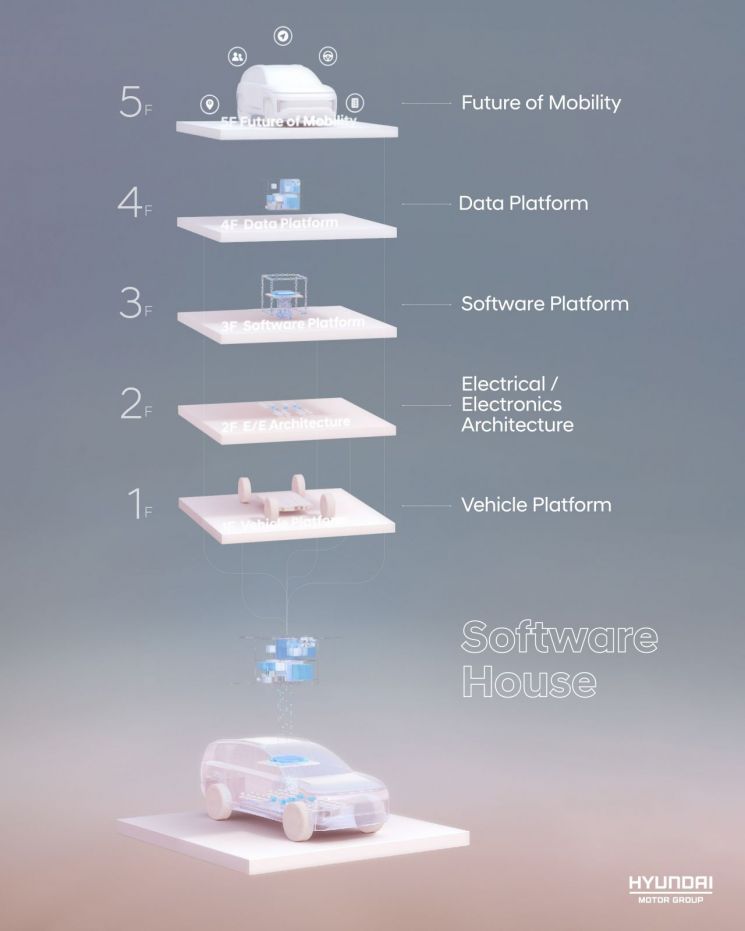
The company will also establish a data platform that combines and processes data generated throughout the vehicle’s entire lifecycle, enabling related services and revenue structures. Jin Eun-sook, head of Hyundai Motor Group’s ICT Innovation Headquarters, said, "It’s not just about vehicle driving but connecting all aspects of the car’s lifecycle," adding, "This will play an important role in providing customers with convenient and diverse mobility experiences."
The upcoming global software center will oversee this future mobility industry. It will develop software-centric mobility devices and solutions. The developed devices will be designed to easily connect with smartphones, and an ecosystem will be created to support various application developments.
Song Chang-hyun, head of Hyundai Motor Group’s TaaS (Transportation as a Service) Division, said, "In the future, software-centric vehicles will become commonplace," adding, "People’s perceptions and means of mobility will change, and completely new forms of mobility devices and services will emerge, greatly transforming the mobility industry paradigm."
Hyundai Motor Group plans to accelerate development of software-centric smart mobility and invest heavily in personnel and organizational resources to transition into an IT-based mobility company. Hyundai Motor Company and Kia will invest 18 trillion won by 2030. This includes technology development for new businesses such as autonomous driving, strategic equity investments in startups and research institutions, and building big data centers. The development organization will also gradually expand to recruit overseas software talent.
With the mobility ecosystem established as planned, the company expects its revenue structure to change as well. With platform standardization, parts can be shared regardless of vehicle class, reducing manufacturing costs by more than 20%. Subscription service revenues are expected to increase, and new businesses will be possible through an ecosystem connecting various mobility devices and services.
Park Jung-guk, head of Hyundai Motor Group’s Research and Development Headquarters, said, "We aim to provide valuable customer experiences by adding our own optimized dedicated software technology on top of excellent hardware technology and expanding its application areas."
© The Asia Business Daily(www.asiae.co.kr). All rights reserved.


















