Tesla and Hyundai Invest in Robots... "High Business Relevance"
[Asia Economy Reporter Yoo Hyun-seok] Global automakers are rushing to invest in robots. This is interpreted as being driven by the fact that technologies such as artificial intelligence (AI) and LiDAR, applied in future vehicles like autonomous and electric cars, can also be utilized in robots, and that business areas can be expanded to industrial sites and daily life.
According to the automotive industry on the 16th, Tesla unveiled the humanoid robot 'Optimus' at 'AI Day 2022' held in California, USA, on September 30 (local time), and announced that commercialization could be possible within the next 3 to 5 years.
At the event, Tesla released a video showing Optimus performing tasks such as lifting and moving boxes or walking around an office to water plants. Along with this, the next-generation Optimus was unveiled; this model weighs 73 kg, is equipped with a 2.3 kWh battery pack in its chest, and is expected to have the capability to move its limbs autonomously through built-in chips and actuators.
Robots are a focus not only for Tesla but also for other automakers. Honda introduced 'PathBot' in 2019, which uses AI technology to find routes and provide guidance, and Toyota unveiled the small delivery robot 'Micro Palette' in 2020. Ford is also developing the bipedal robot 'Digit.'
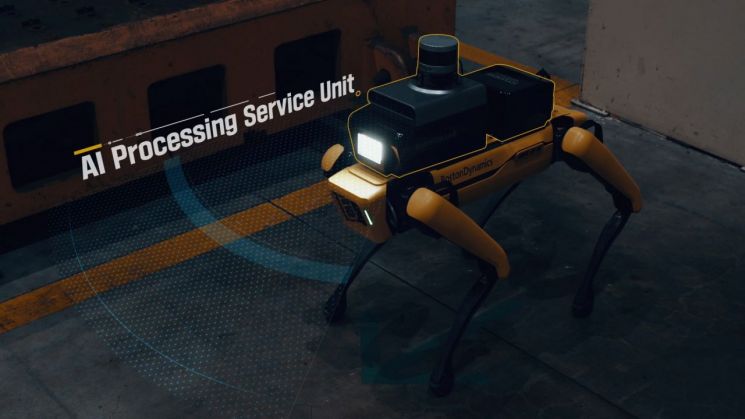
Hyundai Motor Group is also expanding its robot business by acquiring the American robotics specialist Boston Dynamics. Boston Dynamics owns the quadruped robot 'Spot,' the bipedal robot 'Atlas' that moves like a human, and 'Stretch,' specialized for warehouse and logistics facilities. Among these, Stretch, which began sales in March, had its production orders fully booked this year.
Recently, Hyundai, Kia, and Hyundai Mobis announced that they will invest $424 million (approximately 551.9 billion KRW) to establish a robot AI research institute in Cambridge, Boston, Massachusetts, USA. The robot AI research institute aims to secure foundational technologies that will form the basis of next-generation robots.
The reason automakers are entering the robot business is due to the strong business relevance. Most of the technologies used in future vehicles such as autonomous and electric cars are also applicable to robots. Object perception capabilities using LiDAR and AI can be directly applied to robots. Especially since these can be utilized not only in the automotive industry but also in industrial sites and daily life, automakers find the potential to expand their business areas an attractive factor.
Robots are expected to be a field that can achieve significant growth from an industrial perspective. Boston Consulting Group estimated that the global robot industry size will grow from $25 billion (approximately 35 trillion KRW) in 2020 at an average annual growth rate of 20%, reaching $160 billion (approximately 220 trillion KRW) by 2030.
Lee Hang-gu, senior researcher at the Korea Automotive Technology Institute, said, "Robots have been a field related to automakers since the past," adding, "Recently, as we move toward future vehicles, control technologies have brought more attention to this area, and investments will continue in the future."
© The Asia Business Daily(www.asiae.co.kr). All rights reserved.

















