Strengthening Interfloor Noise Standards Including Post-Verification System Introduction
Urgent Response Needed to Enhanced Noise Criteria
 Minister of Land, Infrastructure and Transport Won Hee-ryong holding a meeting on inter-floor noise with residents at an LH housing complex in Jungnang-gu, Seoul, on August 18.
 [Image source=Yonhap News]
[Asia Economy Reporter Cha Wanyong] As inter-floor noise has become a serious social issue, the government has stepped up related regulations. Along with establishing stronger legal standards and rules for inter-floor noise, it announced incentive measures to encourage construction companies to develop noise reduction technologies. In response, construction companies are creating dedicated research centers or departments and are actively moving forward with the development of inter-floor noise reduction technologies.
Government Tightens Noise Standards
According to the government on the 10th, the “Regulations on the Scope and Standards of Inter-floor Noise in Multi-family Housing” will be revised, with the current direct impact noise standards (1-minute equivalent noise level) of 43dB during the day and 38dB at night strengthened to 39dB and 34dB respectively. The revised regulations will be promptly announced for administrative notice. In other words, even smaller noises than before will be legally recognized as inter-floor noise.
Prior to this, from August 4th, a post-confirmation system for inter-floor noise was introduced. This system verifies the noise blocking performance not in laboratories but in completed apartments. At the stage of approval for use after apartment completion, 2-5% of all units are randomly selected to evaluate inter-floor noise. If the inspection is not passed, supplementary construction must be carried out.
For lightweight impact noise (light and hard impacts), the standard will be lowered from 58dB to 49dB, and for heavyweight impact noise (heavy and soft impacts), from 50dB to 49dB, thus strengthening the standards for floor impact noise that causes inter-floor noise.
The government also proposed incentives to encourage construction companies’ participation in realizing inter-floor noise reduction. Construction companies with excellent noise blocking performance will receive incentives. According to the post-confirmation results, a first-grade rating for heavyweight impact noise will receive a 30% discount on housing sales guarantee fees, second grade 20%, and third grade 10% respectively.
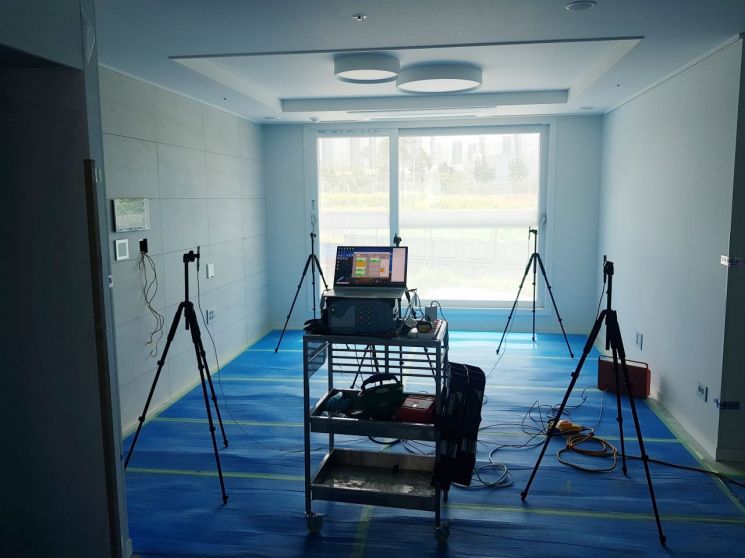
Full-scale Development of ‘Inter-floor Noise Reduction’ Technologies
As the government strengthens regulations on inter-floor noise, construction companies are competing to develop noise reduction technologies.
First, Samsung C&T operates ‘Raemian Goyoan (安) Lab (LAB)’, the largest inter-floor noise specialized research center in Korea, located in Giheung-gu, Yongin-si, Gyeonggi Province. It covers a total area of 2,380㎡ across basement level 1 to the 4th floor, providing not only research facilities but also spaces where inter-floor noise can be experienced. Currently, it has secured four first-grade and three second-grade technologies related to heavyweight impact noise blocking performance, but since the application of these technologies is decided through consultation with project owners, commercialization will require time.
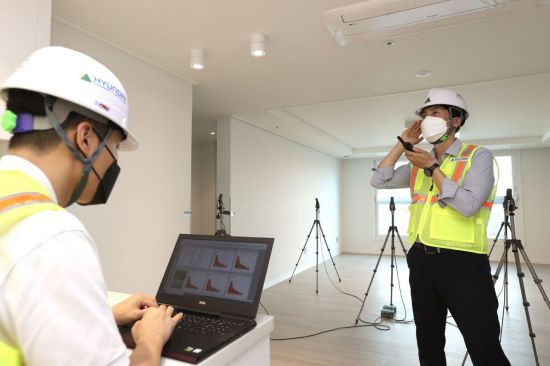
Hyundai Engineering & Construction received the first-ever first-grade rating in Korea for floor impact noise blocking performance from the nationally accredited institution (LH Quality Testing Accreditation Center) that measures inter-floor noise levels. Using a construction method that applies high-density specialized mortar and high-performance cushioning materials made from special materials, it maximized the performance of the ‘floating floor structure’ to reduce noise. Hyundai E&C plans to standardize the construction method and prepare for on-site application by next year by establishing long-term quality assurance measures. Furthermore, it plans to accelerate research and development (R&D) by setting up a demonstration facility for verifying noise reduction technologies and building technical data at the Mabuk Technology Research Institute located in Giheung-gu, Yongin-si, Gyeonggi Province.
GS Engineering & Construction formed an eco-friendly building research team within its Yongin Technology Research Institute to take charge of inter-floor noise issues. Lotte Engineering & Construction also established a dedicated TFT for inter-floor noise, conducting research to solve noise problems such as developing new cushioning materials and noise reduction ceiling systems.
Daewoo Engineering & Construction developed a ‘Smart Triple Floor Structure’ that can dramatically reduce apartment inter-floor noise. This structure increases the thickness and enhances the performance of materials compared to existing apartment structures and is planned to be applied to apartments in the future. The company has filed patents for related technologies and two additional technologies required for constructing this structure.
Posco Engineering & Construction, operating a separate inter-floor noise TF organization, developed the Hybrid Rigid Reinforced Floor System (Anwoolim). It completed performance verification with heavyweight impact noise at grade 2 and lightweight impact noise at grade 1 on the same 210mm slab as before. It plans to apply this design through floor structure approval from the Ministry of Land, Infrastructure and Transport in the second half of this year.
Lotte Engineering & Construction established a dedicated department consisting of 13 experts with master’s and doctoral degrees to intensify research minimizing inter-floor noise. They have developed noise reduction technologies such as cushioning materials using eco-friendly new materials produced by Lotte Chemical and a ‘wall-supported ceiling system’.
© The Asia Business Daily(www.asiae.co.kr). All rights reserved.



















