Distortion of Korean History in US Harvard Textbook... VANK 'Protests'
Textbook Authors "Take It Seriously, Will Consider Corrections"
VANK Conducts Campaign Until Fully Corrected
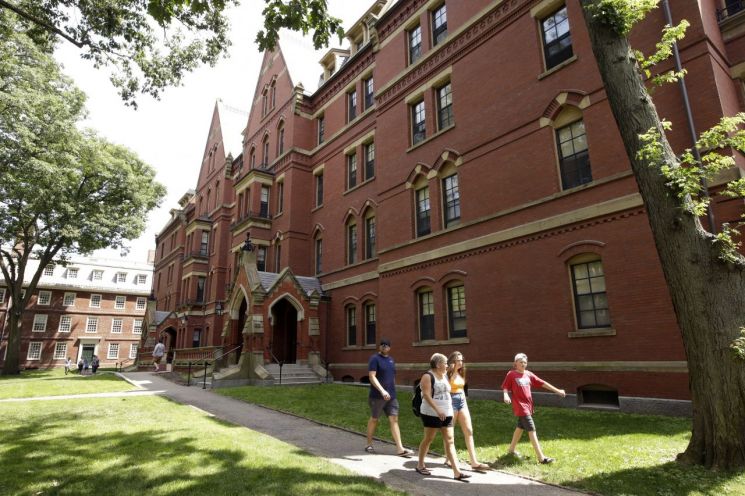 Harvard Business School in the United States has shown a commitment to correcting the content of a textbook that sparked controversy over the distortion of Korean history. The photo, taken on July 16, 2019 (local time), shows people walking at Harvard University in Cambridge, Massachusetts, and is not related to any specific expressions in the article. Photo by AP Yonhap News
[Asia Economy Reporter Hwang Sumi] Harvard Business School in the United States has shown its willingness to correct the distorted Korean history content in its textbook. This comes about a week after the Cyber Diplomatic Mission VANK filed a protest and requested correction from Harvard.
According to VANK on the 8th, Professor Forrest Reinhardt of Harvard Business School sent an email to VANK the day before, stating, "We take the issue you raised very seriously."
This was a response to VANK's protest that the required textbook 'Korea' at Harvard Business School contains distorted Korean history content. Professor Reinhardt is known as a co-author of this textbook.
Earlier, on the 29th of last month, VANK announced that it had sent a letter of protest and a request for correction to the school, stating that Harvard Business School was teaching students with this textbook containing distorted history.
According to VANK, in 'Korea,' ancient Korean history begins with Silla's unification of the Three Kingdoms in 668 AD. There is no explanation of Goguryeo or Baekje culture, and Balhae history is not mentioned at all. Furthermore, Goryeo is distorted as a vassal state paying tribute to China.
Moreover, the textbook contains content suggesting that Korea greatly developed thanks to Japan. The textbook states, "During the 35 years of Japanese colonial rule, the Japanese government integrated the Korean economy with Japan's and prohibited the use of the Korean language." It then adds, "However, during this period, Korea underwent significant industrialization, and transportation and electricity developed," and "Education, administration, and economic systems were also modernized."
In response, VANK strongly opposed, saying, "The required Harvard textbook ignores the history of Koreans who suffered under Japanese colonial rule." They emphasized, "The textbook that diminishes the Three Kingdoms period and distorts Goryeo history must be corrected."
After receiving VANK's protest letter, Harvard responded in about a week. Professor Reinhardt stated in the email, "We are always interested in receiving feedback on textbooks used by students and improving our research." He added, "We hope the content will be edited regarding this issue."
Meanwhile, VANK interprets Harvard's response as a positive consideration for correction but plans to continue the campaign until the distorted content is fully corrected.
© The Asia Business Daily(www.asiae.co.kr). All rights reserved.
![Clutching a Stolen Dior Bag, Saying "I Hate Being Poor but Real"... The Grotesque Con of a "Human Knockoff" [Slate]](https://cwcontent.asiae.co.kr/asiaresize/183/2026021902243444107_1771435474.jpg)
















