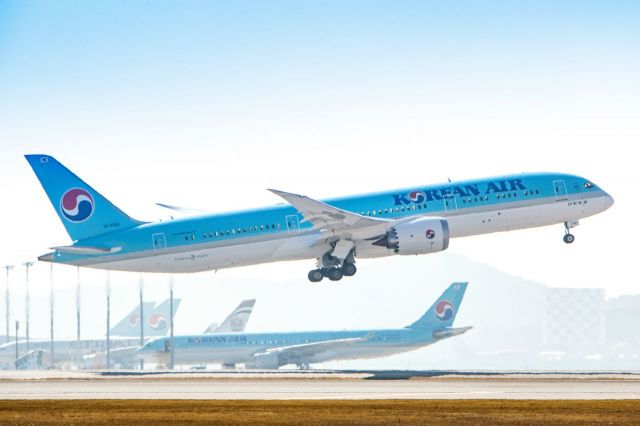
[Asia Economy Reporter Kwon Jae-hee] Airlines, which had been expected to soar again with the abolition of PCR tests for overseas arrivals and the resumption of visa-free entry to countries like Japan, have now encountered an unexpected obstacle in the form of exchange rates. As the exchange rate surpassed 1,400 won, the airline industry's profitability is inevitably deteriorating due to the nature of the business, where lease fees and fuel costs are all paid in dollars. Airlines that were expected to take off again with the 'reopening' are struggling to shake off their sluggish performance.
According to the Korea Exchange on the 9th, Asiana Airlines closed at 11,900 won on the 7th, up 2.59% from the previous trading day. This is about a 50% drop compared to the highest price of 23,500 won recorded on April 4 this year. On the same day, Korean Air closed at 22,450 won, up 2.28%, which is a 31% decrease from the highest price of 32,550 won recorded on April 6 this year. T'way Air also closed at 1,615 won, up 0.62%, which is a sharp 58% drop compared to the highest price of 3,830 won on March 16. Jeju Air and Jin Air also recorded declines of -46% and -25%, respectively, compared to their highest prices this year.
Airline stocks had been grouped as 'reopening' related stocks and had high expectations for growth after the COVID-19 pandemic, but recently, due to the high exchange rate shock, their stock prices have been on a downward trend again. Airlines have a business structure where most essential operating costs, such as aircraft lease fees and fuel costs, must be paid in dollars, so the higher the exchange rate, the greater the cost burden. According to the industry, Korean Air is estimated to incur a foreign exchange loss of about 35 billion won and Asiana Airlines about 28.4 billion won for every 10 won increase in the exchange rate in the second quarter.
The exchange rate shock is an emergency not only for low-cost carriers (LCCs) but also for major airlines. T'way Air reported foreign exchange losses in the 50 billion won range in the first half of the year, while Jeju Air and Jin Air recorded losses in the 20 billion won range. The major airlines are no exception. Korean Air's lease liabilities due within one year were about 1.4526 trillion won as of the second quarter, and Asiana's were about 636.9 billion won.
The outlook for third-quarter earnings is also bleak due to the exchange rate impact. According to financial information provider FnGuide, Korean Air's third-quarter consensus is sales of 3.4858 trillion won and operating profit of 570.8 billion won. This is estimated to be about 200 billion won less than the operating profits of 788.4 billion won in the first quarter and 735.9 billion won in the second quarter.
Park Soo-young, a researcher at Hanwha Investment & Securities, said, "The airline industry is highly sensitive to exchange rates, and the rise in exchange rates is as big a negative factor as COVID-19," adding, "Although we need to watch until the end of this year, it seems difficult for the exchange rate to stabilize in the short term, so an expansion of foreign exchange losses is inevitable."
© The Asia Business Daily(www.asiae.co.kr). All rights reserved.

















