Completion of the '100-Day Daily Recovery Project' Approved as the First Decision of the 8th Civil Administration... Foundation Laid for Large-Scale Resident Demand Projects through Government, Seoul City, and Seocho-gu Collaboration & Realizing Communication Administration through 'Public Sentiment Administration' by Visiting Living Sites and Directly Listening to Residents' Voices & Promoting Various Cultural Performances Providing Cultural Healing Opportunities That Bring Comfort and Hope to Daily Life & Expanding Support for Small Business Owners for the Prosperity of Local Markets
[Asia Economy Reporter Jong-il Park] Jeon Seong-su, the Seocho District Mayor, who has marked the first 100 days of the 8th elected term, revealed 10 special changes made together with the residents.
First, the '100-Day Daily Recovery Project,' which was processed as the first approval of the 8th elected term, has been completed.
This project, carried out to quickly restore the daily lives of residents exhausted by COVID-19, involved a total of 69 initiatives. The district focused on helping residents safely return to pre-COVID daily life through a two-track strategy of daily recovery and safe quarantine. Covering all areas of residents' lives as a 'comprehensive measure,' the project was steadily implemented over 100 days. As a result, on August 24, it was introduced as a model case of local government at the Central Disaster and Safety Countermeasures Meeting chaired by the Prime Minister, spreading nationwide, and enabling residents to safely recover their precious daily lives.
Efforts to resolve large-scale long-standing projects have also begun. The government, Seoul City, and Seocho District collaborated to lay the foundation for solving major large-scale projects. In September, the Seoul City Urban and Architectural Joint Committee approved the district unit plan for Seocho-dong 1342, raising expectations for high-density mixed-use development around Hyoryeong-ro. This district unit plan has been a long-standing wish of residents who have been negotiating with Seoul City since 2011, making this decision particularly meaningful. The district plans to use this district unit plan approval as a starting point to accelerate the undergrounding of the Gyeongbu Expressway, reconstruction projects, and the Yangjae AI Special Zone, addressing long-standing resident demands in Seocho with speed.
Additionally, on September 13, a policy meeting was held between Seoul City council members and Seocho District to build consensus on resolving current issues and pledge cooperation, with plans to continue close collaboration with the government and Seoul City.
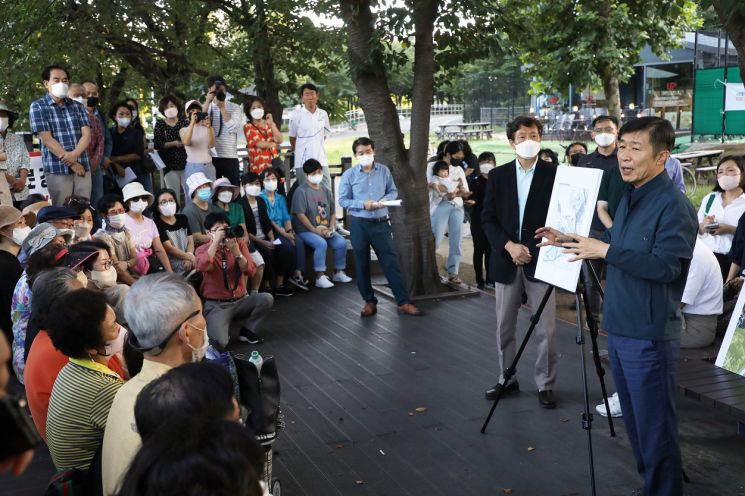
Beyond large-scale projects, the district also listened to residents' voices and approached them more closely through 'public sentiment administration' that empathizes with residents. Since July, Mayor Jeon Seong-su has visited 14 sites across 8 neighborhoods through the 'Visiting Seong-su Talk' program, meeting over 370 residents.
He also directly communicated with residents by holding meetings with about 30 complainants through the 'Let's Meet the Mayor' initiative. Furthermore, the 'Seongsu Direct Line,' which responds promptly to residents' requests 365 days a year, received approximately 500 complaints and sought solutions. By making the living environment his workplace and communicating at the residents' level, he practiced empathetic administration.
Various cultural performances were held throughout Seocho, sharing beautiful melodies of comfort and hope in daily life. On September 23-24, the 'Seoripul Concert and Bazaar' was held to comfort residents weary from COVID-19 and flood damage, attracting about 10,000 participants. The bazaar raised 50 million KRW in donations, which will be used to support flood-affected residents.
In addition, youth street concerts, classical cafes, and flower seat concerts were held, offering residents healing time through culture and arts in their daily lives.
Moreover, support for small business owners was expanded to usher in a 'Golden Age of Alleyway Commerce.' The direct transaction market, which had been closed due to COVID-19, was reopened, and especially, the 'Seocho Direct Transaction Grand Market for Chuseok' was held for the first time in three years. Efforts to revitalize alleyway commerce continued through the 'Yangjaecheon Local Brand Commercial District' and the 'Maljukgeori Alley-type Shopping District Branch,' promoting cultural and spatially distinctive alleyway commerce.
Additionally, Seocho Love Gift Certificates worth 24.2 billion KRW were issued, low-interest loans for small and medium-sized businesses were expanded, and loans totaling 60 billion KRW were provided to help small business owners recover from difficulties caused by high interest rates and inflation.
Companionship with the vulnerable continued across various fields. Through events like 'Seocho AI College' and 'Youth Artist Special Exhibition,' support was provided from youth education to employment, while also supporting young artists. Programs such as water park experiences for vulnerable children’s families and support for youth private counseling fees encouraged healthy growth for future talents. Furthermore, by signing a business agreement for the opening of the 6th Neulbom Store, social activity support for people with disabilities was provided. The Senior Neulbom Cafe was opened in Seocho-dong, and on Senior Citizens Day, an exhibition of seniors' works and a Rock Festival were held to support healthy aging.
Also, even small complaints were addressed to resolve residents' inconveniences. Protest and demonstration banners occupying the Gangnam Station area for a long time were removed five times, ensuring residents' safety and enhancing Seocho's urban dignity. The 'Seocho Ombudsman' was operated to objectively investigate and handle grievances, protecting residents' rights.
Preparing for the digital transformation era, the district did not forget to prepare for a smart city of the future. An innovation talent development agreement was signed with Soongsil University to nurture AI talent, and the blockchain-based Seocho Coin system, prepared over a long period, was launched at senior welfare centers and community centers.
Furthermore, Seocho was selected for the Ministry of Land, Infrastructure and Transport's 'Digital Twin Land' contest and the Ministry of the Interior and Safety's 'Digital Twin' contest, laying the groundwork for a leading Seocho. Seocho District was recognized for these efforts by receiving smart city certification from the Ministry of Land, Infrastructure and Transport and plans to continue applying smart technologies throughout administration to build a smart city.
Additionally, leisure facilities were provided in the city center. On August 1, the Seoripul Water Playground was opened along with a camping-style outdoor heat shelter, ensuring residents had a cool summer. Over 8,700 residents visited the Seoripul Water Playground during August. The 2.3 km Seoripul Park barrier-free trail was opened, and the Oneutgol underpass connecting to Cheonggyesan was renovated, creating healing spaces where residents can relax comfortably in nature.
Lastly, residents directly participated in district administration, realizing a mature form of resident autonomy where 'we make our neighborhood ourselves.' Thirty-two members were appointed to the 'Smart City Living Lab Promotion Team,' where residents propose policies and derive smart improvement plans by integrating smart technology. In cooperation with the Seoul Autonomous Police Committee, 37 members of the 'Pet Dog Patrol Team' began activities, patrolling neighborhoods with their pets to ensure safety. During the summer vacation, Seocho V Week was operated for two weeks from July 25, with 600 residents participating in volunteer activities.
Especially during the heavy rain in August, 'Civil-Government Emergency Recovery Teams' composed of residents in each neighborhood were operated, conducting rapid recovery work throughout the neighborhoods. Thanks to the efforts of over 1,500 residents, the district was able to recover quickly despite the damage. This was a manifestation of mature local autonomy.
Seocho District Mayor Jeon Seong-su said, “For 100 days, I have run breathlessly every day with only the residents in mind. It was a meaningful time to communicate closely with residents and set the direction for Seocho for the next four years.” He added, “I will continue to keep the promise to create a Seocho that residents look forward to tomorrow without losing the initial spirit.”
© The Asia Business Daily(www.asiae.co.kr). All rights reserved.

















