USA, France, Netherlands, etc. have no mask-wearing mandate
Some countries mandate masks only on public transport, medical, and social welfare facilities
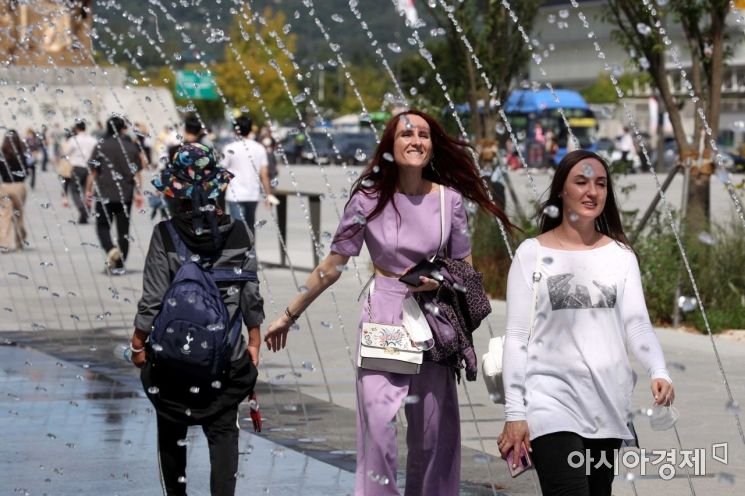 On September 26, when the outdoor mask mandate was lifted, some citizens were seen removing their masks and moving around at Gwanghwamun Square in Jongno-gu, Seoul. From this day, the mask mandate was also lifted for outdoor gatherings, performances, and sports stadiums with more than 50 attendees, marking the complete removal of the outdoor mask mandate after about 1 year and 5 months. Photo by Moon Honam munonam@
Among the 25 major countries including the Organisation for Economic Co-operation and Development (OECD), South Korea is the only country where wearing masks is mandatory throughout all indoor areas.
According to data on the 'Status of Mandatory Mask Wearing by Major Countries including OECD' provided by the Korea Disease Control and Prevention Agency on the 11th, as of the 20th of last month, none of the other 24 countries besides South Korea had effectively mandated mask-wearing in all indoor locations.
First, eight countries including the United States, Denmark, Slovenia, Turkey (T?rkiye), France, Hungary, the Netherlands, and South Africa have no government regulations related to mandatory mask-wearing at all.
Egypt has enforced mandatory mask-wearing indoors and outdoors since May 2020, when COVID-19 began, but no separate enforcement measures are being taken, such as crackdowns by authorities. As a result, it is known that most citizens in Egypt do not wear masks.
Chile previously mandated mask-wearing in all indoor locations similar to South Korea's situation, but lifted the mandate entirely on the 1st of this month along with restrictions on indoor capacity. Currently, masks are only required in medical facilities.
Australia and New Zealand also eased indoor mask mandates last month. New Zealand ended its COVID-19 'traffic light system' on the 13th of last month, lifting indoor mask mandates except in medical and aged care facilities. Australia removed the mask mandate on domestic and international flights to Australia starting from the 9th of the same month.
Among the 16 countries where mask mandates are enforced in certain locations, all require masks in medical facilities. Ten countries, including Austria and Germany, mandate mask-wearing in social welfare facilities where vulnerable elderly and people with underlying conditions are relatively numerous.
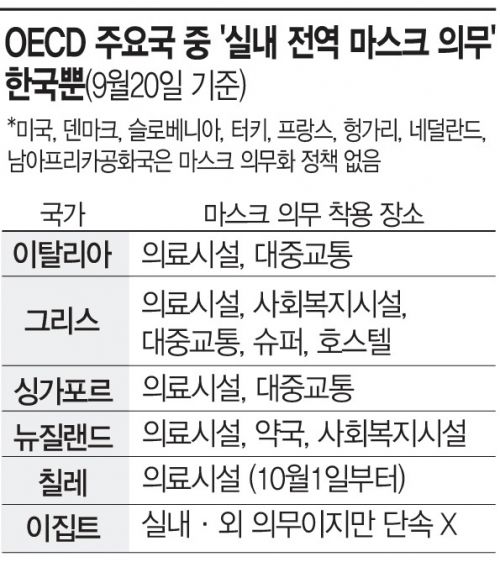
There are also countries that require masks in multi-use facilities where many people gather, such as supermarkets, public transportation, and hostels. In eight countries including Italy and Singapore, mask-wearing is mandatory on public transportation. Greece has designated supermarkets and hostels as places where masks must be worn.
However, the absence of mandatory indoor and outdoor mask-wearing does not mean that citizens in those countries do not wear masks at all. Japan currently has no mask mandate, but mask-wearing is recommended when it is impossible to maintain a 2-meter distance indoors, during conversations, outdoors when maintaining distance is difficult, or when visiting hospitals to see elderly people. Nevertheless, most local citizens voluntarily wear masks both indoors and outdoors.
In South Korea as well, regardless of mask mandate regulations, there is a high opinion of continuing to wear masks for the time being. According to a survey on public perception of mask-wearing conducted by Korea Research from August 12 to 16, 64% responded that they would continue to wear masks outdoors regardless of regulations, and 75% said they would wear masks indoors.
© The Asia Business Daily(www.asiae.co.kr). All rights reserved.


















