'Correct Language Use' Emphasized on Hangul Day
Shouting Continues Between Ruling and Opposition Parties at National Assembly Audit... "You Stay Quiet" "Ill-mannered" "Bite Your Tongue and Die"
President Yoon's U.S. Visit Remarks Cause Ripple Effects for Two Weeks
King Sejong Suppressed Opposition to Hangul Creation... Achieved Results Through Persistent Persuasion Instead of Hostile Attitudes Like "If These XX Don't Do It"
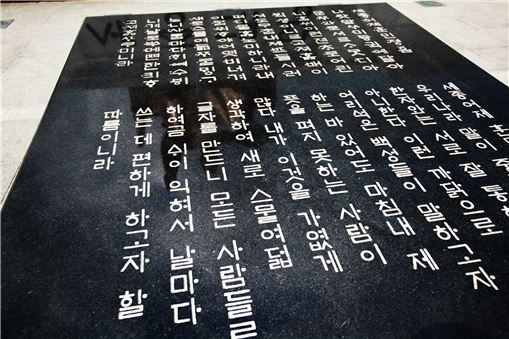 Hunminjeongeum. Photo by Getty Images Bank
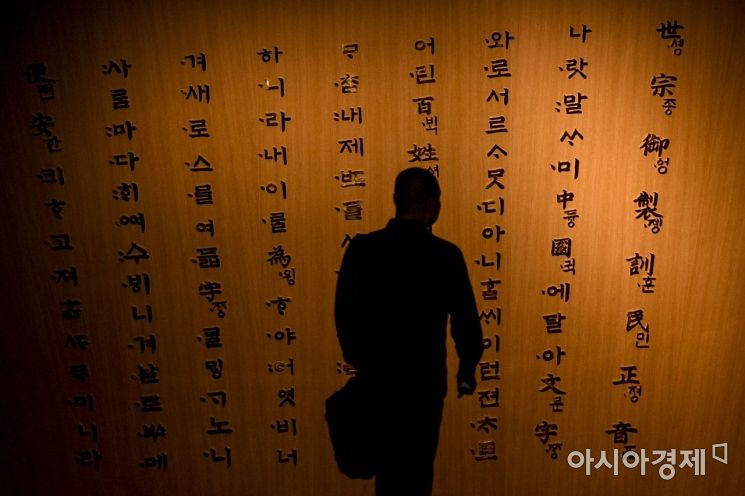 A foreign visitor at the National Hangeul Museum in Yongsan-gu, Seoul, is looking at the Hunminjeongeum installed inside the museum. Photo by Jinhyung Kang aymsdream@
"Our language is different from Chinese, so the Chinese characters do not correspond with it. Because of this, many foolish people, even if they want to express something, ultimately cannot convey their meaning. Feeling pity for this, I have newly created twenty-eight letters, so that everyone can easily learn them and use them conveniently every day."
This is the modern translation of the preface to Hunminjeongeum, which begins with 'Naratmalssam-i Jungguk-e Dala' (Our language is different from Chinese). In the 'Jeonginji Preface' written in the Hunminjeongeum Haerye to convey King Sejong's love for his people and practicality, it is said that "the 28 letters created by Sejong can be learned by wise people in one day and by foolish people in ten days."
Although Hangul was created to be so easy to understand, on this year's 576th Hangul Day, an unexpected 'listening test' is taking place in the political arena.
58.7% Heard 'Biden' vs. 29.0% Heard 'Nallimyeon'
On the 21st of last month (local time), after President Yoon Seok-yeol had a brief conversation with U.S. President Joe Biden at the 7th Replenishment Conference of the Global Fund held in New York, a private remark he made while walking out to Foreign Minister Park Jin and others nearby became the starting point of controversy.
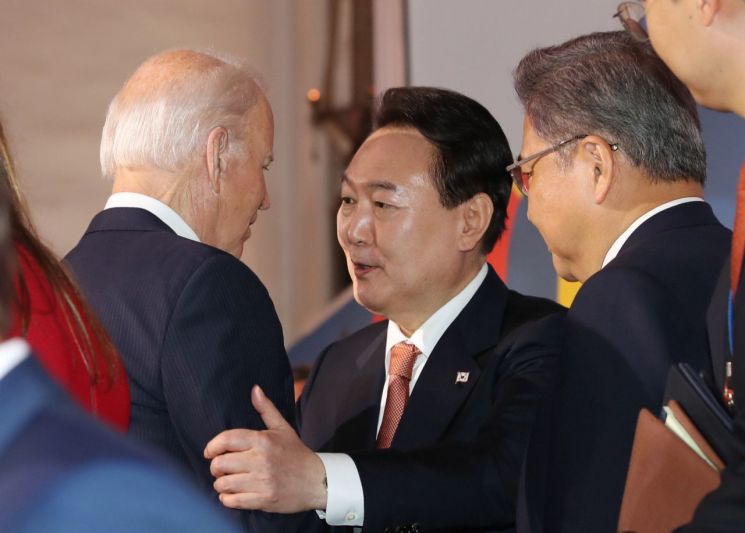
"If (these XX) in the National Assembly don't approve it, (Biden/Nallimyeon) will be embarrassed, what should we do?"
Some, including the Democratic Party, interpreted that President Yoon mentioned 'Biden' and criticized it as a 'diplomatic disaster,' but the presidential office explained after 15 hours that he said 'Nallimyeon,' not 'Biden.'
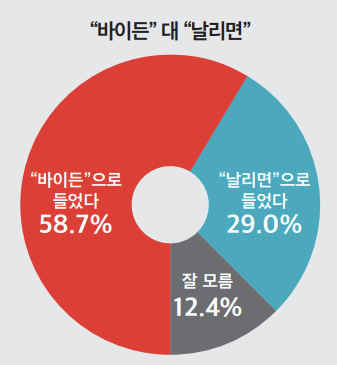
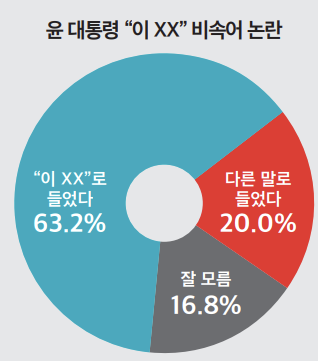
As the political dispute between ruling and opposition parties failed to reach a conclusion, an absurd nationwide public opinion poll was even conducted to determine whether people heard 'Biden' or 'Nallimyeon.'
In this survey, more than half of respondents (58.7%) said they heard 'Biden.' Those who heard 'Nallimyeon' accounted for 29.0%, and 12.4% said they were unsure. (Survey of 1,009 men and women aged 18 and over nationwide, conducted by Media Tomato via wireless ARS from September 26 to 28 over three days, with a 95% confidence level and ±3.1% margin of error)
The vulgar expression "this XX, embarrassed" is also controversial. If he said 'Biden,' it is interpreted as referring to the U.S. Congress; if 'Nallimyeon,' it refers to the National Assembly of the Republic of Korea. Regardless of the assumption, the use of the phrase 'this XX' itself is a rude remark, and the president's 'language dignity' can be criticized.
Recently, another public opinion poll was conducted on this issue, and 6 out of 10 respondents (63.2%) said they heard the vulgar expression 'this XX.' Twenty percent said they heard other words, and 16.8% were unsure. (Survey of 1,022 men and women aged 18 and over nationwide, conducted by Media Tomato via wireless ARS over two days from the 4th to 5th, with a 95% confidence level and ±3.1% margin of error. For detailed survey outlines and results, refer to the Central Election Poll Deliberation Commission website.)
Amid the controversy over the president's vulgar language, this year's National Assembly audit seems to have lost its original focus on 'people's livelihood National Assembly' and 'people's livelihood audit.' On the 6th, during the National Assembly Science, Technology, Information and Broadcasting Committee's audit of the Korea Communications Commission, a video containing the remark was shown, and a dispute arose comparing President Yoon's 'pronunciation.'
Only Shouting, 'Nallineun' Language Dignity... Lawmaker: "You (Nina) be quiet," "No manners," "How dare you," "Bite your tongue and die"
The behavior of lawmakers is not much different. The audit venue is called a 'scolding place' every year because both ruling and opposition parties tend to start by shouting.
On the 5th, during the National Assembly Health and Welfare Committee audit, the opposition party launched an offensive regarding President Yoon's visit to a daycare center.
President Yoon visited a national and public daycare center in Sejong City on the 27th of last month, where he said, "Babies come here too, even those under two years old. (Yes, from six months) Ah, from six months... but they all walk." The Democratic Party criticized the president for not being well-prepared for the visit, and a dispute broke out between ruling and opposition lawmakers during this process.
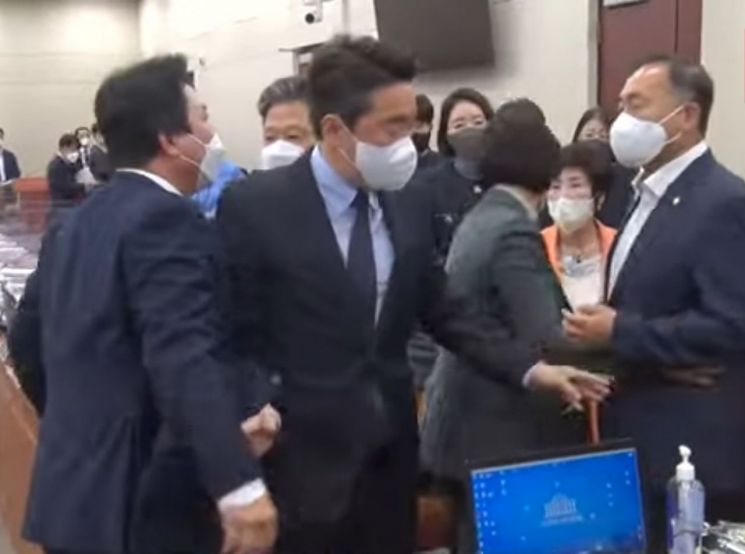
When Democratic Party lawmaker Kim Won-i said, "I'm also talking to the chairman! Please be quiet," People Power Party lawmaker Kang Ki-yoon retorted, "You (Nina) be quiet!"
The nerve-wracking exchange starting with 'You (Ni)' did not end there.
Later, Lawmaker Kim snapped, "Are you becoming like the president? That's why the president says 'this XX, embarrassed.'" Kang sharply responded, "Are you a president stalker? (When Kim adjusted his clothes) What are you trying to do by taking off your shirt?"
On the 4th, during the National Assembly Administration and Security Committee audit, a loud argument broke out between ruling and opposition parties over Democratic Party lawmaker Lee Hae-sik's remark calling the Yoon administration a 'lying government.'
When Lee said, "The Yoon administration consistently lies. Saying that 49.6 billion won is enough for the presidential office relocation cost is also a lie," People Power Party whip Lee Man-hee responded, "The chairman should strictly warn against making definitive statements about facts that do not exist and labeling it a 'lying government.'"
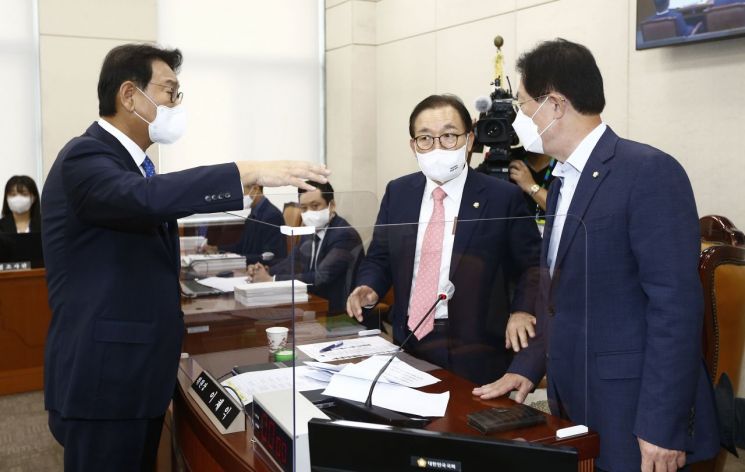
In response, Democratic Party whip Kim Gyo-heung asked, "Since when has the National Assembly had to be controlled regarding speech?" Then he raised his voice, "No manners at all!" After that, the two lawmakers exchanged loud words such as "Who are you calling no manners?" "How dare you interfere with a lawmaker's speech?" "That's rude."
In addition, during the National Assembly Industry, Trade, Energy, Small and Medium Business Committee audit, when a ruling party lawmaker criticized an opposition lawmaker for saying 'this person,' he sarcastically replied, "I didn't say 'this XX.'" In the National Assembly Legislation and Judiciary Committee, opposition lawmakers raised issues about the chairman's unilateral meeting management, causing disruptions.
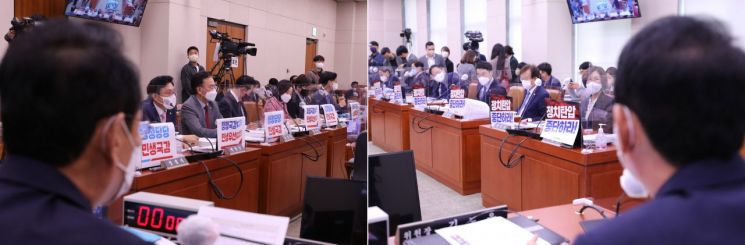
On the 7th, Democratic Party lawmakers belonging to the Legislation and Judiciary Committee held a press conference and stated, "Due to the oppressive meeting management by Chairman Kim Do-eup and the ruling party lawmaker's obstruction of proceedings, the Ministry of Justice audit could not be properly conducted. As long as the chairman continues to operate the committee in a violent and biased manner, a normal audit cannot proceed."
They particularly criticized, "The oppressive act of cutting off a colleague lawmaker's microphone during their speech by ordering 'Turn off the mic' is absolutely unacceptable," adding, "A lawmaker's speech is a constitutional right and act representing the voice of the people, yet Chairman Kim, as the standing committee chairman, has neglected his responsibility and duty to guarantee and consider this."
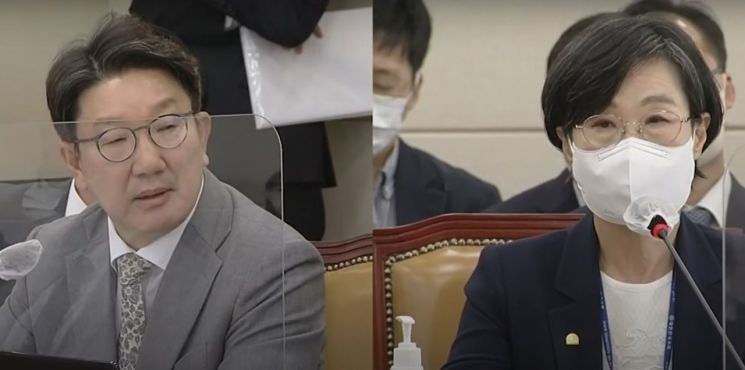
"Bite your tongue and die"
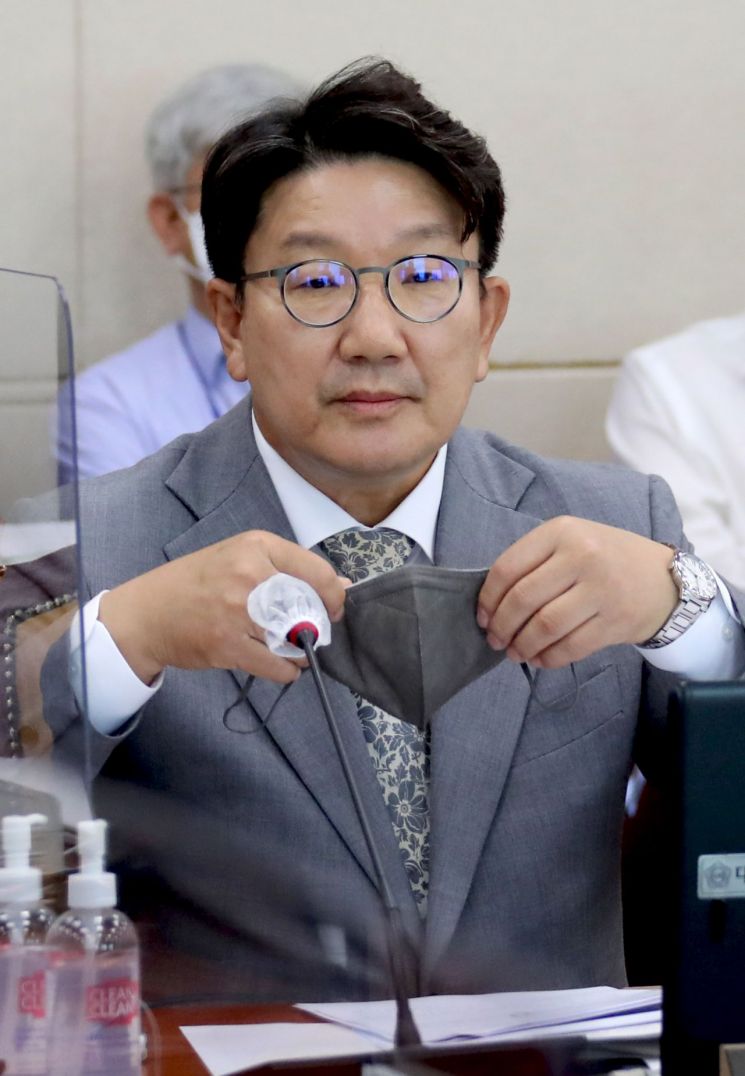
This remark was made during the same day's Science, Technology, Information and Broadcasting Committee audit. People Power Party lawmaker Kwon Seong-dong demanded the resignation of Kim Je-nam, chairman of the Korea Nuclear Safety Foundation, saying that Kim's stance does not align with the Yoon administration's energy policy. He mentioned that Kim was a former 19th National Assembly Justice Party lawmaker and said, "Is this cuckoo moving from one nest to another? Bite your tongue and die. Why do such things?"
When this remark became controversial, Lawmaker Kwon explained, "I said, 'If it were me, I would rather bite my tongue and die.' I am not telling Chairman Kim to bite his tongue and die." He emphasized, "It is an expression of my will, meaning 'If I were in that situation, I wouldn't act like that.' Please do not distort the intent of my remark and understand it as 'my political will expression.'"
In response, Democratic Party lawmaker Jo Seung-rae immediately protested. He said, "It is uncomfortable to argue over a fellow lawmaker's remark. However, since you insist on a language test, (if you look at the transcript) Lawmaker Kwon's subject in 'bite your tongue and die' is 'I,' and whether the person feels insulted or not is something the parties involved in the conversation feel."
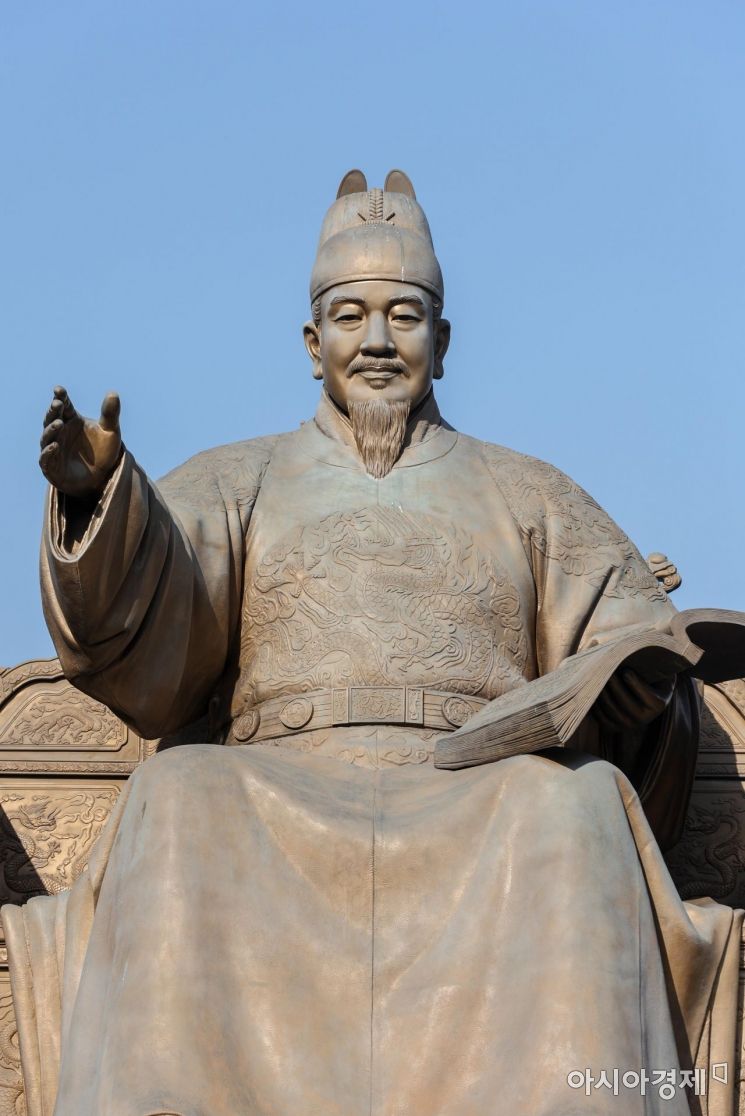 Statue of King Sejong installed at Gwanghwamun Square, Jongno-gu, Seoul. Photo by Jin-Hyung Kang aymsdream@
"It is difficult to say exactly which comes first, language or thought, but it is undeniable that they are deeply connected."
"When using language, it is very important to consider the social and cultural characteristics reflected within it to use appropriate language. Failure to do so can result in being rude or even making communication impossible."
These are all statements from high school 'Grammar' and 'Speech' textbooks. Language is a vessel that contains thought. Depending on whether the words habitually used are 'negative' or 'positive,' 'comforting' or 'critical,' one can infer a person's character and conduct. Even for individuals who do not represent others, we tend to expect a certain level of language dignity. Citizens feel not only disappointed but also devastated by the rude remarks of the 'president,' who represents the nation, and 'lawmakers,' who represent the people.
Opinions always clash. King Sejong also devoted his heart to creating Hunminjeongeum with the scholars of Jiphyeonjeon but had to endure constant petitions opposing it from Confucian officials influenced by Sinicized ideology.
However, the reason Hunminjeongeum ultimately became Korea's unique script might have been the result of continuous dialogue and efforts to persuade the opposition, rather than the attitude of saying "What if these XX don't approve?"
© The Asia Business Daily(www.asiae.co.kr). All rights reserved.