Seoul National University Hospital Announces 145-Month Long-Term Follow-Up Results of Parkinson's Disease Patients Undergoing Deep Brain Stimulation Surgery
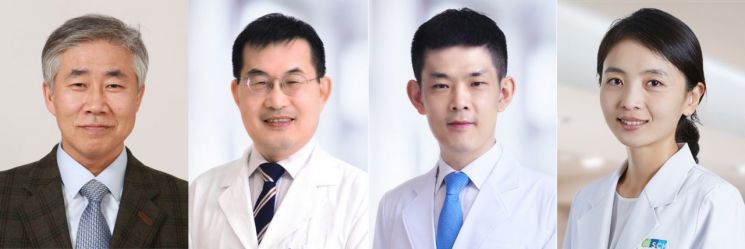 From the left, Professor Baek Seon-ha, Department of Neurosurgery, Seoul National University Hospital; Professors Jeon Beom-seok and Kim Han-jun, Department of Neurology; Professor Park Hye-ran, Department of Neurosurgery, Soonchunhyang University Hospital.
[Asia Economy Reporter Kim Young-won] A study has found that deep brain stimulation (DBS) of the subthalamic nucleus is safe and effective in the long term for patients with advanced Parkinson's disease. Deep Brain Stimulation (DBS) is a surgical method that places fine electrodes in deep brain nuclei to stimulate neural activity. It is known to be effective for various neurological disorders, but little has been known about its long-term effects beyond 10 years.
A joint research team led by Professor Baek Seon-ha of the Department of Neurosurgery at Seoul National University Hospital, Professors Jeon Beom-seok and Kim Han-jun of Neurology, and Professor Park Hye-ran of the Department of Neurosurgery at Soonchunhyang University Hospital announced on the 7th the results of analyzing the current survival status and pre- and post-operative follow-up tests of 81 patients with advanced Parkinson's disease who underwent bilateral subthalamic nucleus deep brain stimulation at Seoul National University Hospital from March 2005 to March 2008.
Parkinson's disease is a degenerative brain disorder characterized by bradykinesia (slowness of movement), resting tremor, and muscle rigidity. It is known to occur due to the progressive death of dopamine-producing neurons in the substantia nigra of the midbrain, although the exact cause remains unclear.
Most Parkinson's patients can maintain daily activities with appropriate medication, but long-term drug treatment often leads to reduced efficacy due to side effects. In such cases, deep brain stimulation, which involves inserting electrodes into the basal ganglia to regulate abnormal neural circuits through electrical stimulation, is used as an alternative treatment.
In particular, since 2005, DBS targeting the subthalamic nucleus has been covered by health insurance, and its short- and mid-term therapeutic effects and safety have been proven. It has also been recognized for maintaining patients' quality of life, leading to more patients receiving surgical treatment. However, little has been known about the survival rate and long-term prognosis of this treatment for advanced Parkinson's disease.
Accordingly, the research team analyzed the survival rate and pre- and post-operative conditions of patients who underwent bilateral subthalamic nucleus DBS based on long-term follow-up of a large patient cohort. The study included a total of 81 patients, comprising 37 men (45.7%) and 44 women (54.3%).
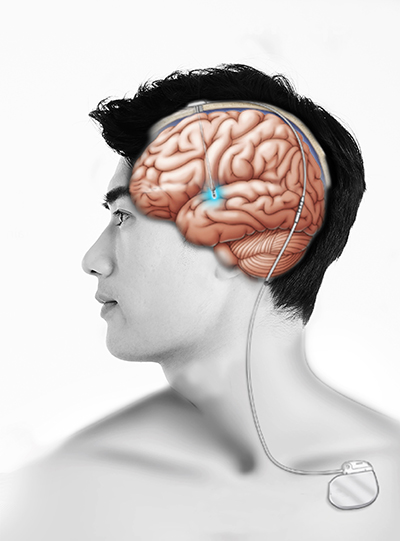 Schematic diagram of the insertion of stimulation electrodes for deep brain stimulation. [Photo by Seoul National University Hospital]
The analysis showed that the average age of patients at the time of surgery was 62 years, and the median follow-up period after hospital visits was 145 months. The cumulative survival rates after surgery were 98.8% at 1 year, 95.1% at 5 years, and 79% at 10 years. In other words, the survival rate of Parkinson's patients who underwent surgery was similar to that of the general population for at least five years, the research team explained.
During the 11-year follow-up period, 35 patients (43%) died, and 46 patients (57%) survived. The deceased lived an average of 110.46 months after DBS. Among the 81 patients, 33 (40%) maintained ambulatory ability even after more than 11 years. The UPDRS scale, which assesses the severity of Parkinson's symptoms, showed significant improvement up to 5 years post-surgery but tended to increase again after 10 years.
Notably, patients whose electrodes were well positioned bilaterally within the subthalamic nucleus at the initial surgery showed higher survival rates and maintained walking ability. The research team confirmed that bilateral subthalamic nucleus DBS is a safe and effective treatment for advanced Parkinson's disease and may positively influence disease progression.
Professor Jeon Beom-seok stated, "This study is significant in that it tracked Parkinson's patients who underwent bilateral subthalamic nucleus DBS in Korea and confirmed safety and efficacy through survival and long-term prognosis analysis over at least 10 years."
Professor Baek Seon-ha added, "The finding that many patients who received DBS maintain ambulatory ability and quality of life even after more than 10 years offers great hope to patients suffering from Parkinson's disease for a long time."
Meanwhile, this study was recently published in the online edition of the SCI journal 'Neurosurgery.'
© The Asia Business Daily(www.asiae.co.kr). All rights reserved.
![Clutching a Stolen Dior Bag, Saying "I Hate Being Poor but Real"... The Grotesque Con of a "Human Knockoff" [Slate]](https://cwcontent.asiae.co.kr/asiaresize/183/2026021902243444107_1771435474.jpg)

















