Four Years of Trade War, Accelerated US-China Trade Decoupling
Despite US Sanctions, China Remains a Promising Supplier
"US-China Trade Expected to See Greater Qualitative than Quantitative Changes"
[Asia Economy Reporter Kim Pyeonghwa] Since the full-scale start of the US-China trade war in 2018, various trade sanctions have continued, resulting in a decoupling phenomenon where the mutual trade proportion between the US and China has decreased despite the overall increase in trade volume. Recently, both countries' efforts to strengthen domestic supply chains have further intensified this trend. However, given the difficulty for the US to completely block China, it is assessed that future US-China trade may undergo qualitative changes rather than just changes in scale. There is also advice to seek domestic response strategies accordingly.
The Korea International Trade Association (KITA) International Trade and Commerce Research Institute announced on the 7th a report titled 'Four Years of the US-China Trade War: Progress and Outlook - Review of Bilateral Trade Proportion and Decoupling.'
Last Year’s US-China Trade Volume Hit an All-Time High... But the Proportion Decreased?
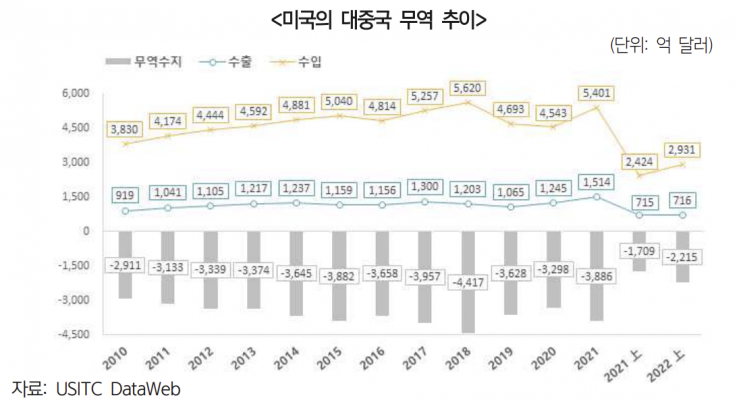
According to the report, last year, the US-China trade volume recorded an all-time high and showed growth, but the mutual trade proportion continued to decline. Trade between the US and China decreased after reaching $682.3 billion in 2018 but turned to an upward trend with $691.5 billion in 2021. In the first half of this year, it recorded $364.7 billion, a 16.2% increase compared to the same period last year.
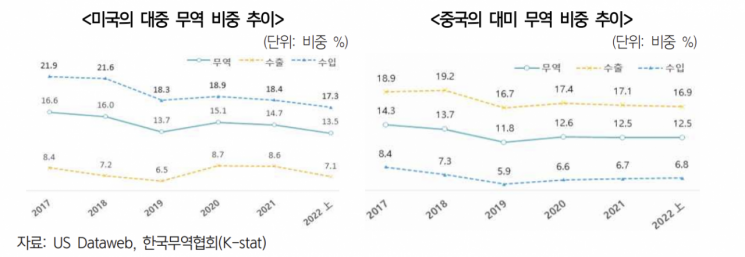
The trade proportion shows the opposite trend. The share of China in US trade peaked at 16.6% in 2017 and has been declining since. The US's trade proportion with China was 13.7% in 2019, 15.1% in 2020, and 14.7% in 2021, gradually decreasing. In the first half of this year, it was 13.5%. The share of the US in China's trade also steadily declined from 14.3% in 2017 to 12.5% in the first half of this year.
The report points to the trade war between the two countries as the background for this phenomenon. Various trade sanctions that intensified since 2018 have had an impact. The US imposed up to 25% additional tariffs on $360 billion worth of imports from China in four rounds starting in 2018 and placed Huawei on the export control list, among other restrictions. Sanctions were applied not only to semiconductors and semiconductor equipment but also to communication equipment and power equipment. The Uyghur Forced Labor Prevention Act was also announced.
In response, China imposed retaliatory tariffs on $130 billion worth of imports from the US. It introduced a blacklist similar to the US export control list. It also enacted systems such as the Export Control Law, the Anti-Unfair Extraterritorial Application of Foreign Laws Act, and the Anti-Foreign Sanctions Law. However, unlike the US, which directly controlled exports and imports, China's sanctions had minimal effect. It repeatedly used existing methods such as boycott campaigns and non-tariff barriers to restrict trade.
Supply Chain Restructuring Movements Also Affect the Decline in Trade Proportion
The report added that the active supply chain restructuring efforts centered on their own countries by both the US and China, along with trade sanctions, influence the decrease in mutual trade proportion.
The US, through the Chips and Science Act (CSA), promised large-scale tax support to semiconductor investment companies domestically while restricting investments in China. Discussions on the Chip4 supply chain consortium (South Korea, US, Japan, Taiwan), excluding China, have also been concretized. The Inflation Reduction Act (IRA) has aimed to secure supply chains in North America for electric vehicles and batteries. The US has led negotiations on the Indo-Pacific Economic Framework (IPEF) and introduced the Critical Minerals Security Partnership (MSP).
China introduced the Dual Circulation strategy in 2020 to vertically integrate its domestic supply chain. While the strategy emphasizes both domestic demand and exports, the report analyzes that the economic policy focus is shifting from exports to domestic demand. Through the Made in China 2025 initiative, China set a goal to increase the self-sufficiency rate of core components and materials to 70% by 2025. The Belt and Road Initiative actively secures key resources in Africa and South America.
US Cannot Completely Exclude China... "South Korea Must Seek Response Strategies"
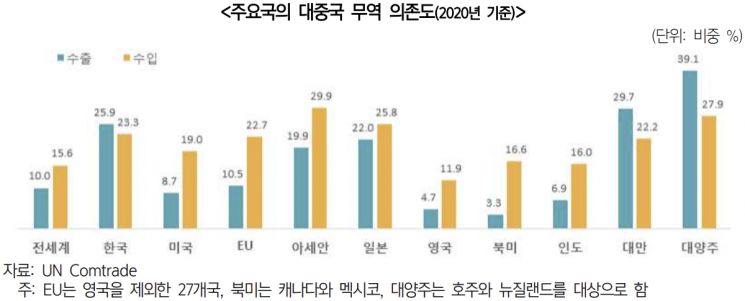
The report expects that while US containment of China will continue, China's status among countries other than the US and global companies will not rapidly diminish. It explains that the US-China policy focus shifted from addressing trade deficits under the Donald Trump administration to restructuring supply chains centered on the US under the Joe Biden administration. The fact that China is a major production base for global companies and an attractive market in terms of size and growth potential supports this view.
Since China's emergence as a key hub in the global supply chain is a result of market logic, artificial reshoring or nearshoring could increase corporate cost burdens, according to the report. Reshoring means companies returning to their home country after expanding overseas. Nearshoring refers to relocating production facilities to neighboring countries close to the home country when reshoring is difficult.
The report predicts that even if US-China trade decoupling continues, the US will likely focus on delaying China's technological development and growth rather than completely blocking China.
Cho Sangheon, Director of KITA’s International Trade and Commerce Research Institute, said, “As concepts like economic security and stable supply chain assurance emerge as new trade order norms, the decline in mutual trade proportion between the US and China may deepen.” He advised, "Since future US-China trade is expected to see more qualitative and sectoral changes than changes in scale, it is urgent for South Korea to seek response strategies."
© The Asia Business Daily(www.asiae.co.kr). All rights reserved.
![Clutching a Stolen Dior Bag, Saying "I Hate Being Poor but Real"... The Grotesque Con of a "Human Knockoff" [Slate]](https://cwcontent.asiae.co.kr/asiaresize/183/2026021902243444107_1771435474.jpg)


















