"Concerned About Next Year's Economy More Than This Year... Complex Economic Crisis to Last for a Certain Period"
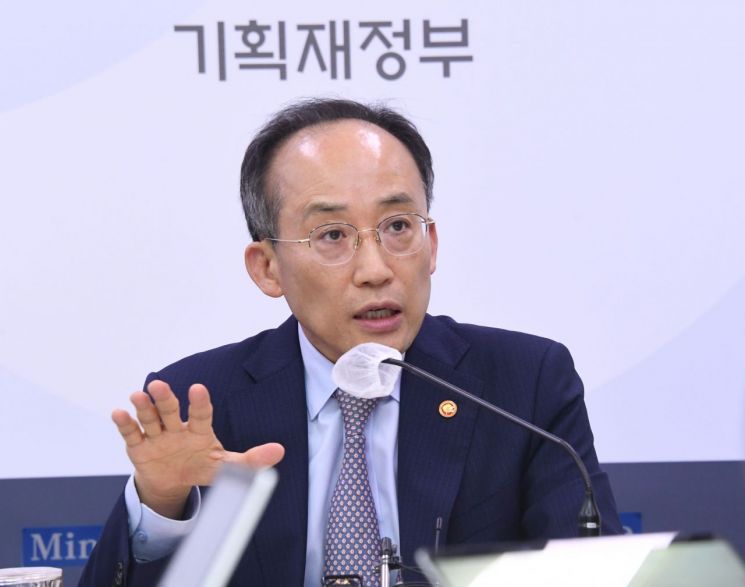
[Asia Economy Sejong=Reporter Kwon Haeyoung] On the 6th, Deputy Prime Minister and Minister of Economy and Finance Choo Kyung-ho stated, "Even if inflation has passed its peak, it will decline very slowly, and a high level of inflation will persist," forecasting that difficult economic conditions such as high inflation and economic slowdown will continue next year. Regarding concerns about a foreign exchange crisis, he dismissed them by saying, "I can say definitively that the possibility is low."
Deputy Prime Minister Choo visited the press room that day and said, "What worries me now is next year's economy (compared to this year)." The economic growth forecast for this year was maintained at 2.6%, as previously announced by the Ministry of Economy and Finance.
He said, "Due to high-intensity financial tightening, there are many forecasts of economic slowdown in advanced countries, and we need to observe how much China will recover from its current low growth next year and whether this state will continue," adding, "I think the economy will slow down next year compared to this year." He continued, "Difficulties will persist until the first half of next year," adding, "Inflation will be lower than now but higher than the average year, and with economic slowdown combined with financial market volatility, a complex economic crisis situation is expected to last for some time."
Regarding concerns about stagflation (rising inflation amid economic slowdown), he drew a line by calling it an "excessive expression," but essentially predicted a pattern of high inflation and economic slowdown. Especially concerning inflation, he said, "Personal services such as dining out and public utility charges do not go down once they rise," expecting them to remain at a high level for the time being.
Nevertheless, he stated that the theory of inflation peaking in "late September to early October" remains valid. He explained, "Considering the current situation comprehensively, there is no change to that forecast," adding, "External sudden variables such as international oil prices, exchange rates, and the Russia-Ukraine situation may have an impact, but I think there will be no significant change to the October inflation peak theory at the latest." Regarding oil price forecasts after the Organization of the Petroleum Exporting Countries Plus (OPEC+) announced production cuts, he said, "Although there was a production cut announcement, we need to observe whether it will fundamentally cause a sharp rise in international oil prices again or whether the current downward trend will continue as it is."
He expected the current account balance for August to record a deficit. Deputy Prime Minister Choo said, "It seems that the current account balance will show a deficit in August," adding, "In September, the trade deficit is expected to shrink significantly, and the current account balance is expected to return to surplus." Regarding concerns about a current account deficit, he explained, "The Bank of Korea and international organizations forecast that South Korea's current account surplus will exceed $30 billion annually this year and next year," adding, "Some worry that a current account deficit might trigger an economic crisis, but we do not foresee that at this time."
Regarding recent concerns about a recurrence of a foreign exchange crisis due to a decrease in foreign exchange reserves, he drew a line by saying, "I can say definitively that the possibility is very low." The Bank of Korea announced that South Korea's foreign exchange reserves stood at $416.77 billion, down $19.66 billion from the end of the previous month. This is the largest decline since about $27.42 billion dropped in October 2008.
Deputy Prime Minister Choo explained, "Although the decrease might seem large compared to existing foreign exchange reserves, the proportion of the decrease is relatively low compared to 2008," adding, "I hope people understand that the authorities play a necessary role to stabilize the market when psychological bias or sudden fluctuations appear in the foreign exchange market, and that foreign exchange reserves decreased as part of some responses."
When asked whether he pressures to slow down the pace of interest rate hikes amid the Ministry of Economy and Finance and the Bank of Korea emphasizing a 'policy mix,' Deputy Prime Minister Choo responded by asking, "Do you want me to poke the Bank of Korea's side?" and emphasized that he does not discuss interest rates at all.
Deputy Prime Minister Choo said, "I often meet the Bank of Korea governor and the working-level staff frequently meet to share economic perceptions and situations," adding, "We are not discussing big steps, giant steps, baby steps, or related matters." He emphasized, "Interest rates are entirely a matter for the Central Bank's Monetary Policy Committee to responsibly decide," adding, "It is undesirable and not done for me to talk about it as it undermines the independence of the central bank."
© The Asia Business Daily(www.asiae.co.kr). All rights reserved.

















