Ministry of Trade, Industry and Energy Holds 'Public Institutions Energy Diet 10 Practice Resolution' Meeting
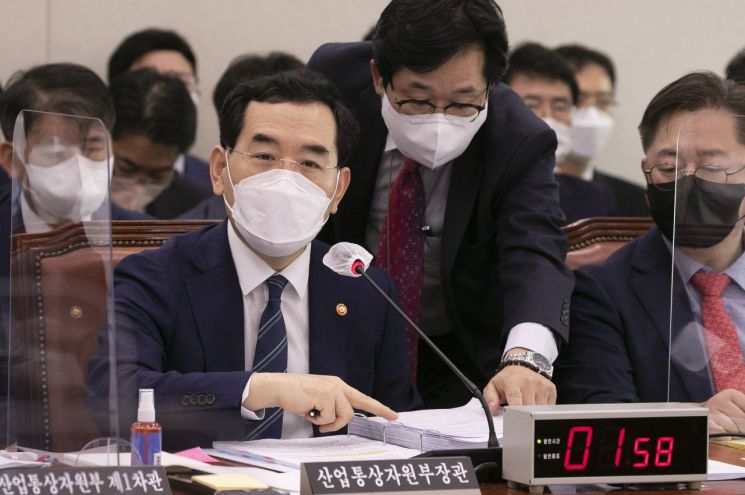 Minister Lee Chang-yang of the Ministry of Trade, Industry and Energy responding
(Seoul=Yonhap News) Reporter Ha Sa-heon = Minister Lee Chang-yang of the Ministry of Trade, Industry and Energy is answering questions from lawmakers at the National Assembly's Trade, Industry, Energy, Small and Medium Business Committee hearing held at the National Assembly in Yeouido, Seoul on the morning of the 4th. 2022.10.4 [Photo by the National Assembly Press Photographers Group]
toadboy@yna.co.kr
(End)
<Copyright(c) Yonhap News Agency, unauthorized reproduction and redistribution prohibited>
[Asia Economy Sejong=Reporter Lee Jun-hyung] The government has officially embarked on an 'energy diet.' With international energy prices soaring, the plan is to reduce energy consumption in public institutions by 10% compared to the average this winter.
The Ministry of Trade, Industry and Energy announced that on the afternoon of the 6th, Minister Lee Chang-yang presided over the 'Public Institution Energy Diet 10 Practice Resolution' event held at the Seoul Energy Dream Center. The event was attended by heads of 16 public institutions, including Korea Electric Power Corporation, Korea Hydro & Nuclear Power, and Korea National Oil Corporation. The heads read aloud and signed a pledge to strive for the government's policies, including ▲achieving the goal of reducing energy consumption by more than 10% ▲complying with the five major winter energy-saving principles.
The Ministry plans to implement energy usage restrictions for public institutions starting from the 18th of this month. The core objective is to reduce energy consumption in public institutions by more than 10% compared to the average usage over the past three years this winter. Accordingly, public institutions will lower building heating temperatures from the current 18 degrees Celsius to 17 degrees Celsius and turn off landscape lighting such as memorial towers and fountains. Additionally, heating devices in buildings will be turned off sequentially during winter peak electricity hours, and more than one-third of the working hours must have lights turned off.
During the meeting, the Ministry shared and reviewed winter energy-saving measures for public institutions and support plans for the private sector. KEPCO will first promote its own 'Energy Diet 10' campaign to reduce electricity consumption at its headquarters and 260 branches nationwide. KEPCO also plans to support the distribution of high-efficiency energy devices during winter and provide electricity bill consulting.
The Korea Energy Agency will support energy efficiency improvement programs such as loans for installing energy-saving facilities. To spread an energy-saving culture, it also plans to promote public campaigns like energy cashback.
The Ministry stated that it will conduct monthly surveys to check whether public institutions are saving energy. A Ministry official said, "We have requested each institution to thoroughly implement their energy-saving plans," adding, "We plan to regularly evaluate and inform the public about the energy-saving efforts of public institutions."
Minister Lee emphasized the importance of energy saving. He said, "In an unprecedented energy emergency, the energy diet is not simply about reducing energy consumption but a critical task that determines the survival of our economy," adding, "Public institutions must take the lead in protecting the health of our economy through the energy diet." He continued, "Today's resolution of practice is a promise to the public from 1,019 public institutions and their affiliated organizations," urging, "Each institution should carefully manage the implementation of reduction targets for the energy diet."
© The Asia Business Daily(www.asiae.co.kr). All rights reserved.

















