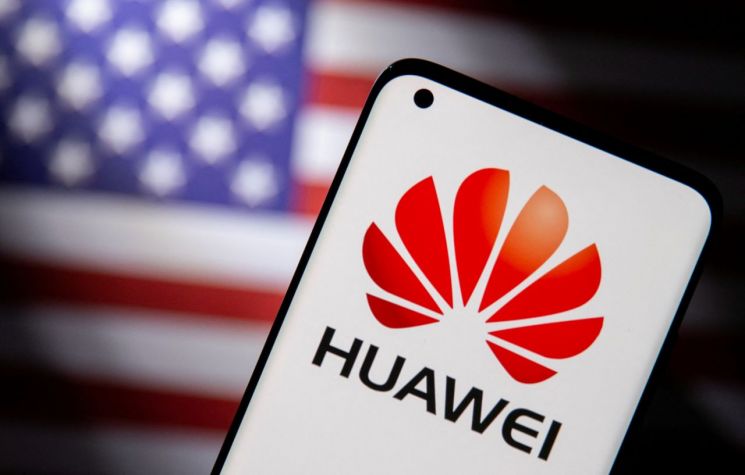
[Asia Economy Reporter Jeong Hyunjin] Chinese information and communication company Huawei, facing difficulties in securing semiconductors due to being placed on the U.S. government's blacklist over national security threats, is suspected of attempting to secure semiconductors and equipment through indirect means by utilizing Chinese startups to evade U.S. surveillance.
On the 5th (local time), Bloomberg News, citing multiple sources, reported that Huawei is supporting a startup in Shenzhen, China, which appears to be ordering manufacturing equipment for semiconductor factories from overseas companies. This startup, Pengxinwei IC (PXW), operated by a former Huawei executive, is considered one of the advanced semiconductor manufacturers established last year in China.
Bloomberg stated that satellite images confirm PXW is building a semiconductor factory near Huawei's headquarters, covering an area equivalent to more than 30 soccer fields, and the construction of the buildings seems to be nearing completion. PXW plans to receive equipment starting in the first half of next year. According to sources, Bloomberg reported, "Huawei is expected to purchase most, though not all, of the products manufactured by this company."
In response, PXW issued a statement saying it has signed contracts with semiconductor manufacturing equipment companies without disclosing customer information and plans to begin mass production at this factory in 2025. The company intends to initially apply 28-nanometer (nm; 1 nm equals one billionth of a meter) technology next year and ultimately aims to develop 14-nanometer and 7-nanometer semiconductors.
Huawei's attempt to procure semiconductors through such indirect routes stems from the increasing need to find alternatives amid the U.S.'s stringent sanctions that have cornered the company. Between 2019 and 2020, the U.S. required domestic and foreign companies using U.S. technology to obtain permission before supplying parts to Huawei and its affiliates such as HiSilicon. As a result, it has become virtually impossible for Huawei to secure semiconductor-related components.
Bloomberg reported that Huawei has lost its foothold in overseas markets and struggled to secure essential semiconductors due to U.S. sanctions. Huawei Chairman Ren Zhengfei also mentioned in a memo to internal employees this year that growth is becoming increasingly difficult due to U.S. sanctions.
However, it is expected that PXW will find it difficult to build a business on the scale of Taiwan's TSMC, which once supplied semiconductor components to Huawei. Nonetheless, there is speculation that this company could help Huawei regain its position in certain areas such as smartphones and servers. Bloomberg noted that it is unclear whether PXW is using assets, intellectual property, or personnel from HiSilicon, a Huawei subsidiary.
When Bloomberg asked the U.S. Department of Commerce’s Bureau of Industry and Security (BIS) whether it is aware of PXW's existence, the agency responded, "We are aware of suspicions regarding the relationship with Huawei and continue to closely monitor efforts to circumvent export controls, including those involving parties listed alongside Huawei."
The Biden administration is reportedly set to announce new sanctions soon that will broadly control exports of advanced semiconductors used in supercomputers, artificial intelligence (AI), and data centers to China.
© The Asia Business Daily(www.asiae.co.kr). All rights reserved.
![Clutching a Stolen Dior Bag, Saying "I Hate Being Poor but Real"... The Grotesque Con of a "Human Knockoff" [Slate]](https://cwcontent.asiae.co.kr/asiaresize/183/2026021902243444107_1771435474.jpg)
















