[Asia Economy Yeongnam Reporting Headquarters Reporter Hwang Doo-yeol] The reason why a repeating V-shaped herringbone pattern appears on the surface of gold (Au) has been revealed, attracting attention.
Professor Feng Ding, a distinguished professor in the Department of Materials Science and Engineering at UNIST, disclosed the reason why herringbone textures appear on atomic-level gold surfaces and published the findings in Science Advances.
The paper was released on the 5th local time.
Gold, familiar to us as a precious metal, is also widely used in scientific fields as a substrate that induces molecular self-assembly or as a support for growing two-dimensional materials.
Therefore, understanding the properties of gold at the atomic level forms the basis for developing various technologies.
Metals including gold have various surface structures depending on synthesis conditions, which are distinguished by numbers recorded after the metal name.
In the case of gold, the surface structure of "gold (111)" is the most stable, and it was discovered half a century ago that the atomic surface of this material is unique.
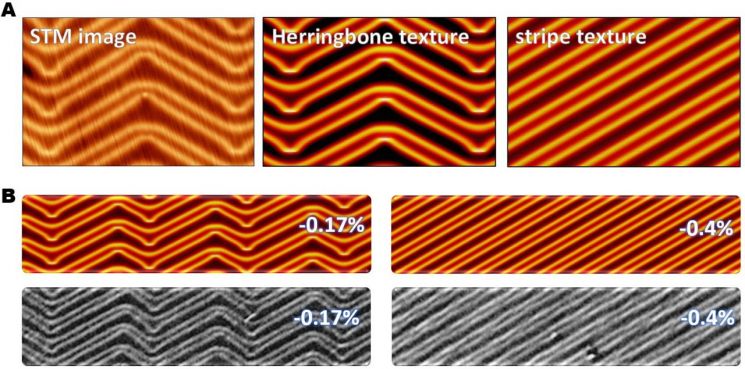
To the naked eye, the surface of gold appears smooth, but when observed at the nanoscale, a herringbone texture appears. However, the reason why this pattern appears has remained a mystery for a long time.
Professor Feng Ding's team solved the reason for the unique texture of the gold (111) surface by utilizing artificial neural networks, one of the machine learning technologies.
They borrowed the power of new technology to unravel the complex and challenging relationship between the gold (111) surface structure and the material's interior.
Professor Feng Ding said, "It is difficult to calculate the movements of nanostructures containing more than 100,000 atoms using traditional approaches. Thanks to artificial neural network technology, which can calculate atomic-level movements very accurately and efficiently, we were able to reveal the principles of the special structure of gold (111)."
According to the research, the number of atoms in the topmost layer of the gold (111) surface is about 4% greater than that in the layer immediately below.
Because of this, some atoms in the topmost layer are placed in unstable positions. To move out of these positions and find stability, the top-layer atoms must shift slightly upward, causing deformation on the gold surface.
As a result, the herringbone pattern forms on the gold (111) surface.
The research team was able to accurately calculate the forces applied to gold (111) atoms and perform simulations using artificial neural networks. The results demonstrated that significant deformation occurs below the topmost layer.
This deformation becomes more severe as the gold (111) atomic layer thickens, while if the thickness of gold (111) is thin, internal deformation is suppressed, resulting in stripes instead of herringbone patterns.
Professor Feng Ding said, "This research is a good example of applying machine learning techniques to new material research to uncover the complex surface structures and formation mechanisms of various materials. It has opened the way to introducing artificial neural networks and other methods in future material surface studies."
 Dr. Pai Li (left), who led this research, and Distinguished Professor Feng Ding are taking a photo against the background of the nano surface of gold (111).
© The Asia Business Daily(www.asiae.co.kr). All rights reserved.


















