Swedish Royal Academy Announces 3 Co-Laureates Including 2 from the US and 1 from Denmark on the Afternoon of the 5th
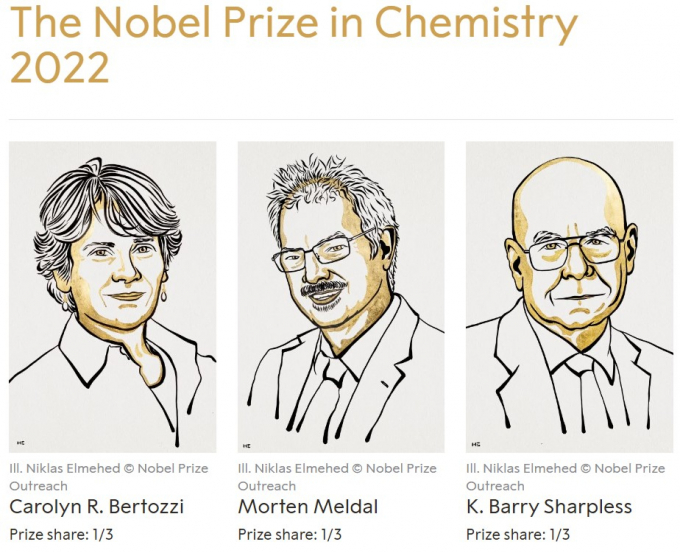 2022 Nobel Prize in Chemistry laureates. From the left, Carolyn R. Bertozzi (56), Professor at Stanford University, USA; Morten P. Meldal (68), Professor at the University of Copenhagen, Denmark; K. Barry Sharpless (81), Professor at Scripps Research Institute, USA.
[Asia Economy Reporter Kim Bong-su] This year, three chemists who devised simple and convenient methods for synthesizing chemical substances, revolutionizing the development of new drugs such as cancer treatments, were jointly awarded the Nobel Prize in Chemistry. Notably, one of them attracted attention by becoming the fifth person in history to win the prize twice.
The Nobel Committee of the Royal Swedish Academy of Sciences announced on the afternoon of the 5th (Korean time) that the 2022 Nobel Prize in Chemistry was awarded to three chemists: two from the United States and one from Denmark. The recipients are Carolyn R. Bertozzi (56), professor at Stanford University, USA; K. Barry Sharpless (81), professor at the Scripps Research Institute, USA; and Morten P. Meldal (68), professor at the University of Copenhagen, Denmark. In particular, Professor Sharpless received the Nobel Prize in Chemistry for the second time, following his first award in 2001, becoming the fifth person in history to do so after Marie Curie and others. At that time, he was jointly awarded with William S. Knowles (USA) and Ryoji Noyori (Japan) for developing an optically active catalytic reaction method capable of synthesizing various medicinal substances and other special structured compounds.
They discovered chemical reaction methods that enable the synthesis of new substances through simple approaches such as "click chemistry" and "bioorthogonal reactions." Professors Sharpless and Meldal laid the foundation for "click chemistry," a functional chemistry that allows molecular building blocks to be linked faster and more efficiently. In 2000, Professor Sharpless first developed "click chemistry," which enables rapid synthesis of desired substances while preventing the formation of unwanted byproducts. Subsequently, Professors Sharpless and Meldal independently discovered the copper-catalyzed azide-alkyne cycloaddition, considered the pinnacle achievement of click chemistry, which is widely used in new drug development. Professor Bertozzi developed "bioorthogonal reactions," which implement this reaction within living organisms such as microbes. Their research achievements have significantly lowered the barriers to new drug development, including cancer treatments, by enabling synthesis without complex chemical reactions that require extensive time and cost.
Johan ?qvist, chairman of the Nobel Chemistry Committee, said, "This year's chemistry award recognizes technology for synthesizing new substances using easy and simple materials rather than overly complex ones," adding, "(Using this) specific functional molecules can be synthesized through simple pathways."
© The Asia Business Daily(www.asiae.co.kr). All rights reserved.

















