IRA Consultation Letter Positive for Changing Atmosphere
Weight Given to Possibility of Substantive Measures After November Midterm Elections
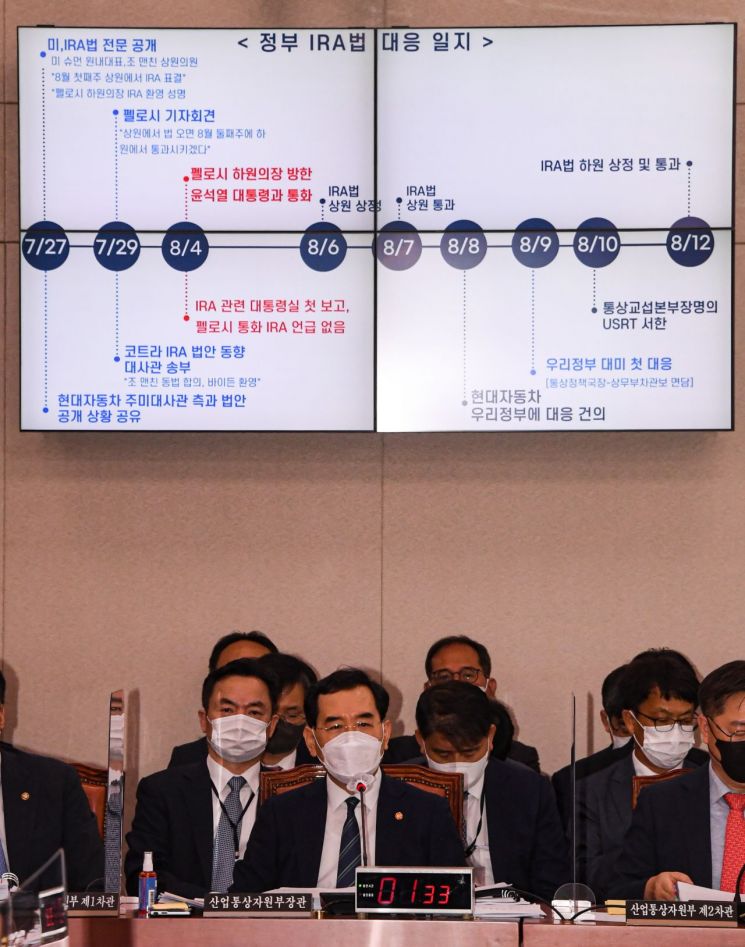
[Asia Economy Reporter Sunmi Park]"The Korean automotive industry can now place its hopes on a suspension of the U.S. Inflation Reduction Act (IRA)."
As U.S. President Joe Biden delivered a letter expressing his willingness to discuss the IRA to President Yoon Suk-yeol, expectations are growing that a solution will emerge to alleviate concerns about exclusion from subsidy eligibility.
On the 6th, the business and automotive sectors acknowledged that since the IRA was politically driven, amendments may not be easy, but they do not see it as an impossible issue. With the president himself expressing a willingness to negotiate and bills proposing IRA suspension already introduced in the political arena, the industry shares a common view that measures to minimize damage to Korean companies are achievable.
Professor Kim Pil-soo of Daelim University’s Department of Automotive Studies said, "President Biden’s letter shows he is well aware of Korea’s concerns regarding the IRA and is committed to ongoing discussions, which presents a good opportunity for us." He added, "The mere fact that the U.S. president recognizes the issue means we have succeeded in highlighting the importance and necessity of the matter." He further stated, "We expect a solution to come by no later than the U.S. midterm elections in November. Even if exceptions or special provisions in the bill are not achieved, we hope for a temporary suspension allowing us to receive subsidies for another two to three years."
Lee So-won, head of the U.S. and Europe Cooperation Team at the Federation of Korean Industries, also noted, "Earlier, U.S. Vice President Kamala Harris told President Yoon that she was aware of Korea’s concerns about the IRA, and this was later confirmed by the president’s letter." She added, "Based on the atmosphere and current trends, we believe a solution could emerge after the midterm elections."
With hope rising, there are calls for the Korean government to intensify diplomatic efforts and build alliances with foreign brands to more actively persuade U.S. lawmakers in both the House and Senate. Since Korean companies are already facing daily disadvantages due to the IRA’s enforcement, it is argued that the government needs to exert stronger pressure and persuasion on the U.S.
Professor Kim said, "There are not many countries with which the U.S. has free trade agreements (FTAs), and while most are included in subsidy eligibility, Korea is excluded." He added, "Since the U.S. has not adequately explained this, we need to strongly pressure the U.S. by emphasizing that Korea is an FTA partner."
Jung Man-ki, vice chairman of the Korea International Trade Association, advised, "During the U.S. Treasury Department’s notice preparation and public hearing processes, it is important to submit official industry opinions." He emphasized, "At this time, Korea should actively highlight that it is an FTA partner with the U.S. and that Korean companies are major investors in the U.S." He explained, "Since the U.S. has introduced industrial transition subsidies and purchase subsidies related to electric vehicles, Korean companies can actively utilize industrial transition subsidies such as manufacturing tax reductions, fossil fuel alternative tax support, advanced technology automobile manufacturing tax support, and domestic manufacturing transition cash support, as well as purchase subsidies for used electric vehicles and commercial electric vehicles."
He also added, "We need to consider similar measures based on reciprocity. In particular, if corporate tax reductions are pursued only for U.S. exports, it could somewhat compensate for the weakening of our competitiveness."
Senior Research Fellow Lee Hang-gu of the Korea Automotive Technology Institute said, "Since the U.S. president sent a letter expressing willingness to negotiate, there is room for hope." He added, "Although the law is decided by the U.S. Congress, the president has executive order authority, so there is sufficient scope to supplement the law." Currently, the U.S. Treasury Department is preparing enforcement regulations related to the electric vehicle origin rules and plans to release final guidelines by the end of the year at the latest.
Lee said, "During the process of creating the IRA enforcement decree, we need to create an atmosphere that minimizes disadvantages to our companies." However, he noted, "Movements by Japan and the European Union (EU), which share similar positions, could act as variables."
Lee Jung-min of KOTRA’s Washington Trade Center explained, "Among local experts, there is talk that some flexibility in applying the IRA electric vehicle origin rules may be possible after the November midterm elections." He added, "Considering the reality of the U.S. electric vehicle supply chain, the full implementation of the IRA origin regulations could be delayed, and exemptions by sector or specific countries may be possible." He advised, "Since the Treasury Department is currently overseeing the establishment of enforcement regulations related to electric vehicles under the IRA, our government and companies need to explain our position and seek mutual understanding with the Treasury’s International Cooperation Office."
© The Asia Business Daily(www.asiae.co.kr). All rights reserved.
![Clutching a Stolen Dior Bag, Saying "I Hate Being Poor but Real"... The Grotesque Con of a "Human Knockoff" [Slate]](https://cwcontent.asiae.co.kr/asiaresize/183/2026021902243444107_1771435474.jpg)











