Preparation of Legislation After Public Consultation in December This Year
OTT Industry Concerns Over Potential Regulatory Tightening
Three Companies Still Operating at a Loss
Attention on Whether Broadcasting Development Fund Will Be Imposed
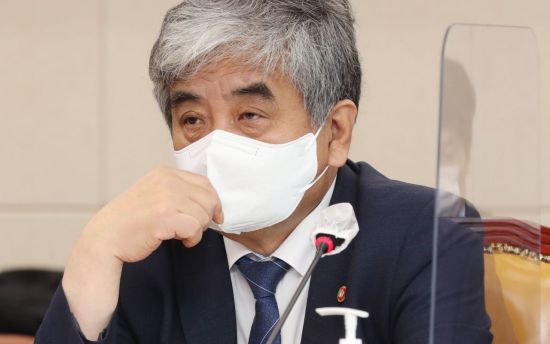
[Asia Economy Reporter Cha Min-young] The Korea Communications Commission (KCC) plans to finalize the enactment of the 'Audiovisual Media Services Act' by December this year, which will incorporate online video services (OTT) into the Broadcasting Act. Since the KCC has insisted that OTT is the same service as broadcasting and should be regulated equally, the industry is expressing concerns about the imposition of the broadcasting development fund and increased regulations.
Changing the Definition of 'Media' to Include OTT in the Broadcasting Act
On the morning of the 6th, ahead of the 2022 National Assembly audit, the KCC submitted a work status report to the National Assembly's Science, Technology, Information and Broadcasting and Communications Committee, stating, "We will prepare the Audiovisual Media Services Act after gathering opinions by December this year." The Audiovisual Media Services Act aims to integrate the currently fragmented regulatory systems?Broadcasting Act, IPTV Act, Telecommunications Business Act (OTT)?into a single legal framework.
The definition of media has been revised to include OTT in the classification. The legal system is dualized into 'content,' which involves program selection and scheduling, and 'platform,' which provides programs and channels to viewers (users), with regulatory measures established accordingly. Unlike existing terrestrial, satellite, and IPTV services, OTT has not been based on a network and has been granted the status of a 'special type of value-added telecommunications business operator,' thus being free from KCC regulation.
Internally, the KCC also appears to intend to take the lead in the growing OTT market. While the KCC views OTT as media and has expressed its intention to enact the Audiovisual Media Services Act, the Ministry of Science and ICT regards OTT as a value-added telecommunications business, and the Ministry of Culture, Sports and Tourism sees it as video media content, each submitting amendments to the Telecommunications Business Act and the Basic Act on Video Promotion, respectively. A government official said, "There is no finalized jurisdictional arrangement among the relevant ministries regarding OTT regulation yet, and discussions are ongoing."
Imposing Broadcasting and Communications Development Fund on OTT Operators
The biggest concern is whether to impose the fund on OTT. As YouTube and Netflix's dominance in the media content market has rapidly increased, bills proposing the imposition of the fund on OTT operators and users have been introduced. Democratic Party lawmaker Kim Young-joo proposed an amendment to the Film Promotion Act related to the imposition of the film development fund in December 2020, and lawmaker Lee Yong-bin also proposed amendments to the Broadcasting and Communications Development Basic Act and the Telecommunications Business Act in September 2021, arguing that the broadcasting and communications development fund should be imposed on online platform companies and other value-added telecommunications business operators.
The government also raised concerns in the industry as KCC Chairman Han Sang-hyuk has expressed a fundamental 'support' stance on the necessity of fund collection. In a press briefing last August, Chairman Han said, "There is a need to collect the fund from OTTs," but emphasized, "However, before proceeding, we will fully listen to operators' opinions and find a reasonable method." The broadcasting and communications development fund, jointly managed by the KCC and the Ministry of Science and ICT, amounted to 1.391 trillion won in 2022, down 50.8 billion won (3.5%) from the previous year.
The problem is that unlike global operators such as Netflix and YouTube, the domestic OTT industry is still in the red. In 2021, Netflix Services Korea recorded sales of 631.7 billion won and operating profit of 17.1 billion won, increasing by 52% and 94% respectively compared to the previous year. Meanwhile, although the sales of the three domestic OTT companies increased, their combined sales only reached 432.4 billion won. The total operating loss of the three companies amounted to 156.8 billion won. Furthermore, there is much debate about whether YouTube can be classified as OTT, raising concerns that only domestic operators running deficits might be subject to the fund collection.
The OTT industry is expressing concerns about strengthened regulations due to the media legislative reform. An industry official said, "There has been no clear discussion or definition of OTT, and the operator status is being mechanically assigned based on simple similarity comparisons with existing media," adding, "OTT already complies with various laws such as the Telecommunications Business Act, the Telecommunications Network Act, the Electronic Commerce Act, and the Fair Trade Act, but there has been insufficient review on how to resolve overlapping regulations if the Media Act is applied."
A KCC official explained, "This law is not about strengthening regulations but about granting legal status to OTTs with uncertain status, thereby reducing regulatory risks and resolving overlapping regulations," and added, "We will not apply the same level of regulation as legacy media such as broadcasting, contrary to industry concerns." The official also noted, "Whether to impose the OTT fund has not been decided."
© The Asia Business Daily(www.asiae.co.kr). All rights reserved.

















