Market Paradigm Shift with New Technologies like '5th Generation 10nm-class DRAM' and '9th Generation V-NAND'
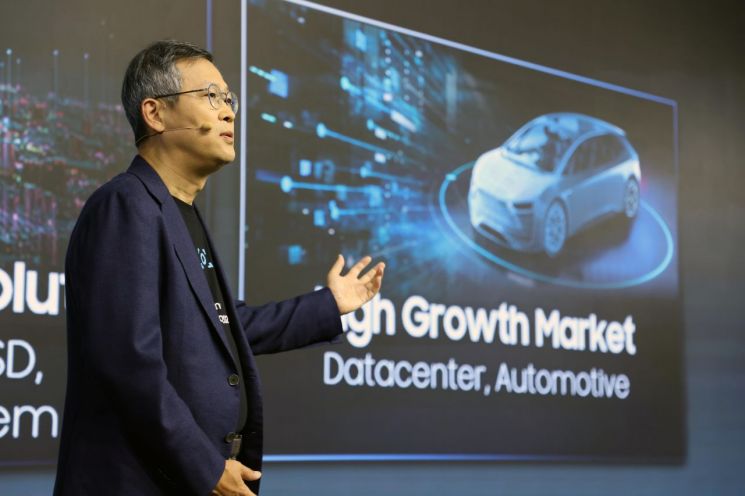 Samsung Electronics President Lee Jung-bae is giving a presentation at the 'Samsung Tech Day 2022' held in Silicon Valley, USA, on the 5th (local time). / Provided by Samsung Electronics
[Asia Economy Reporter Kim Pyeonghwa] On the 5th (local time), Samsung Electronics held 'Samsung Tech Day 2022' in Silicon Valley, USA, unveiling next-generation semiconductor solutions and roadmaps.
Started in 2017, Samsung Tech Day is an annual event showcasing Samsung Electronics' next-generation semiconductor technologies. This year, it was held offline for the first time in three years since 2019. About 800 people attended, including global IT companies, analysts, media representatives, and Samsung Electronics Memory Business Division President (CEO) Lee Jung-bae, Samsung Electronics System LSI Business Division President (CEO) Park Yong-in, and Samsung Electronics North America Head (Vice President) Jung Jae-hyun.
Looking Ahead to System Semiconductors Resembling Human Intelligence
At the morning session, Samsung Electronics announced its plan to become an integrated solution fabless (semiconductor design) company by maximizing synergy among system semiconductor products.
Samsung Electronics holds a portfolio of about 900 system semiconductor products, including ▲System on Chip (SoC) ▲Image Sensors ▲Modems ▲Display Driver ICs (DDI) ▲Power Management ICs (PMIC) ▲Security Solutions. They plan to provide integrated solutions optimized for customer needs through 'Platform Solutions' that fuse product technologies.
President Park said, "In the Fourth Industrial Revolution era, where objects must learn and make judgments like humans, the importance of system semiconductors that play roles such as the human brain, heart, neural network, and vision will grow more than ever," adding, "Samsung Electronics will organically fuse key technologies of various products to lead the Fourth Industrial Revolution era."
Samsung Electronics also revealed plans for cutting-edge system semiconductor development. Since the Fourth Industrial Revolution demands Hyper-Intelligence, Hyper-Connectivity, and Hyper-Data, the goal is to provide performance close to human functions.
In SoC, Samsung will enhance the performance of key IPs such as Neural Processing Units (NPU) and modems, while collaborating with global partners to develop industry-leading Central Processing Units (CPU) and Graphics Processing Units (GPU), strengthening SoC core competitiveness. They also plan to develop ultra-high-resolution image sensors close to the human eye and sensors that detect and implement human senses such as taste and smell.
At the event, Samsung Electronics showcased its advanced system semiconductor products at a booth. These included the automotive SoC 'Exynos Auto V920,' 5G modem 'Exynos Modem 5300,' premium mobile AP 'Exynos 2200,' and image sensor 'ISOCELL HP3.' Samsung also presented a demo session where attendees could experience the clarity of photos taken with the 200-megapixel image sensor ISOCELL HP3.
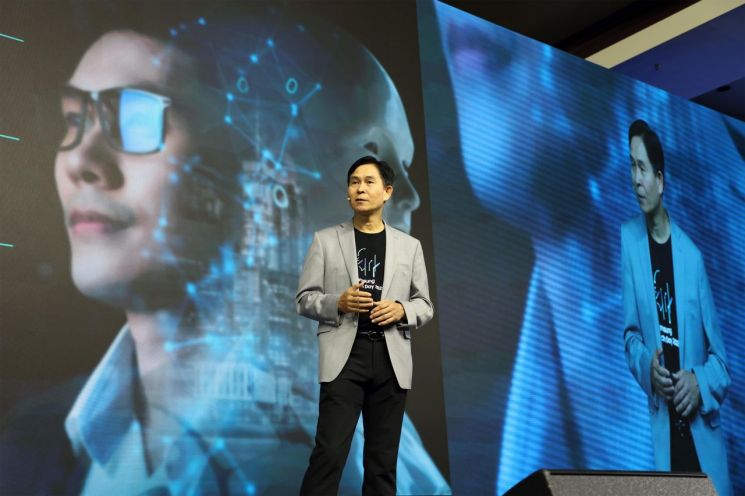 Samsung Electronics President Park Yong-in is giving a presentation at the 'Samsung Tech Day 2022' held in Silicon Valley, USA, on the 5th (local time). / Photo by Samsung Electronics
5th Generation 10nm-Class (1b) DRAM and 8th & 9th Generation V-NAND
In the afternoon, a memory semiconductor session was held. Samsung Electronics unveiled a next-generation product roadmap including '5th generation 10nm-class (1b) DRAM' and '8th & 9th generation V-NAND,' with the goal of maintaining memory technology leadership through differentiated solutions and market creation.
Samsung Electronics plans to overcome technological limits to improve quality satisfaction and concretize new business models for co-growth with customers. Through this, they aim to contribute to the entire industry and develop into a sustainable business.
President Lee said, "The total storage capacity of memory produced by Samsung Electronics over about 40 years has exceeded 1 trillion gigabytes (GB), with half produced in the last three years, reflecting the rapid digital transformation," adding, "In the future, high-bandwidth, high-capacity, and high-efficiency memory will evolve co-evolutionarily with various new platforms."
Samsung Electronics revealed future DRAM solutions to advance data intelligence and various DRAM technologies to overcome the limits of process miniaturization.
To handle the explosively increasing data usage, Samsung Electronics announced it will collaborate with global IT companies to grow next-generation DRAM technologies supporting various system architectures such as HBM-PIM (Processing-in-Memory), AXDIMM (Acceleration DIMM), and CXL (Compute Express Link).
They also plan to timely launch next-generation products such as high-capacity 32Gb DDR5 DRAM for data centers, low-power 8.5Gbps LPDDR5X DRAM for mobile, and ultra-high-speed 36Gbps GDDR7 DRAM for graphics, solidifying leadership in the premium DRAM market.
Samsung Electronics plans to mass-produce the '5th generation 10nm-class DRAM' in 2023 and overcome process miniaturization limits through new process technologies such as High-K Metal Gate and next-generation product structures.
 On the 5th (local time), the scene at 'Samsung Tech Day 2022' held in Silicon Valley, USA / Provided by Samsung Electronics
Developing '1000-Layer V-NAND' by 2030
Samsung Electronics announced plans to mass-produce 9th generation V-NAND in 2024 and develop 1,000-layer V-NAND by 2030, presenting a new paradigm with innovative NAND technology. This year, they plan to mass-produce the world's highest-capacity 8th generation V-NAND-based 1Tb TLC (Triple Level Cell) products.
At the event, Samsung Electronics also unveiled the 8th generation V-NAND 512Gb TLC product, which improves the number of bits stored per unit area by 42% compared to the 7th generation. This is the industry's highest level among 512Gb TLC products.
Samsung Electronics plans to expand the QLC (Quadruple Level Cell) ecosystem to meet diverse customer needs requiring large-capacity data such as data centers and artificial intelligence. They also aim to improve power efficiency to contribute to customers' eco-friendly management.
Since entering the automotive memory market in 2015, Samsung Electronics has maintained rapid growth. They plan to achieve the No. 1 position in the automotive memory market by 2025 by supplying optimal memory solutions for Autonomous Driving (AD), Advanced Driver Assistance Systems (ADAS), Infotainment (IVI), and Telematics.
With the increasing need for high-performance memory due to vehicle advancement and electrification, Samsung Electronics announced it will drive mobility innovation by providing next-generation memory solutions such as LPDDR5X, GDDR7, and Shared Storage.
Samsung Electronics, with a diverse storage lineup from enterprise to client, mobile, automotive, and branded products, also unveiled the SSD 'PM9C1a' applying Host Memory Buffer (HMB) technology, which connects directly to PC-installed DRAM without DRAM inside the SSD.
They are also continuing development of Computational Storage, which enhances internal SSD computing functions. Through high-performance, low-power products optimized for artificial intelligence, they aim to create a sustainable future.
Meanwhile, Samsung Electronics introduced the 'Samsung Memory Research Center (SMRC),' providing an optimal environment for customers to develop and evaluate next-generation memory solutions. Collaborating with Red Hat, Google Cloud, and others, they plan to sequentially expand SMRC starting in Korea in Q4 this year, followed by other regions including the United States.
© The Asia Business Daily(www.asiae.co.kr). All rights reserved.
![User Who Sold Erroneously Deposited Bitcoins to Repay Debt and Fund Entertainment... What Did the Supreme Court Decide in 2021? [Legal Issue Check]](https://cwcontent.asiae.co.kr/asiaresize/183/2026020910431234020_1770601391.png)


















